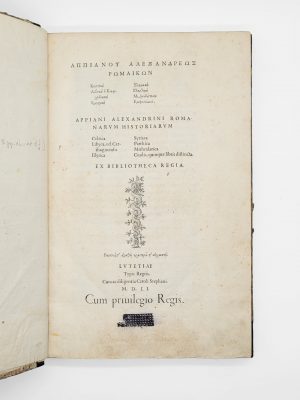
Goff, E-112; Dibdin, III, 556; Proctor, 5644; IGI, 3720; Oates, 2213; Sander, 7110; Essling, 1184; Pellechet, 4629; GKW, 9426; BMC, V, p.580; Hain-Copinger, *6691.
Édition princeps, éditée par Marcus Musurus.
Une référence dans l’histoire de l’imprimerie grecque.
Cet ouvrage fut compilé à Constantinople au milieu du XIIe siècle (aux alentours de 1100-1150) par un lexicographe byzantin resté anonyme. Fidèle à la tradition érudite de Byzance, l’auteur a conçu l’ouvrage comme une immense compilation de lexiques, de répertoires et de traités grammaticaux plus anciens, dont beaucoup ont aujourd’hui totalement disparu.
L’ouvrage se présente sous la forme d’un dictionnaire étymologique et encyclopédique géant contenant près de 10 000 entrées rangées par ordre alphabétique. Pour chaque terme de grec ancien, le dictionnaire tente d’en expliquer l’origine historique, la morphologie, les déclinaisons ou conjugaisons, et la signification exacte. Au-delà des définitions, les entrées incluent une multitude de citations d’auteurs antiques (comme Homère) ou de poètes grecs. Pour les philologues modernes, ce livre est crucial car il conserve des fragments uniques d’œuvres de l’Antiquité dont les manuscrits originaux ont été perdus.
« It is justly said by De Bure, ‘that the present is one of the most magnificent publications which ever issued from the press’. Whether the appearance of it damped the ardour, or rendered useless, the exertions of Aldus, we cannot perhaps accurately determine; but it is certain that his promise of publishing the ‘Etymologicum Magnum’… was never carried into execution…Even if it had been executed under the care of Aldus himself, it could not have been more correctly and perhaps so beautifully, printed; since, with all his zeal for the cause of literature…Aldus never produced any thing, for solidity and skill of workmanship, at all comparable with the Ammonius and Simplicius, the Therapeutica of Galen and the Etymologicum Magnum; each printed by Callierges in the XVth century. The frequent and successful introduction of the red letter, gives a splendour as well as peculiarity to the efforts of the printer whose work is now under consideration » Dibdin, Bibliotheca Spenceriana, III, p.65.
Callierges passa cinq ans à mettre au point le caractère grec qui fut d’abord utilisé pour imprimer l’Etymologicum. Il différait du caractère grec aldin qui, selon Nicolas Barker (Aldus Manutius and the development of Greek Script and Type, 1985), s’inspirait de l’écriture d’Immanuel Rhusotas, en ce sens qu’il était moulé en une seule pièce avec ses accents, alors que le caractère aldin nécessitait une accentuation séparée. Callierges imprimait pour le libraire Nicolaus Blastos, un riche crétois, qui avait déjà obtenu en 1498 un privilège pour tous les livres imprimés avec les caractères de Callierges.
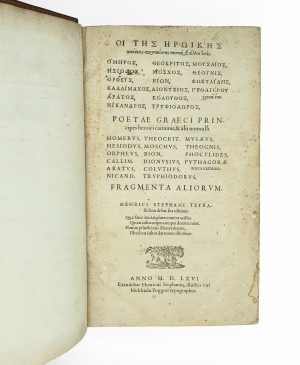
Le poème élégiaque de Musurus sur la première page est l’un des documents les plus anciens et les plus importants sur les aspects techniques de la fonte des caractères (cf. Proctor, The Printing of Greek in the Fifteenth century, Oxford, 1900, pp. 120-124).
Très bel exemplaire.
Provenance : St Benedict’s Library, Écosse (ex-libris).

![<span class="artist-name-product">[ANONYME] </span> Etymologicum Magnum Graecum.](https://www.librairieclavreuil.com/wp-content/uploads/2026/05/anonyme-etymologicum-magnum-graecum-7865-69fc6db17e124.jpg)
![<span class="artist-name-product">[ANONYME] </span> Etymologicum Magnum Graecum. – Image 2](https://www.librairieclavreuil.com/wp-content/uploads/2026/05/anonyme-etymologicum-magnum-graecum-7865-69fc6dbb43e0e.jpg)