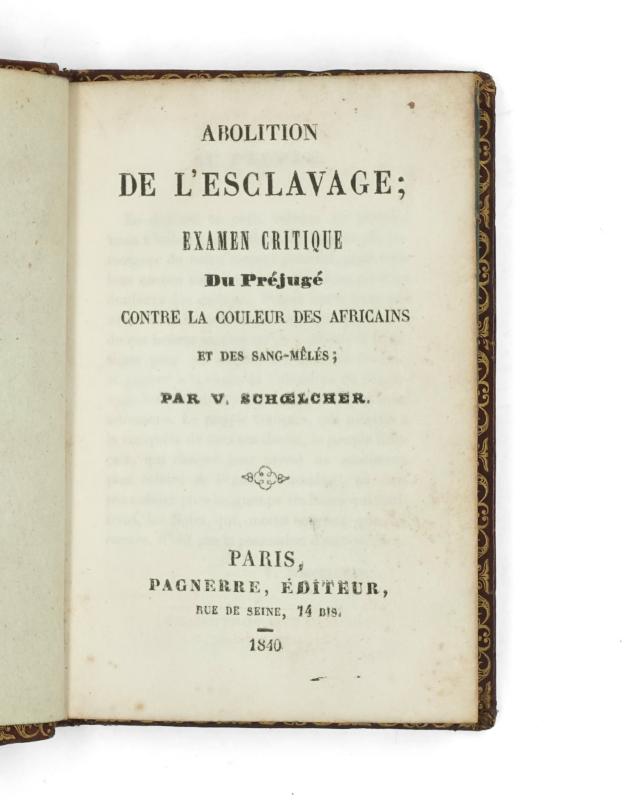
Gay, no. 162; Sabin, no. 77740; Mauro, Africa in Victor Schœlcher’s abolitionist discourse: from the refutation of the “native inferiority of Negroes” to the African project, pp. 149-173; Brasseur, P. (2019). From the abolition of slavery to the colonization of Africa, p.96
First edition.
French intellectual and politician Victor Schœlcher (1804-1893) came from a wealthy industrial background. At an early age, his travels to the West Indies, Cuba, and the United States brought him face to face with the reality of slavery. Deeply affected by what he saw, he became involved in the abolitionist movement and devoted much of his life to the fight against slavery and racism. “Schœlcher strongly opposed the moral and scientific arguments of his time that sought to justify slavery and colonial domination.” Schmidt, N., Victor Schœlcher et l’abolition de l’esclavage (Victor Schœlcher and the Abolition of Slavery), Fayard, 1994.
Published in 1840, AAbolition de l’esclavage : examen critique du préjugé contre la couleur des Africains et des sang-mêlés is a highly committed essay. In it, Schœlcher methodically refutes the racial theories of his time, drawing on historical, moral, and political arguments. The work is not limited to a humanitarian denunciation: it constitutes a genuine intellectual plea for racial equality and prepares the ideological ground that will lead, eight years later, to the decree of 1848 definitively abolishing slavery in the French colonies.
This book is now considered fundamental to the history of the abolition of slavery.
The catalog appears at the end of the volume, presenting and promoting the publisher’s editorial collection and explaining its intellectual and educational project. It places the work within a series of popular publications intended for the instruction of artisans, workers, and committed readers, in a spirit of social reform characteristic of the 19th century.
A very fine copy in its original binding. The half-title is missing, and the spine is sun-faded.