Borba de Moraes, II, pp. 743-4 ; Brunet IV, 1349 : « Ouvrage estimé et dont les exemplaires sont rares » ; Palau 273201 ; Sabin 72524 ; Sommervogel, VI, col. 1965 ; Medina, Biblioteca hispano-americana, III, 1771.
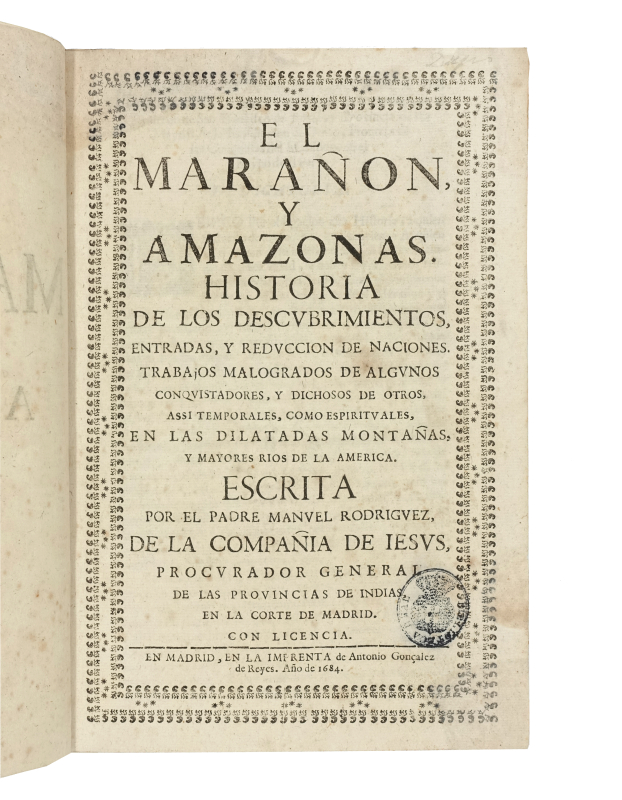
A rare first edition of one of the most important accounts of the discovery of the Marañón River region and its indigenous peoples.
Father Manuel Rodríguez, a Jesuit born in 1633 (according to sources, either in Spain or in Colombia – New Granada) and who died in Valladolid in 1701, dedicated his account to Jerónimo Baca de Vega, governor of the province of Maynas in Peru.
Comprising six books, the work compiles earlier accounts, missionary reports and chronicles, and, incorporating first-hand information, recounts the discovery and exploration of the Amazonian nations.
The account opens with the expedition of Francisco de Orellana, who, in 1542, was the first to travel the entire length of the great Marañón River. The famous episode of the attack led by female warriors — the Amazons — helped to permanently establish the name ‘Amazon’ for the river. The work then recounts the quest for a mysterious land known as El Dorado; this expedition, led by Pedro de Ursúa, was jeopardised by the mutiny of Lope de Aguirre, who murdered Ursúa before being executed himself in 1561. An abridged version of Nuevo descubrimiento del gran río de las Amazonas by Father Cristóbal de Acuña (Madrid, 1641) appears on pages 101 to 141.
The work describes missionary activity at length: the founding of Jesuit residences in Quito, the organisation of the reductions — villages intended to bring together and evangelise the indigenous populations —, progress in religious education, a description of the peoples of the Maynas region, and the search for gold.
Finally, the concluding section, which is sometimes missing, presents a chronology of Peru and the New Kingdom of Granada (1491–1684). According to Antonio de León Pinelo, as cited by bibliographers such as Sabin and Sommervogel, this section is thought to have been printed separately in Madrid in 1688 and subsequently appended to certain copies before the final index.
The final leaf, resembling a colophon within an attractive wood-engraved frame, is rather curious and lists the print run (0001), the books (0006), the chapters (0090), the pages (0444), the year of printing (1684) and the years covered (0044). It summarises the two main themes of the work: territorial conquest and spiritual conquest.
Borba de Moraes explains that “l’une des raisons pour lesquelles cet ouvrage est si rare est qu’il a été publié sans l’autorisation de la Congrégation de la « Propaganda Fide », contrairement aux ordres de Clément X pour les ouvrages de ce type. Il a donc été inscrit parmi les ouvrages interdits dans l’« Index », bien qu’il ait obtenu toutes les autres autorisations ecclésiastiques et civiles”
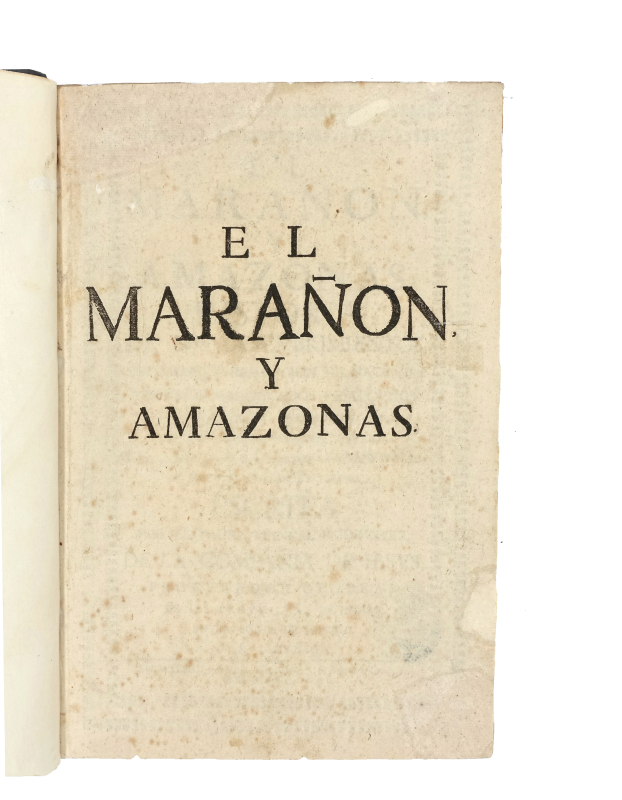
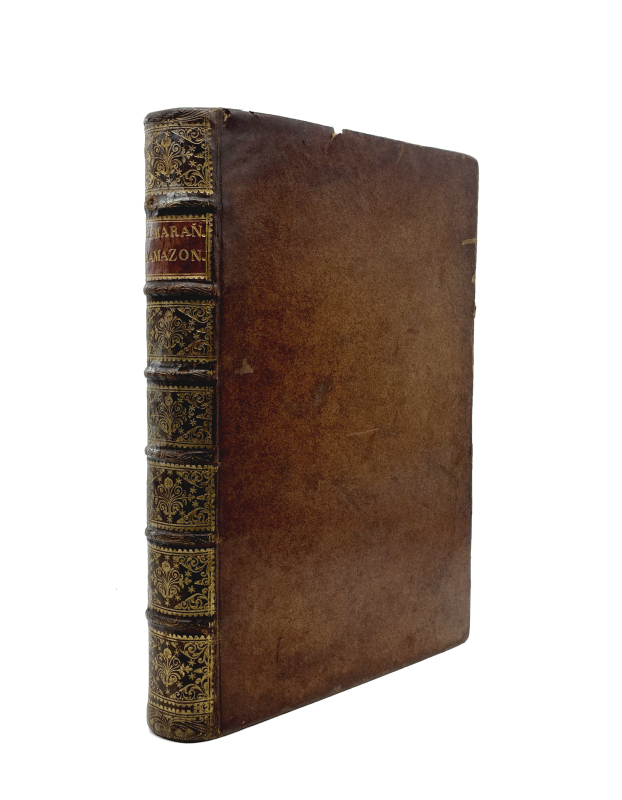
Foxing, ink stain on p. 147, water stain on p. 279. Modern endpapers. Restoration to most leaves. Scratches and small tears on the covers and spine (with small white marks). A modest copy.
Provenance: Mario Pimenta Camargo (bookplate): a collector of Brazilian art, he was director of the São Paulo Museum of Art (Masp) and a board member of the São Paulo Biennial Foundation and the Museum of Modern Art in New York.