Not in Sabin or Chadenat.
Rare first edition.
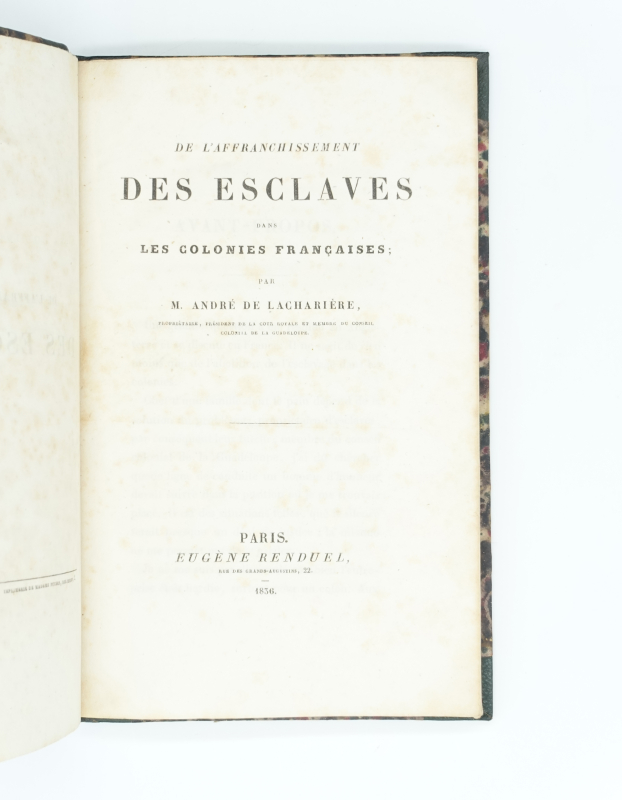
André de Lacharrière, a landowner in Guadeloupe, magistrate, delegate of the colonists to the French Conseil de la Marine, then member of the Conseil Colonial and President of the Cour Royale from 1836, was one of the men who contributed to the many texts that appeared in the 1830s dealing with slavery.
On 12 November 1830, a decree abrogated a number of prohibitions on free and enfranchised people of colour, who were then able to dress as they wished, use white names and meet without permission.
This decision gave rise to a number of disparate texts, ranging from segregationism and abolitionism to a wait-and-see attitude.
André de Lacharrière oscillated between these three strands in his numerous publications.
He began in 1831 with his Observations sur les Antilles françaises, in which he asserted that “pour améliorer le sort de la population esclave […] l’abolition, ou pour mieux dire la cessation complète de la traite” (p.75-76.) was necessary. His benevolent words were marred by a nagging paternalism. Lacharière asserted that blacks could only achieve progress through contact with whites.
In his second work on the subject, Du système de colonisation suivi par la France, published in 1832, Lacharière noted certain errors committed by nations that had abolished slavery and how they affected the French colonies: ” La Guyane, la Martinique, la Guadeloupe éprouve depuis quelque temps un fléau inconnu jusqu’ici, la désertion des noirs. C’est le gouvernement anglais qui lui a donné naissance” (p.53.)
Our work is the 3rd written by Lacharière on the subject of slavery, and it is the one that fully embraces the issue. Written in 1836, De l’affranchissement des esclaves dans les colonies françaises approaches the subject from both a pragmatic and moral point of view.
It describes the fears associated with the abolition of slavery, and in particular the financial repercussions for slave owners and colonists. While he was not fundamentally opposed, he expressed reservations and questioned the means put in place for such a revolution. His concern was for the well-being of the colonies : “l’abolition de l’esclavage n’est qu’un moyen ; il faut l’adopter s’il conduit à ce but, l’ajourner s’il en éloigne.” (p.55)
However, the fears expressed seem to have a solution, faith: “L’abolition de l’esclavage laissera un vide immense. La religion seule peut le combler”. (p.117)
Finally, the following text, in response to our Réflexions sur l’affranchissement des esclaves dans les colonies françaises published in 1838, expresses a form of abnegation : “L’abolition de l’esclavage est une question de temps, dit-on. Qui peut en douter ? N’en est-il pas de même de toutes les institutions humaines ?” (p14.)
Lacharière’s critical path is emblematic of the various moments and reflections at work in France and its colonies in the 1830s. Although he was never fundamentally against abolition, he raised many moral and materialistic questions that inevitably constituted by major societal changes.
Small tear in margin on p. 134.
Some foxing.
[Bound with]:
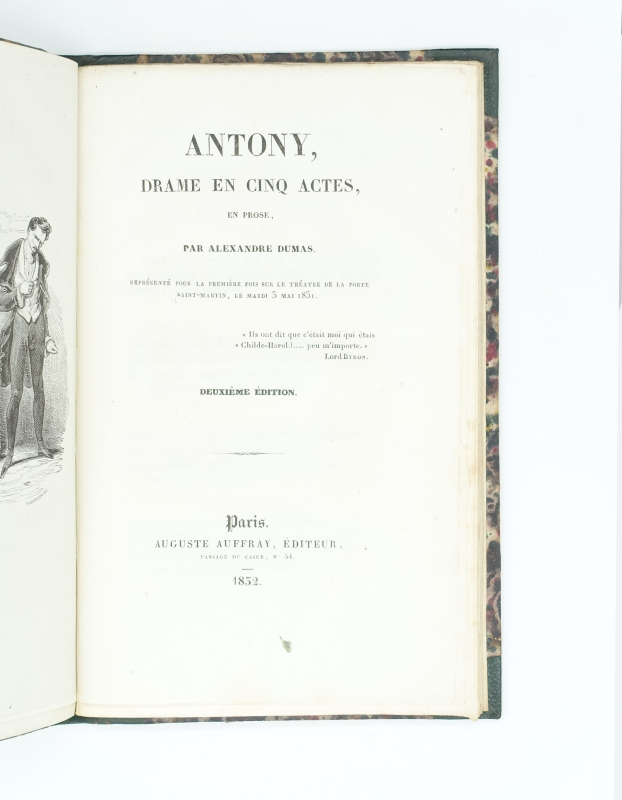
DUMAS. Alexandre. Antony, drame en 5 actes en prose. Paris. Auguste Auffray, 1832. 5 unn.l. (half-title, frontispiece, title, foreword), 100 pp., 1 nn.l. (post-scriptum).
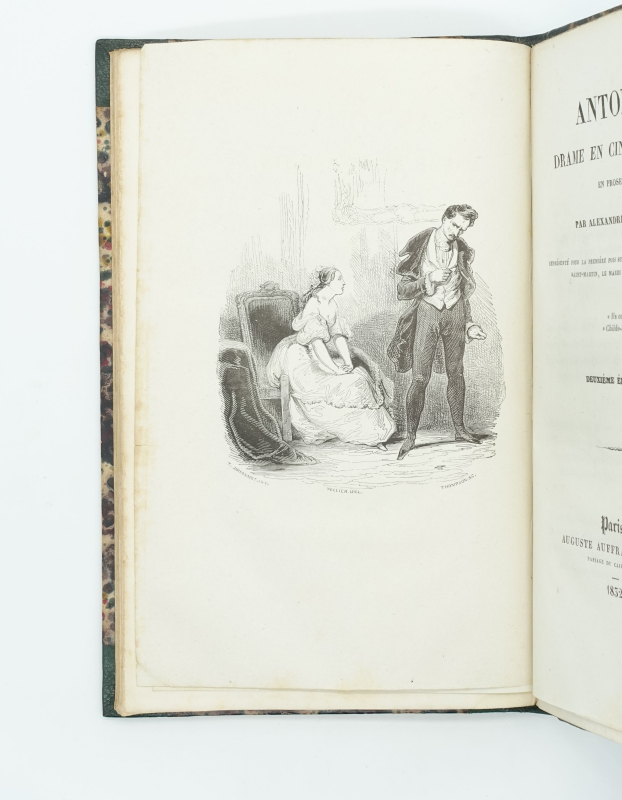
Second edition, illustrated with a frontispiece by Tony Johannot engraved by Tellier and Thompson.
Some foxing.
Slight indentation on the spine of the binding.