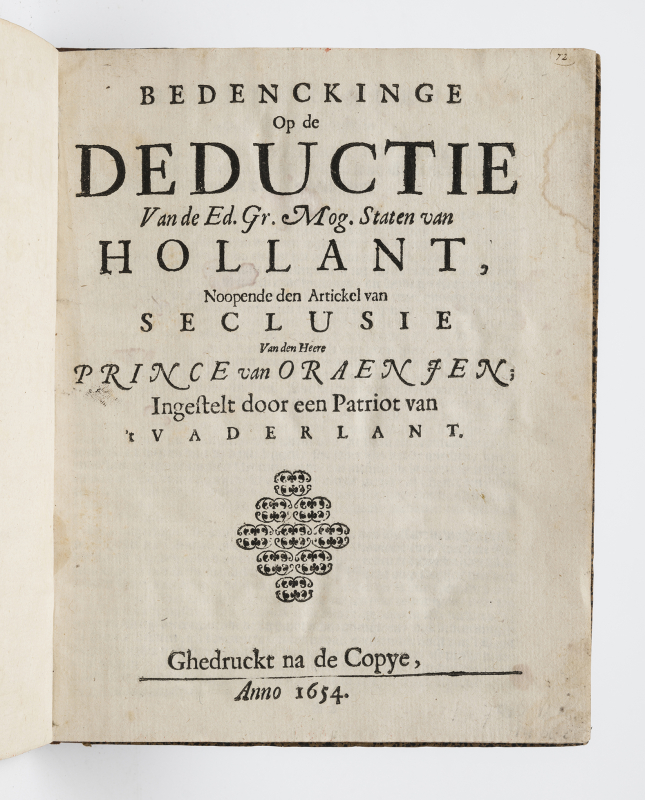
[Preceded by] : Bedenckinge op de Deductie van de Ed. Gr. Mog. Staten van Hollant, noopende den Artickel van Seclusie van den Heere Prince van Oraengien. Ghedruckt na de Copye, 1654.
Borba de Moraes, Bibliographia brasiliana, II, p. 696 – Garraux, Bibliographie brésilienne, p. 128 – Brunet, II, 1782 : “Morceau rare, et que recommande autant le nom de l’imprimeur que le sujet” – Knuttel Collection (Dutch Pamphlets) 7550a.
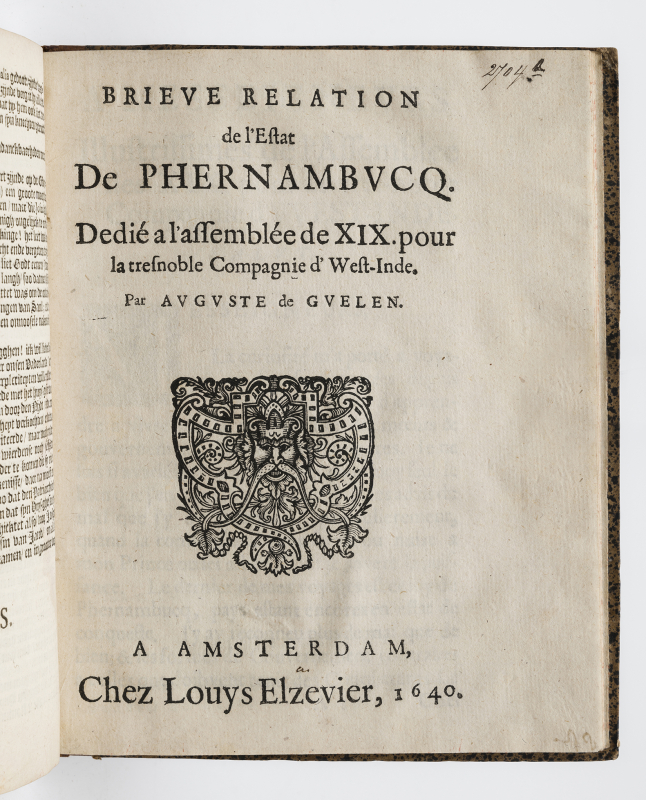
Extremely rare first French edition of Guelen’s work (a Dutch edition was published in the same year) of his account of Dutch administration in Pernambuco.
Since 1630, the Dutch had conquered this region at the eastern tip of Brazil, one of the richest in sugar production (in 1654, they were driven out by a revolt of Portuguese settlers).
Addressing the board of the East India Company, in a tone sometimes provocative, Guelen analyses Dutch rule in Pernambuco along three lines: the militia, trade and justice. For each of these, he outlines the shortcomings and then lists the measures (“orders”) likely to improve the situation : that the Governor and the colonels be respected, that the soldiers be listened to and cared for, “that care be taken to always have a good number of ships in the Récif Roadstead”, and that these ships be equipped with soldiers and “good fireworks”. To reduce losses and corruption, he recommends greater involvement from the Company’s governors: “[that] for the payment of the slaves, machinery, and goods purchased from the Company, one of the Lords of the Grand Council should not spare two or three steps to come down from their chamber to the square in front of their door to inspect the condition of the sugar and ensure it is accepted in payment according to the sugar’s merit” (f. D). Nevertheless, it is justice which, in his view, is the paramount issue, since “there is, however, very little of it; not to say none at all; or if there is any, it is kept so hidden that one is hardly willing to speak of it, neither to free Flemings, nor to Flemings serving in the Company’s pay, nor to the Portuguese” (f. D2).
The text that opens the volume [whose title may be translated as: “Reflections on the Deduction of the Most Noble and Powerful States of Holland concerning the article of exclusion of the Lord Prince of Orange”], is a famous anonymous Orangist pamphlet, signed “by a patriot of the fatherland”.
It responds to the ‘Deductie’ by the great republican councillor Johan de Witt, published the same year during the constitutional crisis following the First Anglo-Dutch War. This pamphlet refutes the secret Act of Exclusion which removed the Prince of Orange from power.
Bedenckinge: Small paper defect on f. F2; faint water stains. — Phernambucq: handwritten call number (or old price) on the title page. Small corner tear with loss on ff. D, F and F2. — Spines cracked, rubbed, small snags.