
VENDU
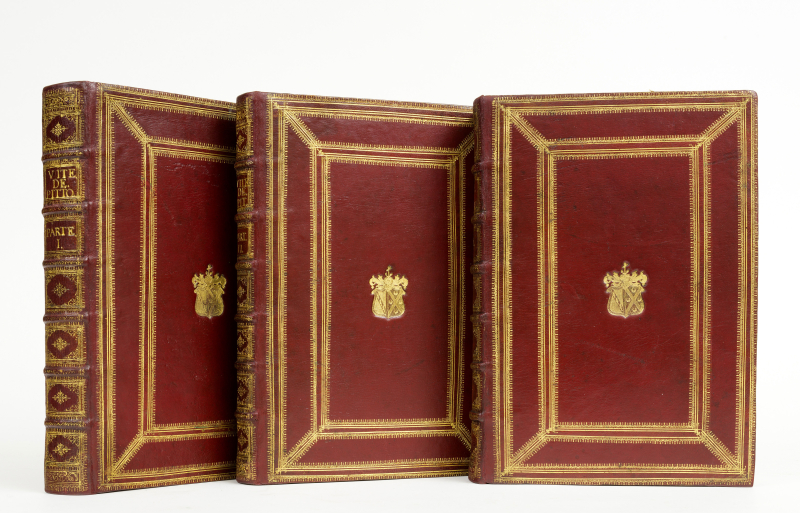
3 parts in 3 volumes, 4to (235 x 160 mm) 28 nn.ll. (including title and engraved portrait), 523 pp. (misnumbered 529) for volume I (parts one and two); 20 nn.ll. (including engraved title), 370 pp. nd 1 nnL; (errata) for volume II (part three, first half); 42 nn.ll. (including engraved title) pp. 371 to 974 (misnumbered 1012), 2 nn.ll. (errata, index) for the volume III (part three, second and final part). 144 woodcut portraits after designs by Vasari or his pupils, each with title and within six differing borders of female figures representing the arts (woodcut portrait of Giulio Genga in vol. III with cancel slip correcting title), historiated or decorated woodcut initials and head- and tail-pieces throughout. Full seventeenth-century Italian red morocco, boards with gilt-tooled borders and gilt rules to surround central armorial vignettes, banded spine with title and decoration in gilt, turn-ins with gilt tooled borders, gilt edges.
1 in stock
Mortimer (French), II, 515 ; Julius von Schlosser, La Littérature artistique, Paris, 1984, pp. 309; Brunet, V, 1096 & Suppl., II, 845 ; Cicognara, I, 2391 ; PMM, 88; de Diesbach, Bibliothèque Jean Bonna, le XVIe siècle, 353.
The second edition – the first to be illustrated – of Vasari’s, the first art historian and often referred to as the “father of art history”, famous ‘Vite’ and the first complete edition with much new material.
First published in three parts in two volumes in 1550 by Lorenzo Torrentino, Vasari had provided biographies – with the exception of that for Michelangelo whom Vasari and his contemporaries idolised – of deceased artists only. Eighteen years were to pass before Vasari issued this second edition and he added so much new information that this second edition is considered preferable to the first.
This second edition features woodcut portraits of the artists, adds a further 28 lives (including that of Titian), Vasari’s own biography, a technical treatise on painting and updates much of the information in the previous edition to the year 1567.
“Michelangelo was the only artist still living when the Vite appeared. Vasari ends with a section to ‘artists and readers’. Vasari’s contribution was to create a critical, i.e., evaluative, history of artistic style, although he was far from unbiased. Core to Vasari was the notion of the rebirth of art, a rinascita. Art had a history and by new birth, it reestablished itself as a noble pursuit worthy of study. Vasari’s division of art history into ages took as its paradigm the stages of human development. This, too, was not a novel conception with Vasari, but in his book, it took on a logical sense of order. Art’s early perfection was the antique, but had then declined under Constantine. This low period of barbaric or Germanic art (“Gothic” Vasari called it) far removed from classical models, was ready for renaissance. Cimabue, Giotto and others formed the nascence of art, inspired by the imitation of nature, a primary stage (primi lumi). A developmental period (augumento) was ultimately succeeded by the age of perfection (perfezione)–coincidentally Vasari’s own time and that of Michelangelo. Vasari’s book created a sensation. Michelangelo, Gherardi, Salviati and Carlo Fontana praised it” (A Biographical Dictionary of Historic Scholars, Museum Professionals and Academic Historians of Art online).
This copy with the variant title for vol. I (see Mortimer) with blank verso and without the Medici arms; in copies without the variant, the block for the title, here incorporated within the woodcut frame of the title, is printed on the verso.
“Vasari’s excellent sense of narrative … and lively style combined with his wide personal acquaintance makes his ‘Lives’ a vital contribution to our understanding of the character and psychology of the great artists of the Renaissance, a term (rinascita) which he was the first writer to use … It [the ‘Lives’] became a model for subsequent writings on the history of art … For its period it has remained the chief authority … ” (Printing and the Mind of Man).
“Entre-temps, Vasari avait beaucoup lu et beaucoup appris ; il avait visité des régions qu’il ne connaissait pas, ou bien qu’il avait vues superficiellement (Assise, l’Italie du Nord). Il est indéniable qu’elle apporte beaucoup d’améliorations, bien des négligences , des méprises ont été éliminées… De nouvelles sources se sont ouvertes à lui, surtout les portraits ; grâce à ses activités au Palazzo Vecchio, les portrait de l’élite intellectuelle des Médicis lui étaient devenus familiers ; à présent, il orne son œuvre de portrait d’artistes dessinés par lui et ses élèves et il donne ainsi un modèle à ses successeurs…. Ses matériaux se sont considérablement accrus, la seconde édition le montre, ne serait-ce que par ses dimensions ; un grand nombre de biographies nouvelles sont venues s’y ajouter (trente-quatre rien que pour le XVIe siècle !), et surtout il est tenu compte d’artistes vivants dans un volumineux appendice spécial… A côté des portraits déjà mentionnés, on voit apparaître une nouvelle source : les dessins ; la collection personnelle de Vasari, le Libro souvent mentionné apparaissent cités ici pour la première fois. Vasari qui se sent maintenant, et à bon droit, homme de lettres reconnu, s’efforce d’améliorer son style et son exposé…” (Schlosser).
A magnificent copy in seventeenth-century Italian red morocco with large margins of the first Western history of art and one of the most important books of the Renaissance.
Provenance : This copy was in the collection of Adélaïde Suzanne de Vismes (1753 – 1832), a poet and intimate of Queen Marie-Antoinette, who married the composer Jean-Benjamin de Laborde, a favourite of Louis XV and son of the financier Jean-François de Laborde, who became a ‘fermier général’. In the nineteenth-century the Vasari passed into the collection of John Gardiner Kinnear (1794 – 1865), the Scottish financier, who had his arms stamped on the boards of each volume and her bookplates to front pastedown of each vol. with the text ‘Bibliothèque de Madame de la Borde’ – Jean Gardiner Kinnear (1794 – 1865) with his arms to front and rear boards of each volume.



Monday to Saturday
10am – 1pm and 2:30pm – 7pm
(6pm Monday and Saturday)
© 2023 All rights reserved.