Dibner, Heralds of Science, 54 ; Evans, First editions of Epochal Achievements in the History of Science (1926), 26 (“The scientific treatise on electricity and magnetism”) ; Horblit, 41 ; PMM, 107 ; Sparrow, Milestones of Science, 85 ; Wheeler Gift, 72 ; DSB, V, 396-401.
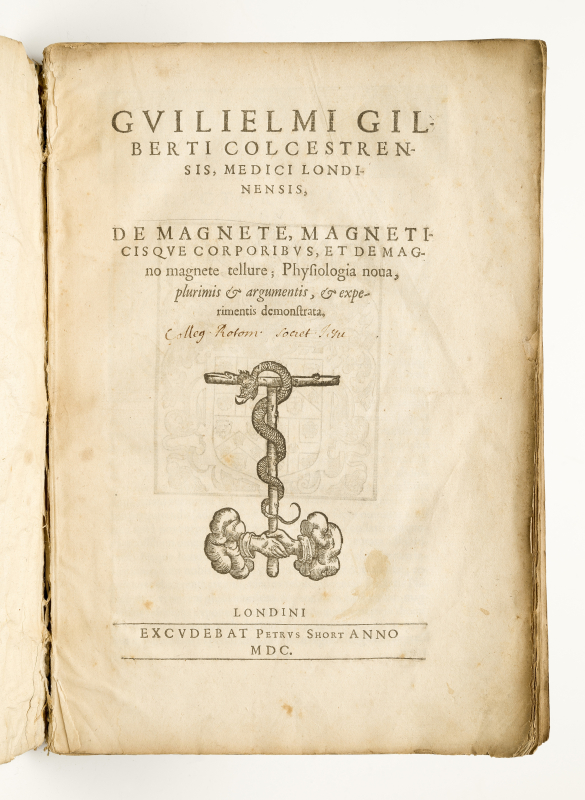
Édition originale. Le premier grand traité scientifique anglais basé sur des méthodes de recherche expérimentales et l’ouvrage fondateur du magnétisme et de la science électrique.
Gilbert utilise ici pour la première fois les termes « électricité », « force électrique » et « attraction électrique ».
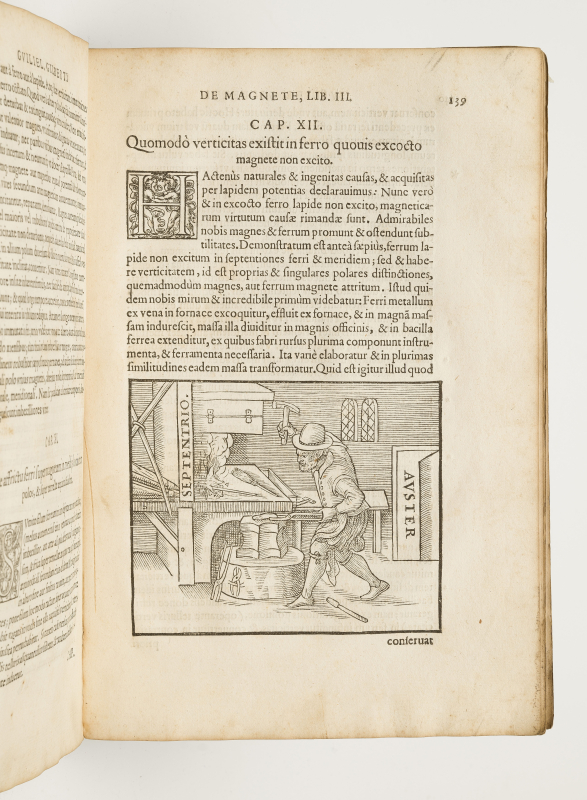
“Gilbert divided his De magnete into six books. The first deals with the history of magnetism from the earliest legends about the lodestone to the facts and theories known to Gilber’s contemporaries… In the last chapter of book I, Gilbert introduced his new basic idea which was to explain all terrestrial magnetic phenomena: his postulate that the earth is a giant lodestone and thus had magnetic properties… The remaining five books of the De Magnete are concerned with the five magnetic movement: coition, direction, variation, declination, and revolution. Before he began his discussion of coition, however, Gilbert carefully distinguished the attraction due to the amber effect from that caused by the lodestone. This section, chapter 2 of book II, established that study of the amber effect as a discipline separate from that of magnetic phenomena, introduced the vocabulary of electrics, and is the basis of Gilbert’s place in the history of electricity” (DSB).
“Gilbert was chiefly concerned with magnetism; but as a digression he discusses in his second book the attractive effect of amber (electrum), and thus may be regarded as the founder of electrical science. He coined the terms ‘electricity’, ‘electric force’ and ‘electric attraction’. His ‘versorium’, a short needle balanced on a sharp point to enable it to move freely, is the first instrument designed for the study of electrical phenomena, serving both as an electroscope and electrometer. He contended that the earth was one great magnet; he distinguished magnetic mass from weight; and he worked on the application of terrestrial magnetism to navigation. Gilbert’s book influenced Kepler, Bacon, Boyle, Newton, and, in particular, Galileo, who used his theories to support his own proof of the correctness of the findings of Copernicus in cosmology” (PMM).
Exemplaire appartenant au premier tirage, avec des petites corrections (autographes ?) aux pp. 22, 47, 130, et 221
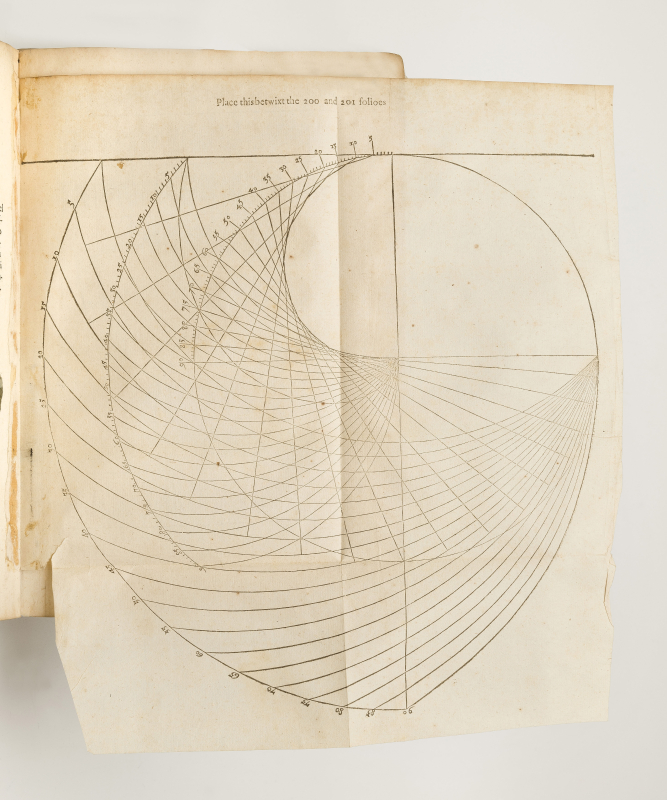
La grande planche dépliante montre des variations du magnétisme terrestre par rapport au méridien, phénomène bien connu par les navigateurs de l’époque. Le texte est orné de nombreux diagrammes.
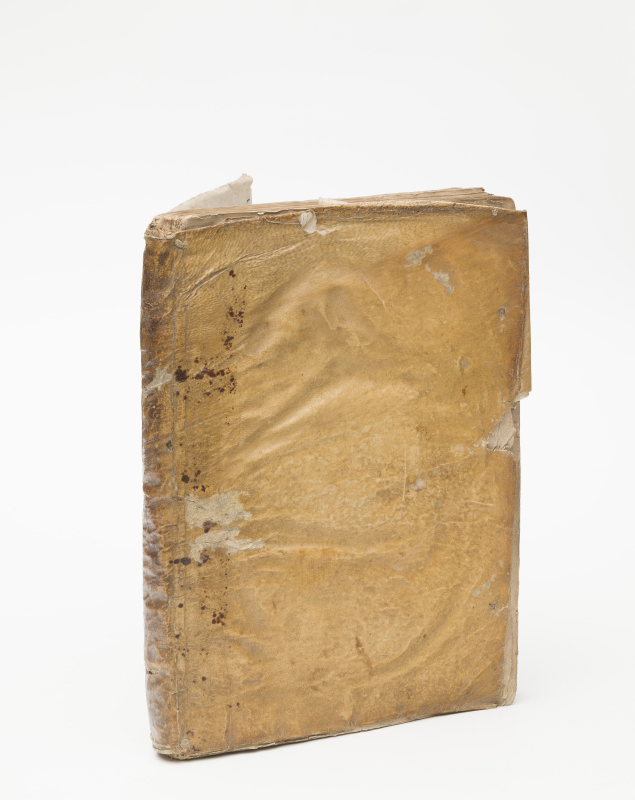
Bel exemplaire, conserve dans sa première reliure.
Provenance : Collège jésuite de Rouen (note sur le titre)