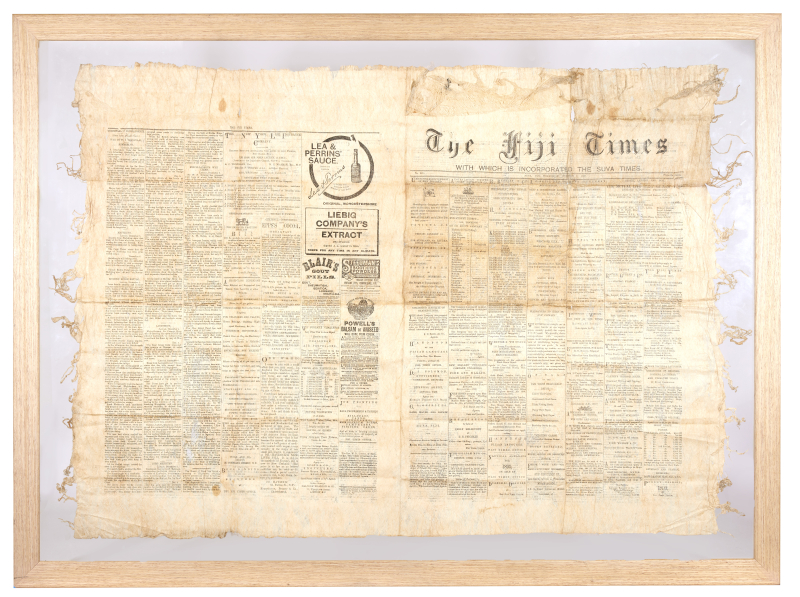
« There are about a dozen known examples of bark cloth newspapers worldwide, the earliest dating back to 1885, a copy of The Polynesian Gazette in a private collection and the newest to 1925, a Fiji Times in The Australian Museum, Sydney. Auckland Museum’s two examples are copies of the Fiji Times from July 4, 1908 and February 17, 1909. Three newspapers in Fiji produced editions on barkcloth, The Polynesian Gazette in Levuka, The Fiji Observer and the one mentioned above, in effect the same newspaper at different times of its history. Barkcloth or tapa is created from the living inner bark of particular trees which is removed in single strips of about 5 to 10cms wide. After scraping off the outer bark layers the soft inner bark can then be beaten and pounded until the fibres are spread and felted together creating sheets of thin bark cloth. In this instance, the editions are printed on a single laminate white masi of a standard width which serendipitously required no trimming to fit into the press. The left and right sides are sometimes fringed by cutting into the sheet to a depth of c.20mm. The image of a clerk in the printing workshop snipping away with scissors to mimic traditional fringing on copies of that day’s paper makes for a whimsical picture… It stands to reason barkcloth was used because there was no newsprint on hand. The paper came from Australia or New Zealand and a shipping delay would account for the situation: no paper, use the next best thing – barkcloth. Today, it is these which take our interest, far more than the ordinary newsprint examples the masi replaced on these occasions » (Sabine Weik-Barton, The Mystery of the Barkcloth Broadsheets, Tuesday, 1 August 2017).