
VENDU
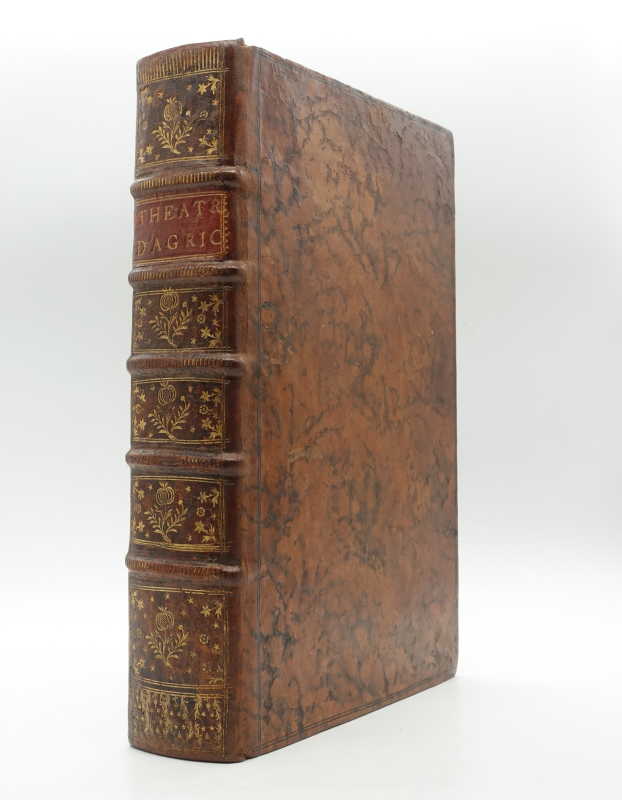
Folio (306 x 200 mm) 8 nn.ll. including engraved title-frontispiece by Malleri, 1004 pp., 10 nn.ll. 18th century marbled calf, spine gilt with raised bands, red edges (some expert restorations).
1 in stock
Tchemerzine, V, p. 817; Pritzel, 8630; Mortimer, French, 494; En Français dans le texte, 79; Simon, Bibl. Bacchica, II, 619; Vicaire, pp.788-789 ; Kress, 236.
First edition of the first modern treaty on agriculture.
“Cette première édition est la plus belle de toutes ” (Thiébaud). it is dedicated to French King Henry IV.
Olivier de Serres is a member of a Huguenot family in the Vivarais region. During the Wars of Religion, he took part in various battles, including the siege of his home town, Villeneuve-de-Berg, in 1573. Afterwards, he retired to his land at Le Pradel, determined not to become involved in religious quarrels. It was at Le Pradel that he spent the rest of his life, devoting himself to his work as a landowner. Olivier de Serres never lost sight of the national interest and wanted to convince the gentlemen to look after their land themselves. For thirty years he devoted his spare time to writing this book, which deals in detail with every aspect of agriculture: the land, clearing and drainage, wheat, wine, livestock, the farmyard, the garden, water and wood, and domestic recipes. This book was responsible for the development of new crops such as hops, maize, beetroot, mulberry and even potatoes.
Olivier de Serres’ style is clear and imbued with rural poetry. He described the gardener as “the goldsmith of the earth, because he surpasses the simple ploughman as much as the goldsmith surpasses the common blacksmith” [orfèvre de la terre, parce qu’il surpasse d’autant plus le simple laboureur que l’orfèvre le commun forgeron]..
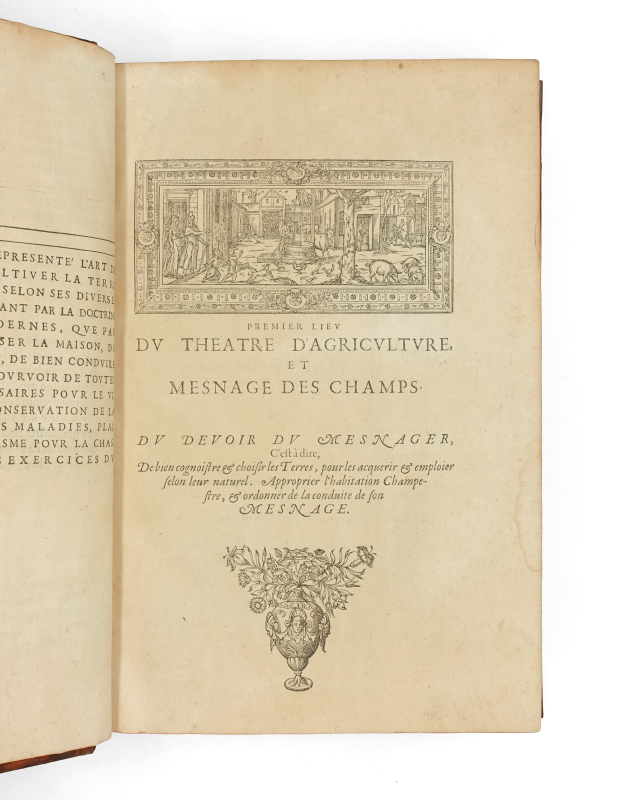
His work is divided into eight large chapters or “places” as he calls them : 1: Du Devoir du Mesnager, c’est-à-dire de bien cognoistre & choisir les Terres, pour les acquerir & emploier selon leur naturel, approprier l’habitation champestre & ordonner de la conduite de son mesnage. 2. Du Labourage des terres-a-grains, pour avoir des Bleds de toutes sortes Agronome et non gastronome, Oliver de Serres ne s’intéresse pas à l’apprêt culinaire lui-même, mais aux modes de conservation des aliments […] : techniques de salaison des différentes viandes d’une part, de l’autre, procédés de mise en conserve des fruits (au sel, au vinaigre, au moût, au vin cuit, au sucre, au miel). Le second chapitre du livre VIII constitue ainsi un véritable traité de confiture ” (Livres en bouche). 3. De la Culture de la Vigne, pour avoir des Vins de toutes sortes, aussi des passerilles & autres gentillesses procedantes des raisins, ensemble de se pourvoir d’autres boissons, pour les endroits où la Vigne ne peut croistre. 4. Du Bestail a quatre pieds, des pasturages pour son vivre, de son entretenement & des commodités qu’on en tire. 5. De la conduite du Poulailler, du Colombier, de la Garenne, du Parc, de l’Estang, du Ruscher & des Vers-à-Soie. 6. Des Jardinages, pour avoir des Herbes & Fruits potagers, des Herbes & Fleurs odorantes, des Herbes medecinales, des Fruits des Arbres, du Saffran, du Lin, du Chanvre, du Guesde, de la Garence, des Chardons-à-draps, des Rozeaux, en suite, la manière de faire les cloisons pour la conservation des fruits en général. 7. De l’Eau & du Bois. 8. De l’Usage des Alimens, & de l’honneste comportement en la Solitude de la Campagne. This last chapter contains recipes for bread, drinks (hypocras, malvasia, mead), fruit and meat jams and preserves, syrups, sauerkraut, truffles, etc., as well as medical remedies for humans and animals. It also explains how to arrange houses and clothes and how to behave honestly in the countryside.
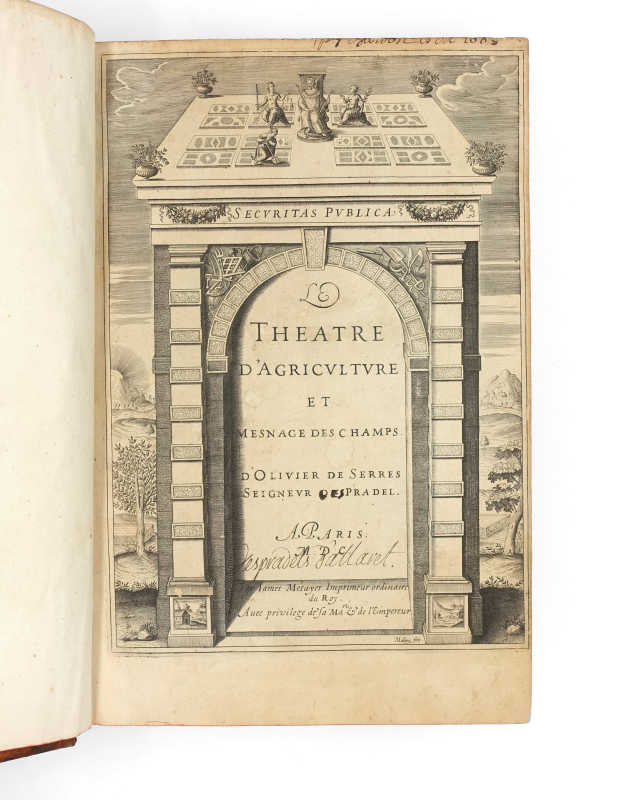
The illustration consists of a fine title-frontispiece engraved by Mallery. It shows an arch with the title in the middle with small views revealing a country landscape at both sides, surmounted by a garden view with parterres in the style of Le Nôtre showing the king seated in the middle and surrounded by three personalities (Justice, Peace, and Labour). The title is indicating Olivier de Serres’ title as being “Seigneur du Pradel”. The iconography is complemented by woodcuts in the text and eight woodcuts at the head of each chapter depicting scenes of rural life.
“Ce traité d’agriculture est le fruit des recherches entreprises par l’agronome sur sa propre exploitation à partir de 1559. L’aspect novateur du Théâtre tient au caractère scientifique de la démarche de son auteur qui, bien que connaissant l’apport des antiques et de ses contemporains, réalisa ses propres expérimentations.
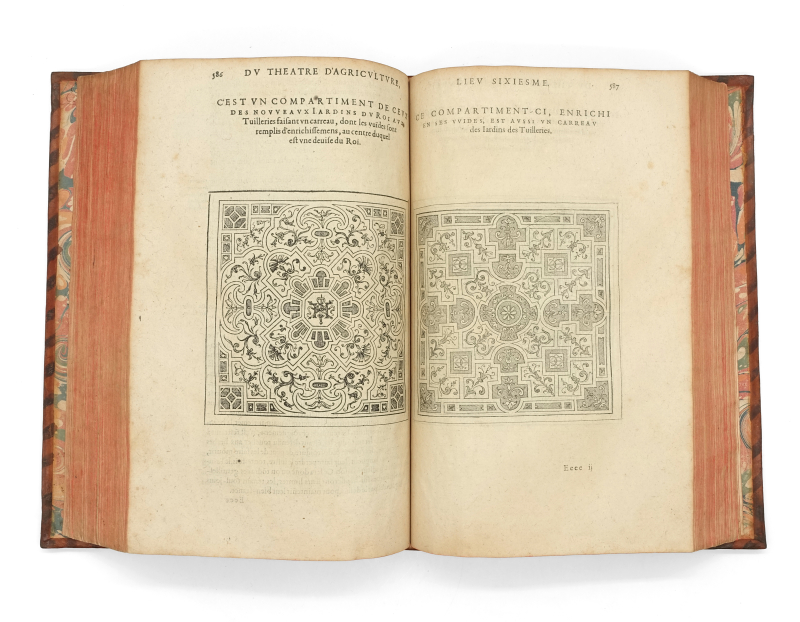
“La publication du traité d’Olivier de Serres s’inscrit dans le cadre politique d’une volonté de relance de l’agriculture dès les premières années du règne d’Henri IV. L’ouvrage, en abordant la question de la culture du mûrier blanc et la sériciculture, participe également à la politique de la soie que veut promouvoir le roi pour lutter contre l’importation de soieries étrangères. En faisant part de la façon de réaliser les parterres dits “à la nouvelle mode” inaugurés pour les jardins royaux, le Théâtre d’agriculture est également devenu un ouvrage de référence en matière d’histoire des jardins” (Frédéric Sichet, France Archives).
Clear light waterstain throughout, paper default pp. 721/722 without loss.
Provenance: Ex-Dono D.D. Poitevin Despradels d’Allavet (Possibly Durand de Poitevin, King’s Councillor in Montpellier, son of Jacques-Alexandre de Poitevin, Director of the Royal Academy of Sciences, and Suzanne Despradels, elder brother of First Empire Major General Jean-Etienne Casimir Poitevin de Maureilhan). The former owner corrected Olivier de Serres’ title from “Seigneur du Pradel” to “Seigneur Despradel” in reference to his own name.


Monday to Saturday
10am – 1pm and 2:30pm – 7pm
(6pm Monday and Saturday)
© 2023 All rights reserved.