Alden & Landis 689/152; Leclerc, Bibliotheca Americana, 487 (‘Cette relation, qui est insérée toute entière dans le troisième volume de l’histoire des flibustiers, est la meilleure relation de toutes celles qui sont entrées dans cet ouvrage’); Howgego, Encyclopedia of Exploration to 1800 I, p. 654; Sabin 67983; Soultrait XVIIe siècle, 276.
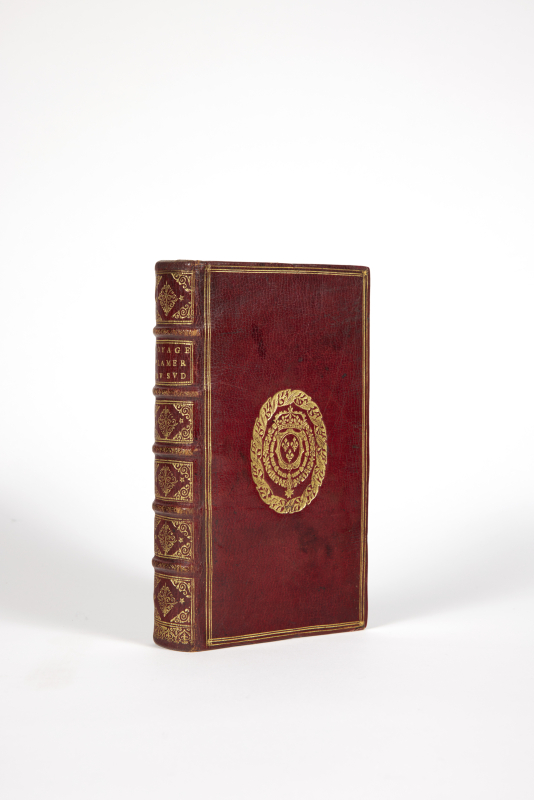
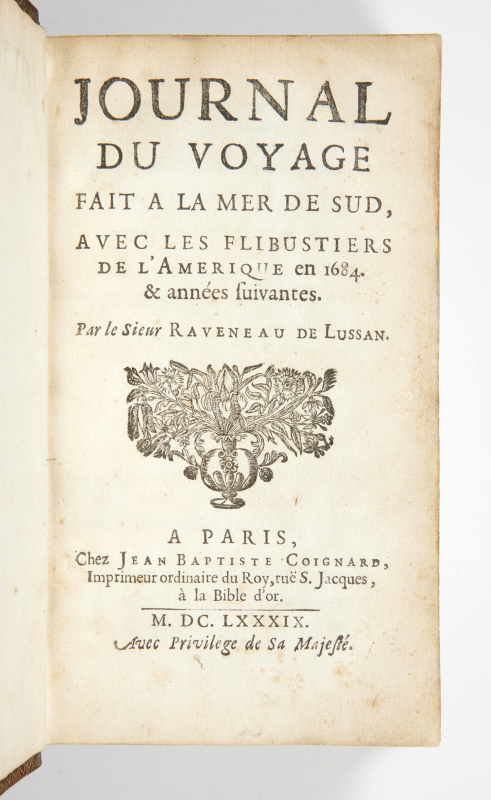
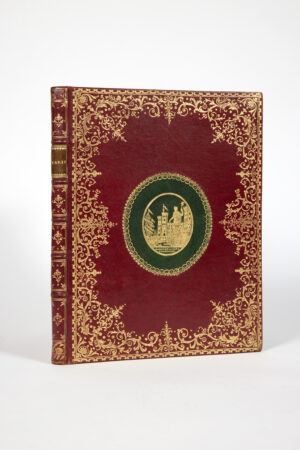
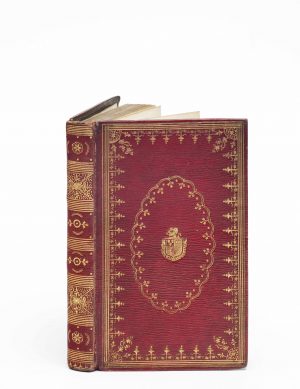
First edition of the only book published by Raveneau de Lussan. An exceptional copy, bound in red morocco leather bearing the arms of King Louis XIV.
The Adventures of a Privateer in America
Tales of privateering captured the public imagination, creating the myth of pirates who were certainly bloodthirsty, yet courageous and charming. The first accounts were those of Œxmelin in 1686, but they were highly fictionalised. Three years later, Raveneau de Lussan published his journal, in which he recounted, without embellishment or false modesty, the ill-fated expedition that took him, over a period of more than two years, from Guayaquil to the Atlantic coast of Central America.
A young man of good birth, a soldier and a Parisian, Raveneau de Lussan was seized, at the age of 22, by an irrepressible desire to travel; he set sail from Dieppe in 1679 for Saint-Domingue, where he remained for three years. There, he ran up such a large debt that, under pressure to settle it, he joined a band of buccaneers. Having set out on 22 November 1684, they did not return until February 1686, after a particularly arduous retreat across Central America.
“L’auteur raconte les péripéties de cette entreprise, les pilleries et les violences qui furent commises. (…) [Son] livre est presque entièrement composé de récits de combats. L’auteur fait preuve d’un sang-froid et d’une sécheresse de cœur extraordinaires : très précis, il ne dissimule aucun méfait et reste insensible devant les cruautés qui sont commises. Son livre présente une peinture réaliste de la vie des flibustiers” (Bourgeois et André, Les Sources de l’histoire de France, I, n° 586).
One can only imagine the readers’ enthusiasm for these exotic adventures. As Larousse writes, indignantly: “Ils couvraient leurs crimes d’un éclat d’intrépidité incomparable, jouaient leur vie comme leur or, élevaient le brigandage, s’il était possible, à la hauteur de l’héroïsme.”
Daniel Defoe drew on Raveneau de Lussan’s Journal or the plot of Robinson Crusoe.
Gilbert Chinard has highlighted the similarities between the two works: “Defoe, écrit-il, me paraît s’être manifestement inspiré des Aventures de Raveneau de Lussan, au moins pour la première partie de son roman. En tout cas, on ne saurait rien voir de particulièrement anglais dans ce désir irrésistible de s’enfuir loin de la maison paternelle et de voyager qui s’empare du jeune Crusoe” (L’Amérique et le rêve exotique, p. 249).
A magnificent copy, bound in morocco leather decorated with the coat of arms of King Louis XIV.
This account of the adventures of the buccaneers has a fascinating provenance, as King Louis XIV was no stranger to the prosperity, and subsequent decline, of the ‘Brothers of the Coast’ organisation. Indeed, by royal decree, France granted the buccaneers its tacit protection, sometimes even encouraging their expeditions; whilst at war with Spain, the king looked favourably upon the buccaneers ransoming and attacking Spanish galleons and destabilising the Iberian colonial empire. Eight years after the publication of Raveneau de Lussan’s Journal, Louis XIV called upon the buccaneers to join the French Royal Navy for an expedition against Cartagena. The contract stipulated that they would be given a third of the booty, with buccaneer officers to be treated on a par with Royal Navy officers… However, concerned about the excessive power of his dubious allies, Louis XIV ordered that they be betrayed once the raid had been carried out; by sowing discord amongst the pirates, the king’s manoeuvre proved fatal to the buccaneers’ organisation.
A precious copy bound for the king and bearing his arms.
Minor spotting, paper faults on pp. 123/124 without missing text.
Provenance: Edouard Rahir (ex-libris, his sale, Paris 5-7 May 1936, lot 1152) – Pierre Berès (catalogue 64 / 266) – Jean A. Bonna ( bookplate).