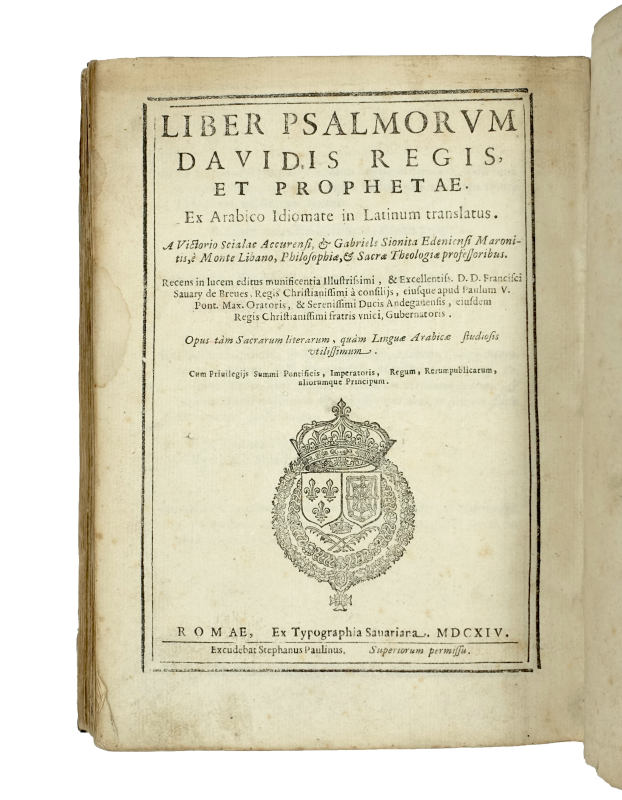
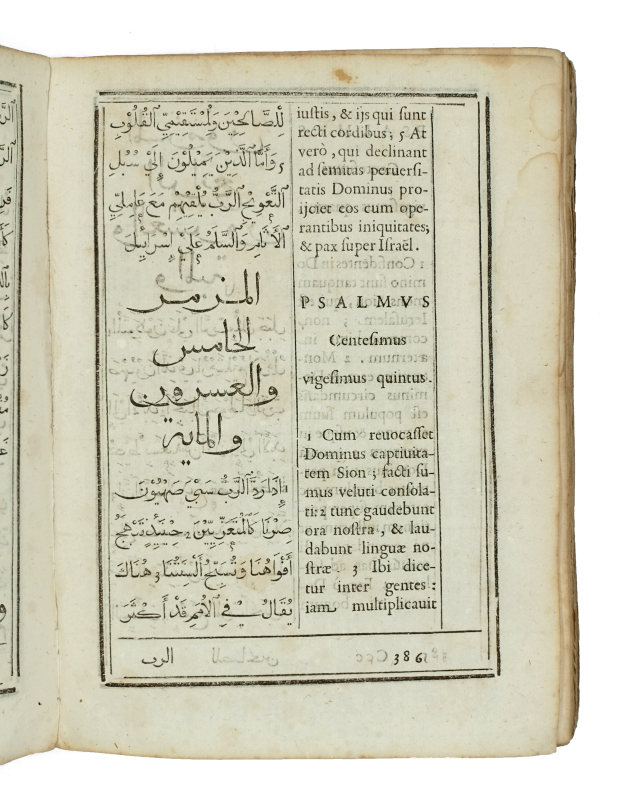
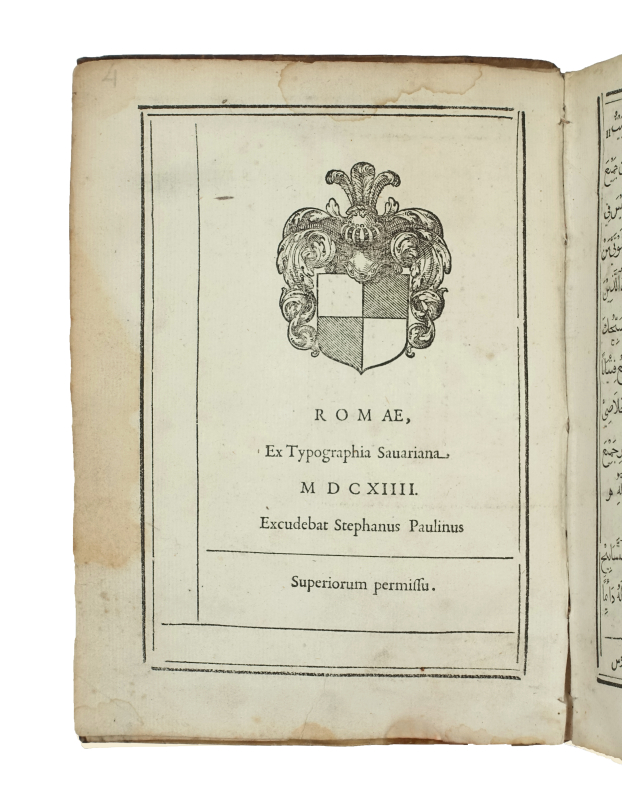
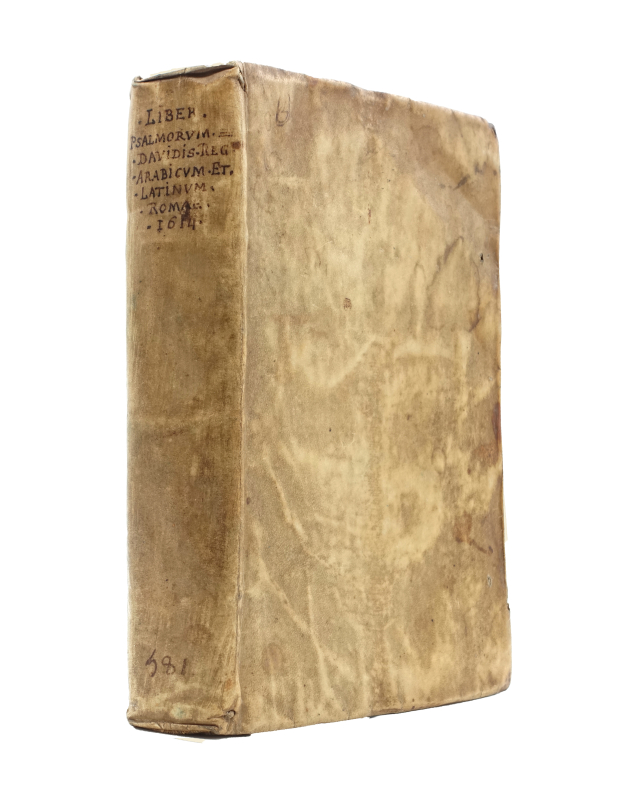
First edition of this adaptation of the Psalms into Arabic. One of only two works produced by the Arabic printing press established in Rome by François Savary de Brèves.
This edition includes the Latin translation by two Lebanese scholars from the Maronite College, Victorio Scialac and Gabriele Sionita, of 151 psalms and 10 ‘laudationes’ drawn from the Old Testament, alongside the original Arabic text. The manuscript for this edition was brought back from Jerusalem by Savary de Brèves.
A French diplomat and French ambassador to Constantinople (1591–1605) and then to Rome (1607–1614), François Savary de Brèves was one of the most famous Orientalists of his time. In Rome, he established the first French Oriental printing house, the Typographia Savariana: developing Arabic, Persian and Syriac typefaces in collaboration with the printer Stefano Paolini (who had previously worked for Raimondi), he designed and cast these elegant typefaces, which respect the calligraphic forms.
This Arabic-Latin psalter, together with Cardinal Bellarmine’s Doctrina christiana, are the only two Christian works printed by Savary de Brèves’s Arabic printing house in Rome, with the aim of encouraging the conversion of Muslims; the first work was printed in an edition of 3,000 copies, the second in 500 or 600 copies.
“Gabriel Sionite et Victor Scialac expliquent dans leur préface pourquoi Brèves a créé une imprimerie arabe. Au cours des voyages qu’il a faits à partir de Constantinople, il a pris conscience de la misère spirituelle des chrétiens arabophones du Proche-Orient et une fois à Rome, il a créé une imprimerie pour leur fournir des livres chrétiens en arabe, “expurgés de leurs erreurs et de leurs fautes”. On ne s’étonnera donc pas que les deux collaborateurs de Brèves soient des Maronites et que la Doctrina christiana ait été imprimée “par ordre de Paul V” et qu’elle porte ses armes. Brèves, ambassadeur à Rome, nous apparaît donc comme un imprimeur orientaliste, mais un orientaliste chrétien et même ultramontain, puisqu’il diffuse la doctrine chrétienne romaine dans les Eglises d’Orient.” Ce livre, destiné aux orientalistes chrétiens en Europe, apparut vite comme un nouveau manuel de langue, pour ceux qui étudiaient l’arabe de la Bible : “En 1632, un arabisant français, Jean-Baptiste Duval, publiera à Paris un “Dictionarium latino-arabicum Davidis Regis”, c’est un index du Psautier pour pouvoir traduire du latin en arabe” (Gérald Duverdier, Savary de Brèves et Ibrahim Müteferrika : deux drogmans culturels à l’origine de l’imprimerie turque. Bulletin du Bibliophile, n° 3, p. 323-324, 1987).
Recalled to France, Brèves transformed his ‘Typographia Savariana’ into the ‘Imprimerie des langues orientales arabique, turquesque, persique’: he printed a work in Turkish and an Arabic grammar, but was unable to bring to fruition his grand project of establishing an Oriental college in Paris. It is known that his knowledge of Oriental languages was such that he was even suspected of having embraced not only the sciences but also the Muslim religion.
His typefaces were acquired from his heirs by Antoine Vitré, and were subsequently acquired by the Royal Library upon the publisher’s death in 1674.
A few stains, loose stitching, small hole on p. 103, slight water stains. Soiled vellum.
Provenance: 19th-century handwritten bookplate, repeated, ‘du Chasseint’.