HC *2157; BMC II 416; CIBN N-37; Bod-inc N-027; BSB-Ink N-74; Goff N-63.
A beautifully printed incunable by the famous German printer Anton Koberger preserved in a large and handsome mudejar binding, possibly bound at Barcelona, from the Abbey collection. From Christian Spain, in the 14-16th centuries, as part of the heritage of al-Andalus, came the so-called “Mudejar” binding style – many with Gothic wooden boards and strong Islamic influences in the decoration.
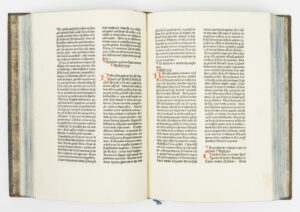
Printed in two columns in Gothic characters with 52 lines per page.
Nicolaus de Ausmo (or Nicolas d’Osimo), theologian and monk of the Order of Friars Minor, lived in the first half of the 15th century. He revised the Summa de casibus conscientiae, a casuistic summary composed in the 1330s by Bartholomew de Sancto Concordia, known as Pisanella, and first published it in 1473 under the title Supplementum summae Pisanellae.
Hans Koberger directed a branch of his uncle’s business in Barcelona, and the present volume is likely to be a witness to trade in Koberger books to the Iberian Peninsula, decorated and bound once there.
“At the end of the fifteenth century, the presence of booksellers and printers shows the entrance of Barcelona book professionals into the international trade networks. Between 1474 and 1500, at least nine foreign booksellers worked as representatives of foreign libraries (the German Hans Koberger and the French Nicolás Mazan) or as dealers of their own funds (the Castilian Martín de Marquina, Sebastián de Escocia, Adrián de Flandes the Germans Ciriaco de Basilea and Enrique Triber, the French Ramón Isach and Carmini Ferrer). Although export sales to France were made to a lesser extent, shipments of books to Palermo, Naples, Valencia or Majorca were common. The relationship between this Mediterranean city and Barcelona was direct. Valencian booksellers such as Gaspar Trinxer, Joan Huguet or Miquel Conrat had previously worked in the Catalan capital. In this network of exchanges between distant geographic areas and markets, the attraction exerted by the Italian book market, both in terms of consumption and production, stood out in the late fifteenth and early decades of the sixteenth century.” Manuel Peña Dìaz. Barcelona: Printers, booksellers and local markets in the sixteenth century.
One of the most interesting aspects of the Middle Ages in the Iberian Peninsula was, undoubtedly, the coexistence of the three cultures of the Book. Between 711 and 1609, Jews, Muslims and Christians shared a common space. Cohabitation generated multiple conflicts, but also unique cultural elements, among which Mudéjar art is the most renowned. Mudéjar craftsmen found on book covers an ideal medium for the display of their vast repertory of geometries, intricate interlaces and chiaroscuros. Moreover, they knew how to adapt to the new demands of the printed book, replacing materials and perfecting techniques, therefore smoothing the way for the transition towards the modern art of bookbinding. The name derives from the Mudéjares, or Moors, who remained in Spain during and after the Christian reconquest of that country.
“With Islamic decorative schemes: elaborate geometric interlace bands against a background entirely filled with hundreds of repetitions of small knotwork or cablework tools.” Paul Needham.
A magnificent book with an important bibliophilic provenance.
Provenance: a few contemporary annotations — [H.P. Kraus (collation note, 1960)] – John Roland Abbey (1894-1969; sold Sotheby’s, 21 June 1967, lot 2055; label on box).

![<span class="artist-name-product">NICOLAS DE AUSMO </span> Supplementum Summae Pisanellae. [Et:] ASTESANUS DE AST. Canones poenitentiales.](https://www.librairieclavreuil.com/wp-content/uploads/2026/05/nicolas-de-ausmo-supplementum-summae-pisanellae-et-astesanus-de-ast-canones-poenitentiales-5128-69fc8ad277d7f.jpg)