Borba de Moraes, Bibliographia brasiliana : I, pp. 470-471. – Rodrigues, Bibliotheca brasiliense, 1399 – Lestringant (Frank), Le Huguenot et le sauvage (Paris, aux amateurs de livres, 1990).
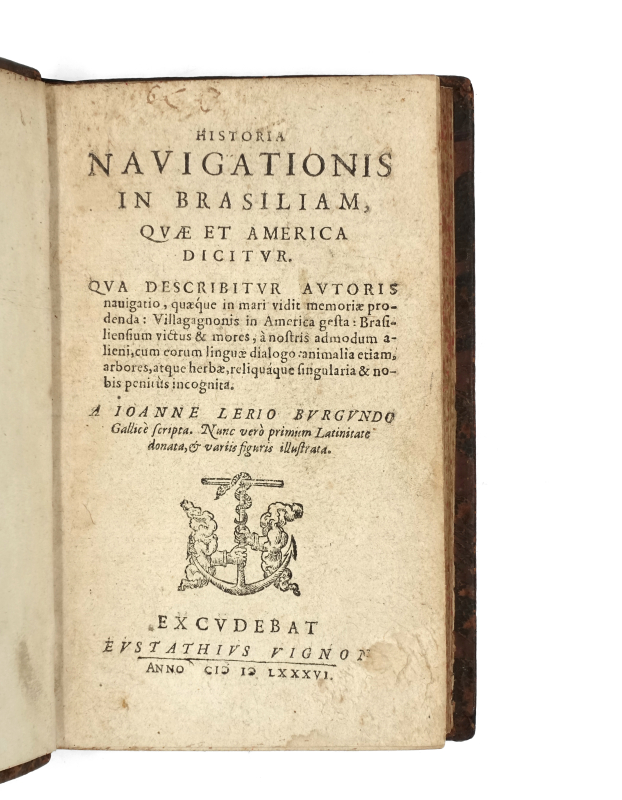
The original Latin edition of Jean de Léry’s famous account of his journey to Brazil in 1557.
Of humble origins, a shoemaker by trade and later an innkeeper, Jean de Léry (1536–1613) converted to Protestantism in the 1550s. Having received a solid religious education, he was sent to Brazil in 1556 as part of Nicolas Durand de Villegagnon’s expedition aimed at founding a Protestant colony in ‘France Antarctique’ (in Rio Bay).
Published nearly twenty years after Léry’s return, this compilation of “things seen” (the manuscript of which was allegedly lost by its author on two occasions and recovered in 1577) forms part of a broader Huguenot discourse strategy, establishing Léry as the spokesperson for the Protestant cause. The original French edition of this famous *Histoire d’un voyage fait en la terre du Brésil* — published in 1578, in La Rochelle (for Geneva?), by Antoine Chuppin — was followed by six editions during the author’s lifetime, up until 1611.
This original Latin edition is translated — perhaps by the author himself — from the third edition published in 1585.
From the preface onwards, Léry takes up the defence of the Protestant missionary project and accuses the Catholic cosmographer Thevet, author of the famous Cosmographie universelle published in 1575, of lies and plagiarism; by amplifying his descriptions of Brazil, Thevet was in fact implicitly disparaging the Reformed ministers and the ‘heretics’ of Villegagnon’s expedition.
A major text for the history of Protestant missions, this account is also essential for the ethnography of the Tupinambás of Brazil. The author provides first-hand observations on the flora, fauna and, above all, indigenous customs: hospitality (chapters V–VI), body painting (chapter VIII), monsters (chapter X), and polygamy (chapter XVII). The earliest Tupinambá musical notations, a rare and precious resource, are linked to invocations and religious rites (chap. XVI, with pp. 214, 219… Léry also describes warlike and ritual practices, including cannibalism (chap. XIV–XV: “They do not eat their prisoners out of hunger, but out of vengeance and to show the hatred they bear towards their enemies.”)
Comparing European violence to that in Brazil, his views are often considered too nuanced for the time, and sparked heated debates in Europe: “I maintain that there are among us cruelties far greater than those one might see among these peoples whom we call barbarians. ”
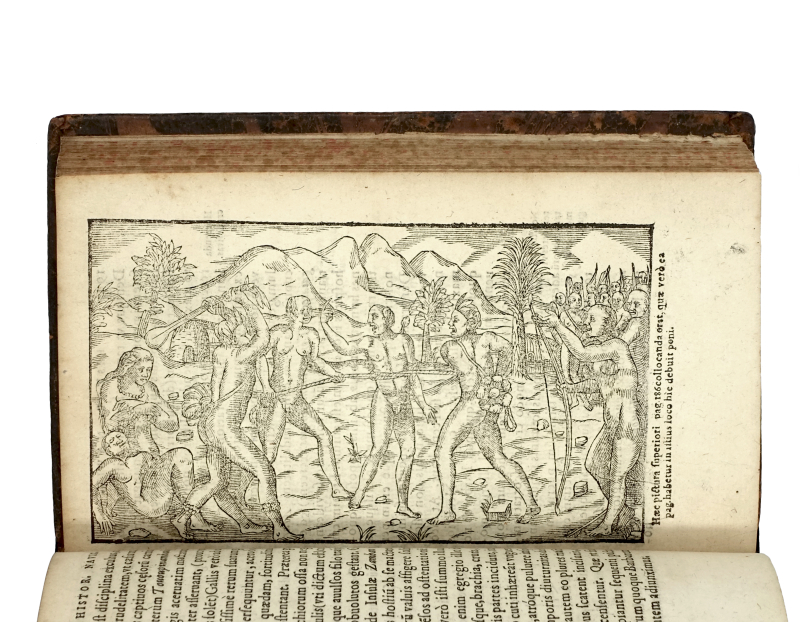
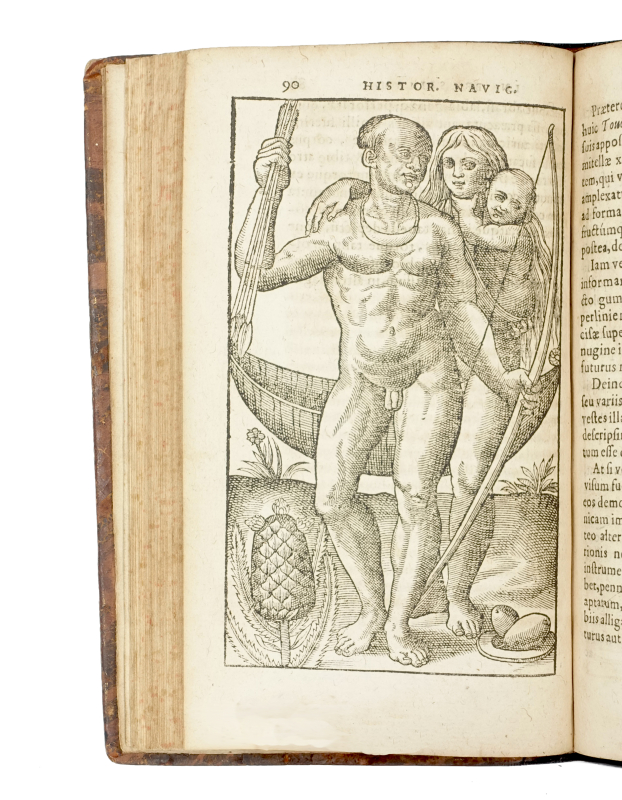
The work is illustrated with 8 woodcuts, three more than in the original French edition: naked indigenous people (women and men) armed, a battle, final rest in a hammock, a fantastical landscape with hybrid animals…
Pagination errors (no pages missing) on ff. Miv, Oviii, Sviii. Small angular losses without damage to the text or woodcuts: pp. 211–216, 252. Title page soiled, scraped (traces of annotations), lined; f. *ii, scraped in the lower margin; a few faint foxing spots; underlining on p. 331. Binding rubbed, spine re-bound.
Copy from the collection of the Brazilian writer and historian Rubens Borba Alves de Moraes (1899–1986). A professor and researcher, he directed the United Nations Library in New York; also a bibliophile, he is the author—among other works—of the famous Bibliographia brasiliana (with his bookplate).
Other previous owners: Mario Pimenta Camargo (bookplate): a collector of Brazilian art, he was director of the São Paulo Museum of Art (Masp) and a board member of the São Paulo Biennial Foundation and the Museum of Modern Art in New York.