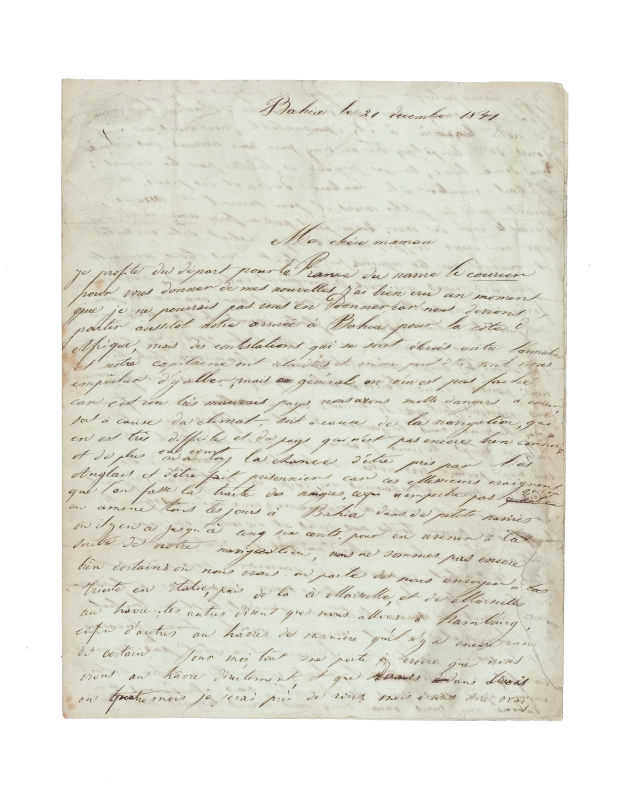
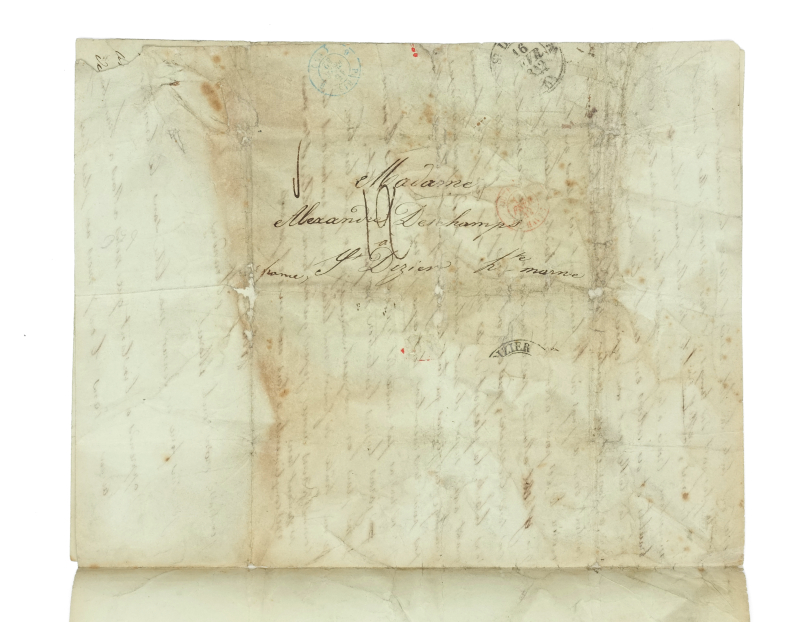
An important and rare letter written from Brazil in 1841 by a French traveller serving in the merchant navy: Alexandre Deschamps.
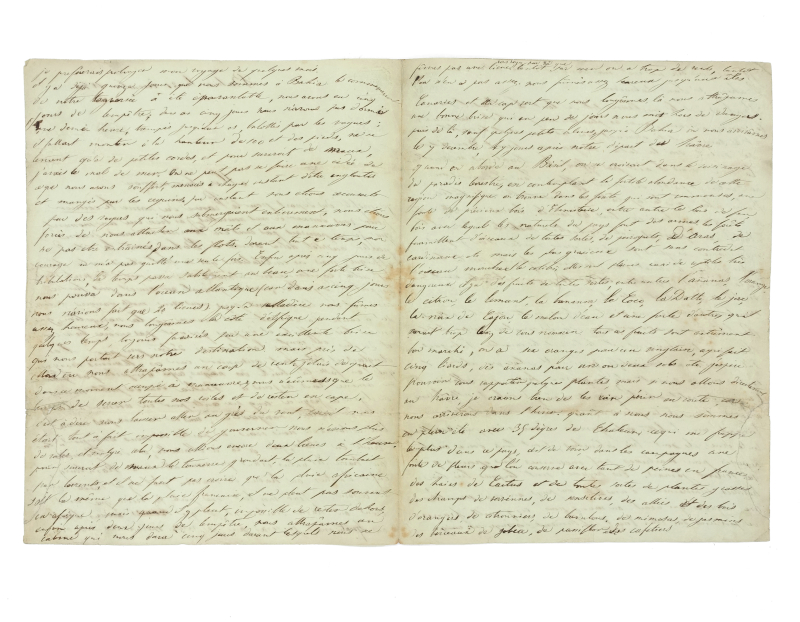
Deschamps writes to his mother, who lives in Saint-Dizier, France. He gives many details of the voyage to Brazil, including a stopover in the Canary Islands and then along the coast of Cape Verde. He mentions the return journey to Le Havre and his fears regarding disputes between the shipowner and the captain.
Another hazard mentioned is the British, who were then fighting against slavery via the West Africa Squadron: “on court la chance d’être pris par les Anglais et d’être fait prisonnier car ces Messieurs craignent que l’on fasse la traite des nègres, ce qui n’empêche pas qu’on en amène tous les jours à Bahia dans de petits navires où il y en a jusqu’à cinq six cents”. The British West Africa Squadron fought against the Atlantic slave trade by patrolling the coast of Africa. It is worth noting, for example, that HMS Black Joke, which joined the squadron after its capture in 1827, was originally a Brazilian slave ship, the Henriquetta, belonging to the Bahia slave trader José de Cerqueira Lima.
In the 1830s and 1840s, Bahia (Salvador) was one of Brazil’s major slave trading centres. Despite the legal ban on the slave trade in 1831, the region remained an important destination for African captives as part of a trade that had gone underground.
Alexandre Deschamps then goes on to describe Brazil in picturesque terms, noting in particular the fertility of the land («Bahia est le meilleur sol de tout le Brésil pour la canne à sucre » ; [“Bahia has the best soil in all of Brazil for sugar cane”]), and provides details of the landscapes: characterised by the presence « de haies de cactus et de toutes sortes de champs (…), des bois d’orangers, de citronniers, de bambous, de mimosas, de jasmins, (…) de passiflores et de cafetiers ; [“of hedges of cacti and all manner of fields (…), groves of orange and lemon trees, bamboo, mimosas, jasmine, (…) passionflowers and coffee trees”] ».
The young man is not immune to the racist stereotypes of his time: in his opinion, Brazilians are “très débauchés” because “ils ont tous deux ou trois négresses pour maîtresses”[very debauched’ because ‘they all have two or three black women as mistresses’]. . He also notes that « la mode (…) est de montrer sa poitrine, surtout dans ce pays où les femmes ont des seins qui leur poussent derrière le dos pour aller trouver la bouche de leurs enfants qui y sont attachés par une espèce de mantelet en soie écossaise [“the fashion (…) is to bare one’s chest, especially in this country where women have breasts that grow behind their backs to reach the mouths of their children, who are attached to them by a sort of tartan silk bib”.] ».
He is unsure whether to remain in the navy and is eager to return to his family in France; we do not know whether he ultimately managed to do so.
A valuable account of a Frenchman’s view of Brazil in the first half of the 19th century.
Paper restoration, some foxing and brown marks, some crease marks, small losses.