Bacchi della Lega, pp.22-23. ; Essling 1505 ; Sander 1088; Dusio, Cristina “De mulieribus Claris del volgarizzamento di Antonio di San Lupidio” in Dal Testo all’Opera, 2017, pp.13-26.
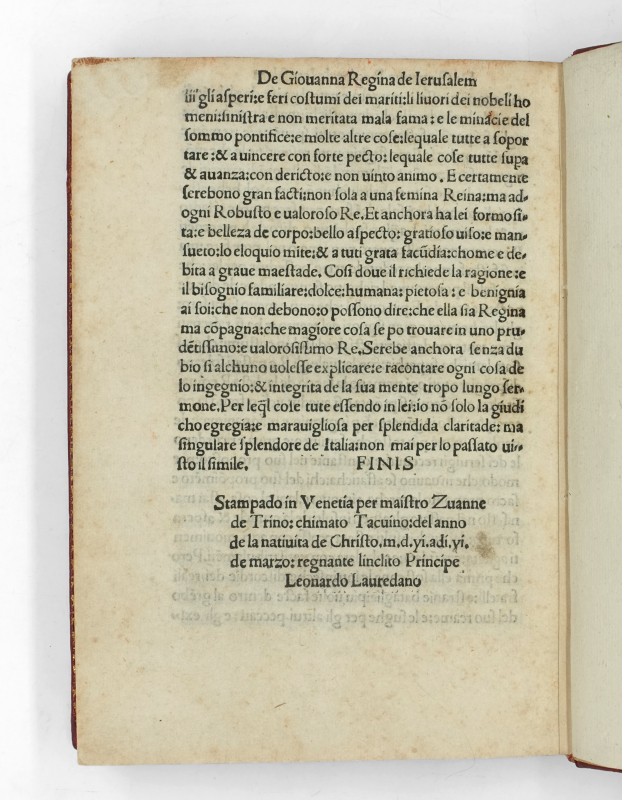
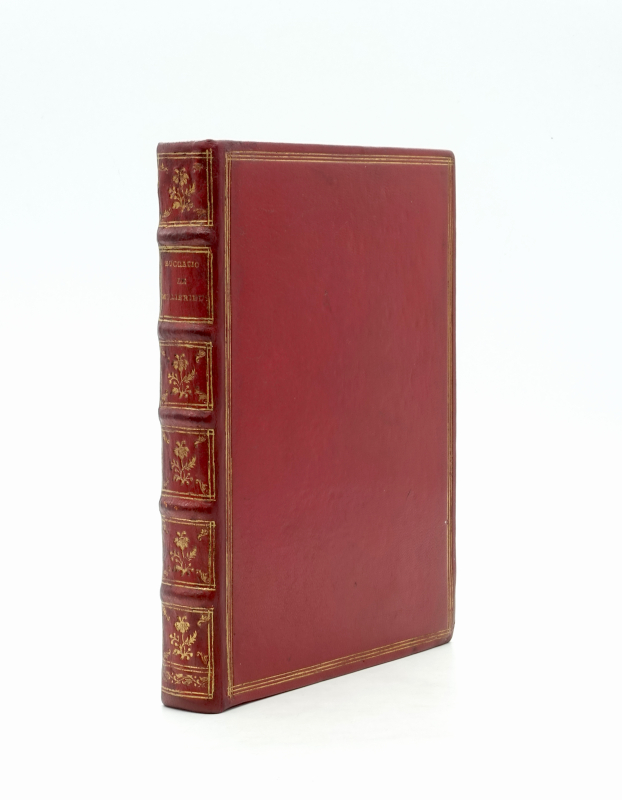
First Italian edition of the first work devoted exclusively to famous women. Illustrated with 105 beautiful woodcuts.
Compiled by Boccaccio around 1361–1362, this collection of portraits is the first to be devoted to remarkable women: historical, biblical and mythological figures, from Eve to Joan of Jerusalem, from Cleopatra to Pope Joan. Boccaccio depicts illustrious women, certainly, but not necessarily all of them virtuous. In his preface, he presents this collection as the counterpart to De viris illustribus, Petrarch’s collection of biographies of great men.
Circulating in the form of manuscripts—in Latin, Italian and French—this collection of portraits of women was a very popular work at the time. Christine de Pisan herself drew inspiration from it in 1405 for her anthology of talented and virtuous women, The Book of the City of Ladies.
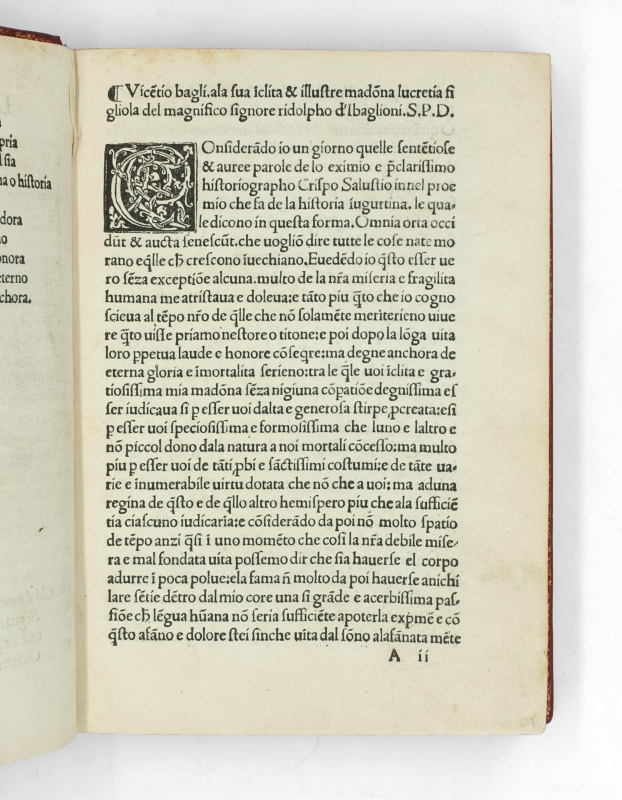
This first printed translation into Italian is the work of Vincenzo Bagli, whose biography remains poorly documented. Bagli was undoubtedly a humanist from the circle of the wealthy Baglioni family of Perugia; indeed, the work is dedicated to Lucrezia Baglioni, daughter of Ridolfo del Baglioni, Lord of Perugia.
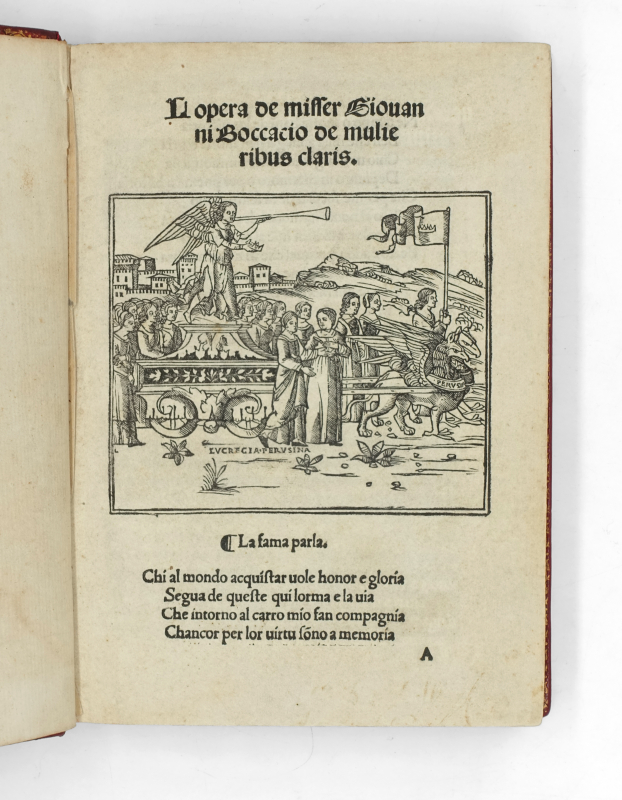
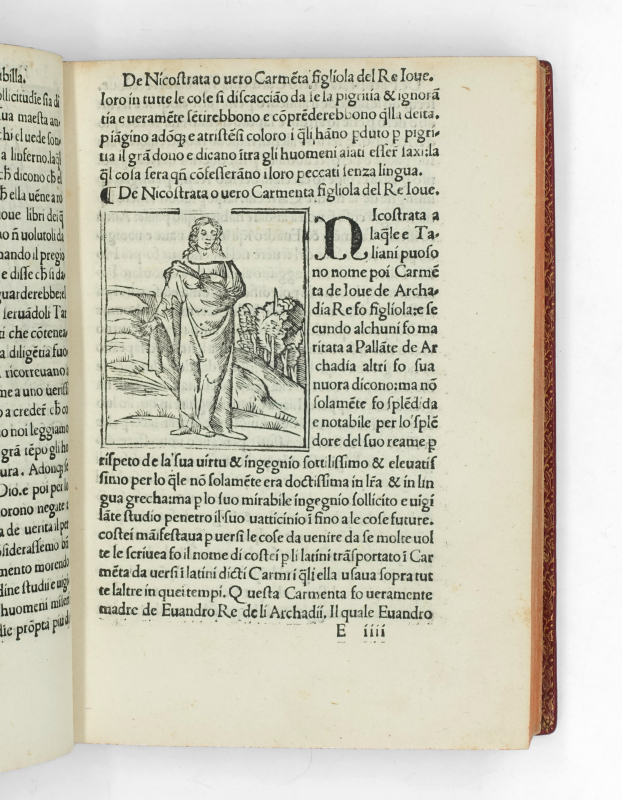
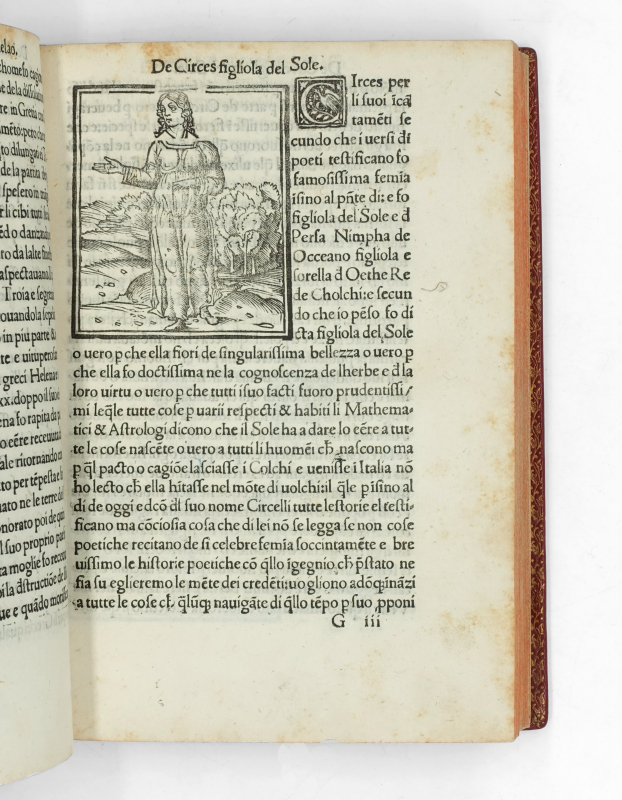
Printed in round type, this fine Venetian edition is illustrated with a large title vignette (113 x 95 mm) depicting the triumph of famous women, with Lucretia at the head of a chariot drawn by two griffins, and 104 woodcuts (60 x 73 mm) of individual female portraits.
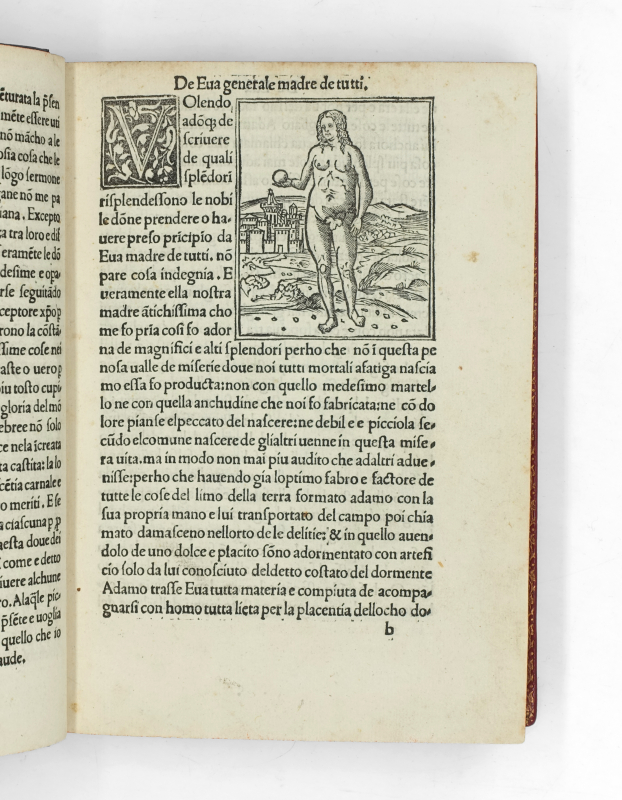
One observes not only the repetition of certain woodcuts (for example, a nude woman holding an apple is used to represent Eve and then, interchangeably, Venus), but also a further concern for economy: some woodcuts have been hollowed out to allow the insertion of interchangeable heads onto different bodies, or vice versa. It is surprising to encounter such techniques in a work of this category, which is otherwise of such fine quality.
“Boccace est le premier à consacrer, avec son De mulieribus claris, un recueil biographique aux femmes. Ce choix est d’autant plus significatif que Pétrarque venait de transférer au domaine historique, avec son De viris illustribus, le modèle du De viris de saint Jérôme. Pour Pétrarque, les hommes protagonistes de l’histoire romaine sont des exemples, et méditer sur leur vie doit conduire le lecteur à imiter leur vertu. L’histoire dans sa forme biographique (puisque le De viris est essentiellement une réduction de Tite-Live sous forme de biographies) a une valeur éducative. Au contraire, en choisissant pour son De mulieribus claris des femmes qui ne sont pas toutes des modèles de vertu, mais qu’il juge remarquables et exceptionnelles, et par là mémorables, Boccace transforme profondément le modèle du De viris illustribus en faisant prévaloir, au moins en partie, les finalités historiographiques et narratives sur celles exemplaires. Son écriture biographique subit l’influence du Décaméron où le genre du récit bref dépasse la logique de l’exemplum en présentant un fait remarquable dans son ambiguïté morale, offrant ainsi au lecteur la possibilité de juger par lui-même. Il en résulte une ambivalence qui n’est pas sans rappeler celle des Cent nouvelles : le De mulieribus claris, œuvre de défense de la femme, contient de nombreux topoi du discours misogyne et antiféministe. Nous y trouvons à côté de femmes fortes, entreprenantes, vertueuses ou courageuses, des femmes lâches, soumises aux désirs sensuels ou manipulatrices.”
(Bartuschat, Johannes. « Un panthéon de femmes exemplaires. Giuseppe Betussi, Boccace et les femmes illustres au xvie siècle ». In : Panthéons de la Renaissance, Élisabeth Crouzet-Pavan et al., Publications de l’École française de Rome, 2021).
Provenance : Ing. Roberto Almagia (1884-1962), Geographer and lecturer at the University of Rome from 1915 to 1959 (bookplate).
A few rare foxing spots and stains; trimmed a little short at the top.