
VENDU
2 large folio volumes (400 x 296 mm), Dimensions of the leaves: 392 x 290 mm. 250 ll. (last blank) [a-k10 l-m12 n–x10 y-z12 A12] for volume 1 and 247 ll. [B-G10 H12 I-L10 M12 N11 + stub, O-T10 V-X12 Y-Z10 aa10 bb8 ; I10 and bb7-8 blanks] for volume 2. (Blank leaf I10 is unknown to Gesamtkatalog, but properly described by Goff and CIBN) ; Printed on 2 columns, 45 lines, type 1 : 126G. Contemporary pigskin over bevelled wooden boards, blind-stamped decoration on the covers, remnants of handwritten title labels, vellum bookmark preserved in t. I (ff. 225-226), original parchment reinforcements holding the bottom of the quires, fragments of vellum manuscripts reused in the endpapers, engraved clasps.
1 in stock
GW, 4205 ; ISTC, ib00530000. Hain, *3037 ; Goff, B530 ; Pellechet, 2274. CIBN, t. A-B, 297. Darlow-Moule, 1911, p. 908. Delaveau-Hillard, p. 121. Regarding the printer : François Ritter, Histoire de l’imprimeir alsacienne aux XVe et XVIe siècles, Strasbourg-Paris, 1955, p. 36-44. Ferdinand Geldner, Die deutschen Inkunabeldrucker I, Das deutsche Sprachgebie, Stuttgart, 1968, p. 55-56, 60-62. F. Geldner, « Eggesteiniana », dans Festschrift H. Widmann, 1974, p. 52-69. Christine Muller, « L’imprimeur strasbourgeois Heinrich Eggestein (XVe s.) : éléments de biographie », Annuaire de la société des amis du vieux Strasbourg, 33 (2008), p. 15-72. Regarding the illumination and provenance : Margaret Lane Ford, Bibliotheca Philosophica Hermetica, 1990, n° 40, p. 88-89 (et la planche). Eberhard König, « New Perspectives on the History of Mainz Printing. A Fresh Look at Illuminated Imprints », dans S. Hindman, Printing the Written Word. The Social history of books c. 1450-1520, Ithaca-Londres, 1991, p. 143-173 (avec repr. d’1 feuillet de notre exemplaire, fig. 5.2). E. König, « Augsburger Buchkunst an der Schwelle zur Frühdruckzeit », dans Gier et Janota (dir.), Augsburger Buchdruck und Verlagswesen, Wiesbaden, Harrassowitz, 1997, p. 173-200, avec reprod. d’1 feuillet de notre exemplaire en pl. 12). Sheila Edmunds « New light on Johannes Bämler », Journal of the Printing Historical Society, 22, 1993, p. 29-53. Christine Beier, « Missalien massenhaft. Die Bämler-Werkstatt und die Augsburger Buchmalerei im 15. Jahrhundert », Codices manuscripti, n° 48-49, 2004, p. 55-72. C. Beier, « Producing, buying and decorating books in the age of Gutenberg. The role of monasteries in central Europe », dans B. Wagner et M. Reed (dir.), Early printed books as material objects, De Gruyter, 2010, p. 65-82.
First edition of Heinrich Eggestein’s Latin Bible, published barely ten years after Gutenberg’s Bible. It is the fifth Latin Bible ever published. This 45-line Bible is the first work to come of the press of Eggestein, the second typographer to introduce printing to Strasbourg after Johannes Mentelin, and the second Bible printed in Strasbourg.
Heinrich Eggestein and the beginnings of printing in Alsace
After studying at the University of Louvain, Heinrich Eggestein (Rosheim, c. 1415-20 – Strasbourg, after 1494) settled in Strasbourg, where his presence is attested from 1438 onwards. According to François Ritter (Histoire de l’imprimerie alsacienne aux XVe et XVIe siècles, 1955), Eggestein was hired in 1440 as seal keeper by Bishop Robert of Palatinate-Simmern, who also employed Johannes Mentelin. In 1442, he is mentioned in the Helblingzollbuch as a practitioner of law (‘Nachconstofler’) in Strasbourg, along with Gutenberg, who stayed in the city from 1434 to 1444, where he probably carried out his first experiments with printing using movable metal type. It is likely that Eggestein travelled to Mainz in the 1450s to learn the art of printing from Fust and Schoeffer, Gutenberg’s successors, although there are no sources documenting this stay. On his return to Strasbourg, where J. Mentelin had introduced printing, he resumed his position as keeper of the seals in July 1461; he was dismissed in 1464, when he set up his own workshop. In March 1466, he obtained a letter of protection from Frederick I, Elector Palatine and Landgrave of Alsace, for himself and his staff, mentioning his activity as a printer and bookseller.
His printing shop was located either in the family home on Rue des Pucelles, opposite Place Saint-Etienne, or in the ‘Dummenloch’ (Rue Thomann) (see Ritter, p. 40). Today, there are approximately 90 publications recorded as having come off his presses until 1483. He began dating his works in 1471. His varied output (including bulls and almanacs) is nevertheless distinguished by a strong representation of legal works, and his editions of Gratian’s Decretum and Justinian’s Institutes were successful. He did not neglect the field of spirituality, with Adrien le Chartreux’s Liber de remediis utriusque fortunæ (1470) and Ludolph of Saxony’s Meditationes vitæ J. Christi (1484). He seems to have initially targeted the ecclesiastical market in Alsace and southern Germany to sell his Bibles. However, he was able to reach other audiences, particularly schools, with the publication of Donatus’ Ars minor (1470) and Guillaume Tardif’s Grammaticæ basis, c. 1472. He used advertising leaflets, probably posted on iconic monuments, to announce his publications (a copy is preserved in Munich; see Christine Muller, 2008, p. 42). The end of his career seems to have been marked by debt problems. From 1478 to 1481, he was sued by the Basel paper manufacturer Anton Gallizian for unpaid debts. In 1483, he renounced his citizenship for the second time. It has been suggested that he moved his presses to another city, but this has not been confirmed.
Text
The text of the Bible is printed in two columns of 45 lines. This is the first Bible printed by Eggestein, who published three in total – the next two appeared in 1468 and 1470 – with the last one featuring textual changes following a revision. The Bible, which went on sale in the spring of 1466, was produced using Eggestein’s first typeface, type 1, 126G according to Haebler’s classification. It is a semi-Gothic or ‘Gothic-Antiqua’ typeface, between Gothic and Carolingian, inspired by Peter Schoeffer’s typeface for Durand’s Rationale in Mainz in 1459 (see Gotico-Antiqua, proto-Roman, hybrid – 15th-century typefaces between Gothic and Roman, Dijon, 2021). Eggestein used it only for printing his Bibles and the Auctoritates utriusque Testamenti.
Eggestein’s Bible brings together the texts of the Old and New Testaments in the Vulgate; the Old Testament is preceded by St Jerome’s letter to Paulinus of Nola and the prologue to the Pentateuch, which gradually disappeared from Bibles in the 16th century under Protestant influence. Volume I comprises the books of the Old Testament from Genesis to the Psalms, while volume II opens with the Proverbs of Solomon and includes the end of the Old Testament up to the books of Maccabees; the New Testament begins on f. 147v, with the two prologues to Matthew, and ends with the Apocalypse of John, which closes the volume. The four books of Ezra are present, whereas in most manuscripts of the Bible, the second book of Ezra is considered apocryphal and, as a result, is not copied (see C. de Hamel, La Bible histoire du livre, Phaidon, p. 201). The basic text is certainly a copy of Gutenberg’s 42-line Bible.
The anonymous rubricator systematically marked the incipits and explicits of the biblical books in red. It was not until the 1470s that rubrics were systematically printed. As in the Chantilly copy (Musée Condé), minor errors were made in the Book of Ezra, which were subsequently corrected (incipit and running title). The rubricator was forced to place the rubric indicating the 22nd verse of Matthew in the margin (vol. II, f. 156v), as the printer had not provided for an indentation, as in Gutenberg’s Bible (Scheide-Bryan, Gutenberg-Jahrbuch, 1962, 117-121). He omitted to transfer the incipit of the Gospel of Luke and, similarly, the explicit of the Epistle of James and the incipit of the Epistle of Peter.
Illumination
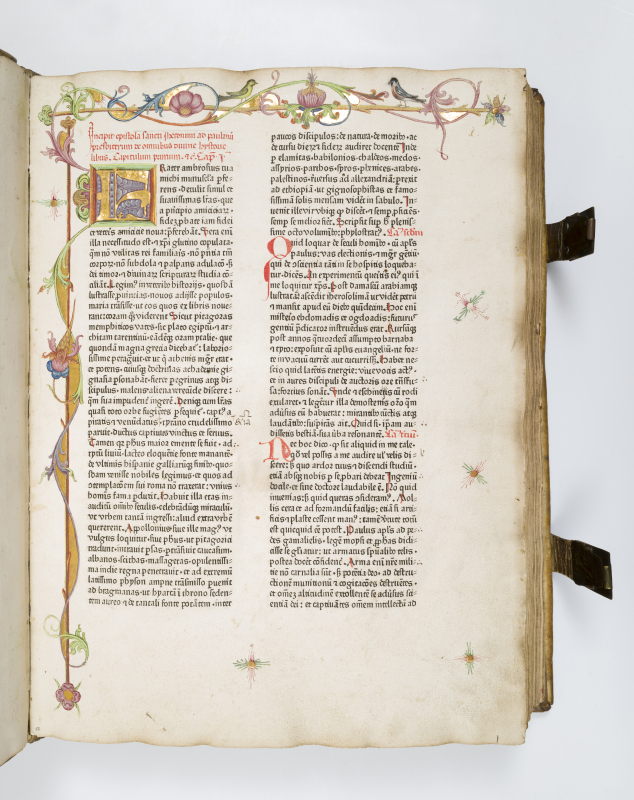
The illumination of three leaves (first leaf of each volume and beginning of Genesis) is attributed by Eberhard König (cat. Kraus 1986 and König 1997) to Johannes Franck (†1472), a monk at St Ulrich and St Afra Abbey in Augsburg who produced the illumination of antiphonaries and a manuscript of Sigmund Meisterlin’s Chronographie des Augustins. This attribution has been endorsed by Margaret Ford (1990). Around the middle of the 15th century, this Benedictine abbey was one of the most influential monasteries in southern Germany under the enlightened abbacy of Melchior van Stammheim (c. 1410-1474), who established a scriptorium there and also encouraged the acquisition of printed works. It is possible that our copy and its illumination were produced at his instigation.
The initial leaf of each volume features an illuminated border of acanthus leaf scrolls, simple in vol. I and also occupying the intercolumn in vol. II, with curling tendrils, supporting stylised birds and flowers. The treatment of the birds, with a varied colour palette, reveals a naturalistic approach. The illuminator created two large initials in the ‘May flowers’ (Maiblumen) style on six lines for the two leaves that open each volume and a large initial extending over the entire height of the column for the beginning of Genesis, with an extension of foliage. They were executed in brown gold, polished and punched, which gives them a particular depth (F at the incipit, I from In principio opening Genesis and P from Parables of Solomon) (see M. Ford 1990). Gold highlights add sparkle to the vine branches, and small radiating dots adorn the margins. It has been argued that the I in the Parables is similar to the initial letter drawn by the Augsburg artist Heinrich Molitor in a copy of Mentelin’s Latin Bible, c. 1460 (Vienna, ÖNB, Ink 3.C.3, see König, 1997, pp. 191 and 195, pl. 10). The opening page of the second volume is particularly noteworthy: the loops and the lines of the foliage are executed with great skill and punctuate the reading of the page, with attention to detail particularly evident in the vine that seems to escape from the frame.
The two large initials that open each volume are set in a two-colour frame, forming contrasting colour combinations (green and brown; blue and pink). This border became a signature feature of Augsburg illumination around 1470. The freshness of the colours is particularly noteworthy.
A great deal of calligraphy and rubrication work has been carried out. Large puzzle initials in blue, red, green or lavender are sometimes decorated with watermarks or embellished with grotesque heads. The work shows similarities with the style of Johann Bämler, a scribe and illuminator active in Augsburg in the years 1450-1480, who enhanced manuscripts and incunabula (see S. Edmunds & C. Beier 2004 and 2010): it can be compared to the decorative repertoire of the Eggestein Bible preserved in Wolfenbüttel, signed by him (Herzog August Bibliothek, Bibel-Slg. 2° 155). It is established that he rubricated incunabula from the Mentelin and Eggestein presses in the late 1460s. In our copy, the collaboration of two artists cannot be ruled out. The Lombard initials of two lines, the incipits, the running titles and the chapter numbers are rubricated in red ink; the capitals of the printed text are also highlighted in red.
Paper
Eggestein mainly used paper from a mill in Piedmont, in the Turin region, which supplied Gutenberg and Mentelin. The vast majority of the leaves bear the famous watermark of an ox’s head surmounted by a star (see P. Needham, ‘Johannes Gutenberg and the Catholicon Press,’ Papers of the Bibliographical Society of America, 1982, p. 401, which indicates that this is state VI of this watermarked paper). In our copy, a few sheets are watermarked with a crown (crown surmounted by a Latin cross transformed into a spearhead, with two half-florets and two bands at the border), a motif previously catalogued by Paul Heitz from the Eggestein Latin Bible kept in Strasbourg (reference K 693, see Les filigranes des papiers contenus dans les incunables strasbourgeois (…), no. 168, p. 17 and pl. VI). Briquet (Les filigranes, dictionnaire historique…, no. 4646) identified it in documents from Azeglio, in Piedmont, dated 1473. As J. Herbert Slater noted from another copy, this paper is appropriately (by happy coincidence?) used for the Book of Kings (Handbuch für Büchersammler, 1906, p. 63). The endpapers feature a watermark with a triangular balance scale motif inscribed in a circle.
Binding
The Bible is preserved in its original binding of embossed pigskin on wooden boards: it was made by an anonymous workshop in Augsburg in the late 1460s, the ‘Kreuz frei’ workshop (Kyriss, Verzierte gotische Einbände, no. 89, I, pp. 76-77 and II (2), pl. 181-182), also known as ‘Kreuzblumen Buchbinder’ (‘the cross-flower bookbinder’: Schunke, Die Schwenke-Sammlung, II, 1996, pp. 9-10 and entries in the Einbanddatenbank). According to Kyriss, this workshop was active between 1447 and 1469. The dies used feature repeated motifs of scrolls bearing the name ‘Maria’ (Kyriss 89-2), rosettes (89-3) and palmettes (89-6). The surviving engraved clasps bear the prayer to the Virgin Mary ‘Sancta Maria ora pro [nobis]’. Another copy of the first Eggestein Bible, preserved in Vienna, was bound by the same workshop (a common palmette motif iron: Vienna, ÖNB, Ink 1.C.6). The endpapers of both volumes contain fragments of manuscripts dating from the 11th to the early 15th century. There are extracts from a breviary from the late 11th century with the remains of an illuminated initial (prayer “Præsta, quæsumus omnipotens deus… ), a breviary including the end of the Visitation (15th century), and folios from another breviary (second half of the 14th century) with an addition of the sequence for the dead in a more cursive hand.
Rarity
The ISTC (Incunabula Short Title Catalogue) lists around forty copies, many of them incomplete, of the first Eggestein Bible in institutions, but it is extremely rare on the market. The Rare Book Hub database lists only two incomplete copies that were sold at public auction in the 20th century: one from an anonymous sale in London, Sotheby’s, 16 June 1937, no. 647, and one from the Earl of Ilchester, sold at Hogdson’s in 1947. To these must be added the sale of Lord Aldenbam, also in 1937 (first part, no. 36), a copy now in the Bancroft Library in Berkeley, also incomplete. An examination of the private market reveals the Scheide copy, complete, sold by bookseller Paul Gottschalk to John H. Scheide in May 1935 and now in the Scheide Library in Princeton (cf. Needham, The Invention and early spread of European printing as represented in the Scheide Library, 2007, p. 32, no. 23). It is preserved in a 16th-century embossed pigskin binding. Several copies in institutions are preserved in later bindings (the Metz copy has retained the covers of the 16th-century binding but with an 18th-century spine, while the Duke of Aumale’s copy in Chantilly has a 19th-century binding, as does the Manchester copy bound for Lord Spencer).
This copy was delicately illuminated and rubricated in Augsburg shortly after printing and is preserved in its imposing embossed binding from the period. It has appeared in the collections of distinguished bibliophiles, starting with Henry Perkins, who owned a copy of Gutenberg’s Bible.
Contemporary numbering of the quires, later old foliation.
A few old annotations on ff. 1 to 3 of volume I.
Claps partially redone (3 fasteners and one clasp redone). Metal bouillons and umbilics missing. Rare small foxing and marginal browning (notably f. 114 of vol. I and f. 103 of vol. II), small stains on ff. 164, 209-210 of vol. II, worm damage on the covers of the binding, minor worm damage on the first 10 ff. of vol. I, and at the end of vol. II. Slight paper defect at the bottom of f. 164 in vol. I and small tear on the flyleaf of vol. II. The bookbinder did not preserve the two folios of instructions for rubrication. This is also the case in the Scheide copy (Princeton) and in that of the Duke of Aumale (Chantilly).
Provenances
Augsbourg, abbaye St Ulrich et Ste Afra ( 17th or early 18th century manuscript note on first leaf of volume 2) – Henry Perkins (by descent his son Algernon Perkins) (Perkins sale, 1873, lot 181) – Sir Thomas Brooke (Engraved book plate), his sale Catalogue of the manuscripts and printed books and printed books, Londres, 1891, vol. I, p. 53) – Rev. W. Ingham Brooke (manuscrit provenance dated 1908, his sale : Catalogue of a small collection of fine illuminated manusripts and rare early printed books, Londres, Sotheby’s, 7 mars 1913, lot n° 3) – Charles S. Ascherson, 1913 (engraved book plate, collection sold en bloc to Bernard Quaritch in 1945) – Quaritch, cat. 637, 1946, n° 554 – Paul Hirsch (collation note dated 1946 and mss note dated September 1946 mentionning that he offered the book to his wife Olga) – Lew D. Feldman (House of El Dieff), cat. Fortieth anniversary, 1974-1975, n° 2 – Kraus, cat. 173, 1986, n° 12 – Joost Ritman (book plate « Bibliotheca Philosophica Hermetica », purchased from H.P. Kraus in 1988) – French collector.

Monday to Saturday
10am – 1pm and 2:30pm – 7pm
(6pm Monday and Saturday)
© 2023 All rights reserved.