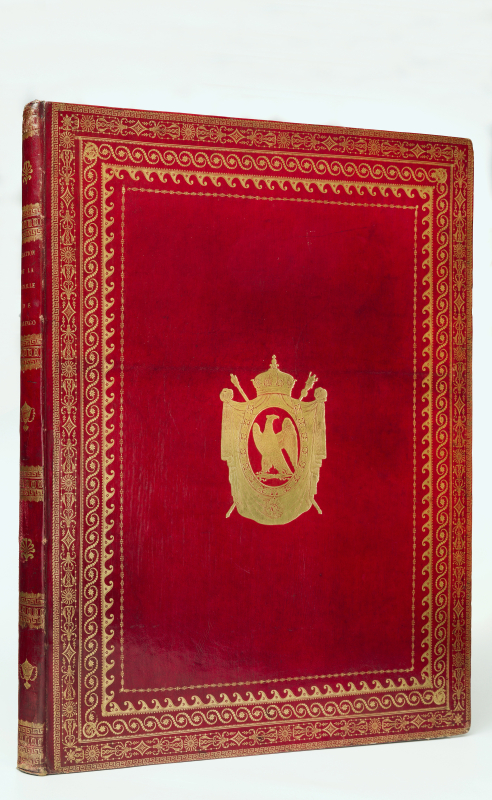
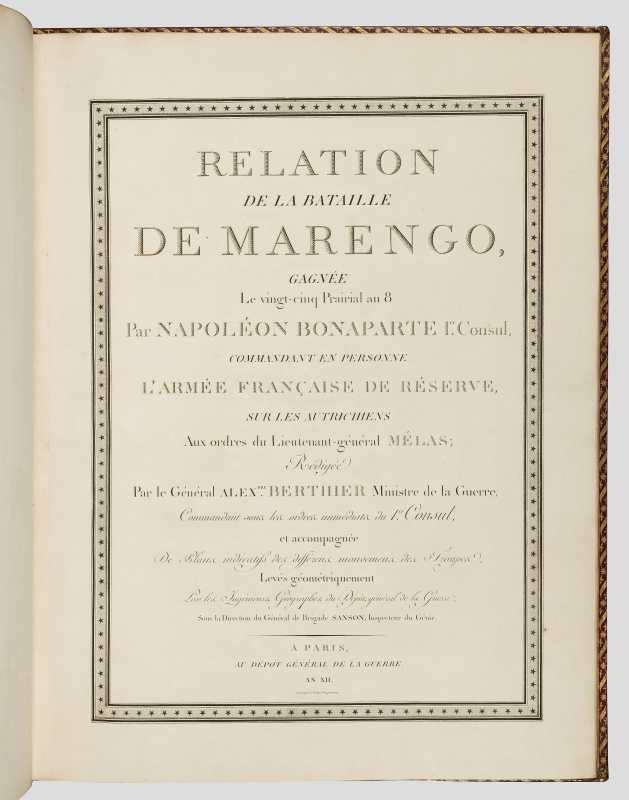
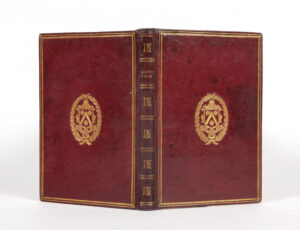
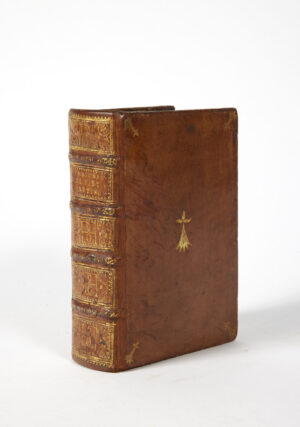
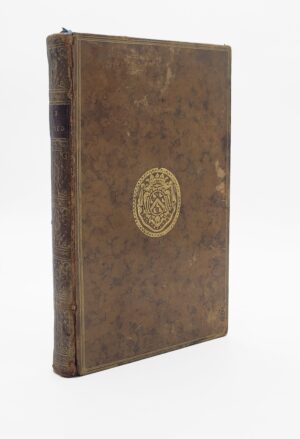
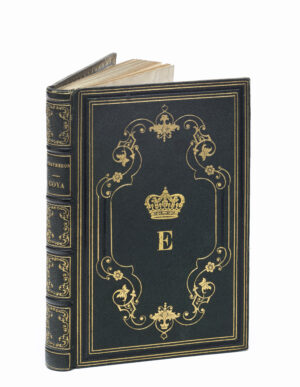
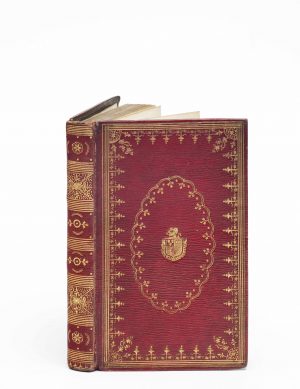
First edition of this famous work devoted to one of the great achievements of the Italian campaigns. A sumptuous presentation copy, printed on large vellum paper in very large folio format and bound in red morocco with the emperor’s coat of arms.
Like the Tableaux historiques des campagnes d’Italie (Historical Tables of the Italian Campaigns), to which it is in a way complementary, this Relation de la bataille de Marengo (Account of the Battle of Marengo) is one of the very first literary or artistic monuments commissioned by Napoleon to establish his power and forge his legend. After a brief laudatory review of the first campaign and the Egyptian expedition, Berthier describes in detail the course of this decisive but long and uncertain battle, attributing all the credit for the victory to Bonaparte’s skill.
We know that the French army, forced to retreat in the face of superior Austrian forces, was saved at the last minute by the providential arrival of Desaix’s reserve corps, who was killed in action. If we are to believe Berthier, this retreat was in fact nothing more than a clever trap set by the First Consul to lure the enemy into revealing themselves and better encircle them thanks to Desaix’s planned and calculated return. Whether justified or not, this version served to reinforce the image of Bonaparte as invincible and indispensable to the fatherland. His power, which was still fragile at the time, was definitively consolidated, and the victory at Marengo, magnified by Berthier, not only gave France definitive control over northern Italy, but also opened the way to the coronation.
Dated 1804 (Year XII) on the title page, the work was not published until the following year and presented to Napoleon “on the field of Marengo on 25 Prairial [14 June] Year 13, the anniversary of the Battle,” as indicated in Berthier’s dedication to the Emperor. It took nearly five years to complete, with the text changing, as in the Tableaux, as the hero’s status evolved.
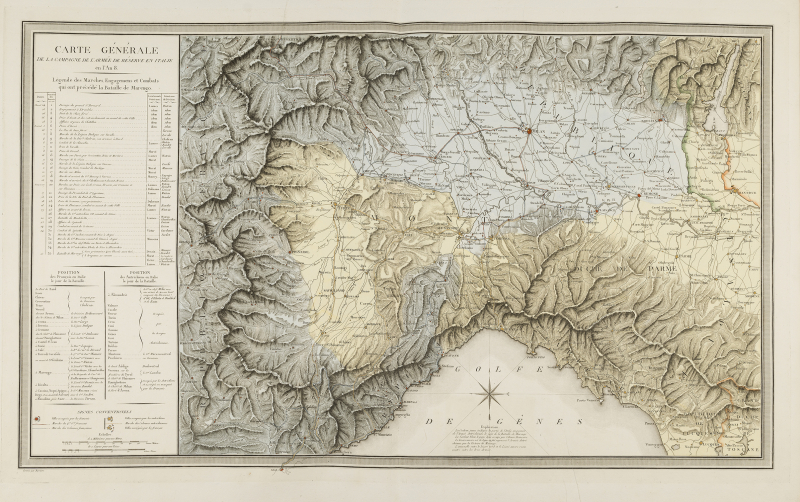
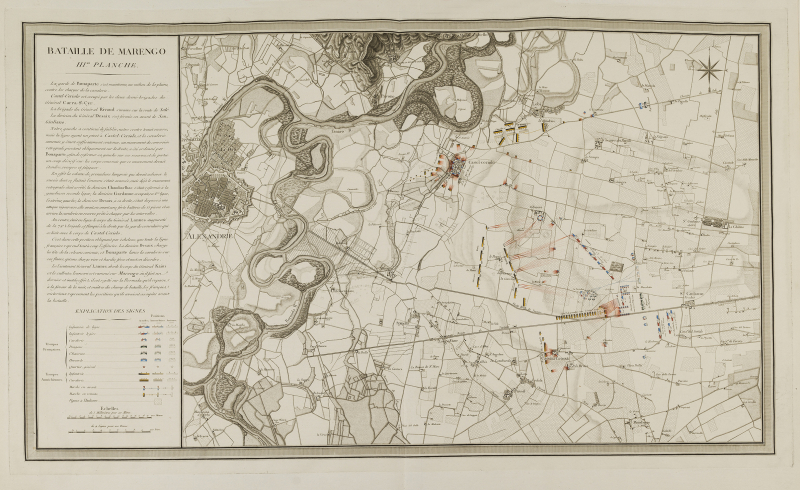
The volume is superbly illustrated with a general map of the campaign in two versions, one entirely coloured, the other in black, and four double-page plates describing the battle in its different phases, with colour highlights tracing the movements of the troops. All the pages are presented in a starry frame.
Entrusted to the Imperial Printing House, this edition was published simultaneously in quarto format, for civil servants and opinion leaders, and in octavo format for wide distribution in the provinces.
A small number of copies were also printed on vellum paper in very large folio format (25 according to Brunet), luxury copies such as this one, intended as gifts for certain selected dignitaries of the State. These sumptuous copies, now very rare, were mostly bound in red morocco (green for the one at Malmaison) and decorated identically, probably by Bizouard, one of Napoleon’s favourite personal bookbinders (cf. Culot. Le décor néo-classique des reliures françaises du Directoire, du Consulat et de l’Empire).
This copy was presented to Joseph Marie Portalis (1778–1858), whose armorial bookplate appears on the inside front cover. Then a young master of requests at the Council of State, Portalis, who was made a count of the empire in 1809, was the son of the famous jurist Jean-Etienne Marie Portalis, one of the drafters of the Civil Code. The Emperor, who greatly appreciated his father, showered him with favours before disgracing him in 1811. Returning to court in 1813, he went on to have a brilliant career as first president of the Court of Cassation, served for a time as Keeper of the Seals, then as Minister of Foreign Affairs during the Restoration, and ended his career as a senator during the Second Empire.
Magnificent copy, in very fresh condition.
Provenance: Edouard Rahir (I, 1931, no. 31) – Cortland Bishop (not in the catalogues), with bookplates – French private collector.