
VENDU
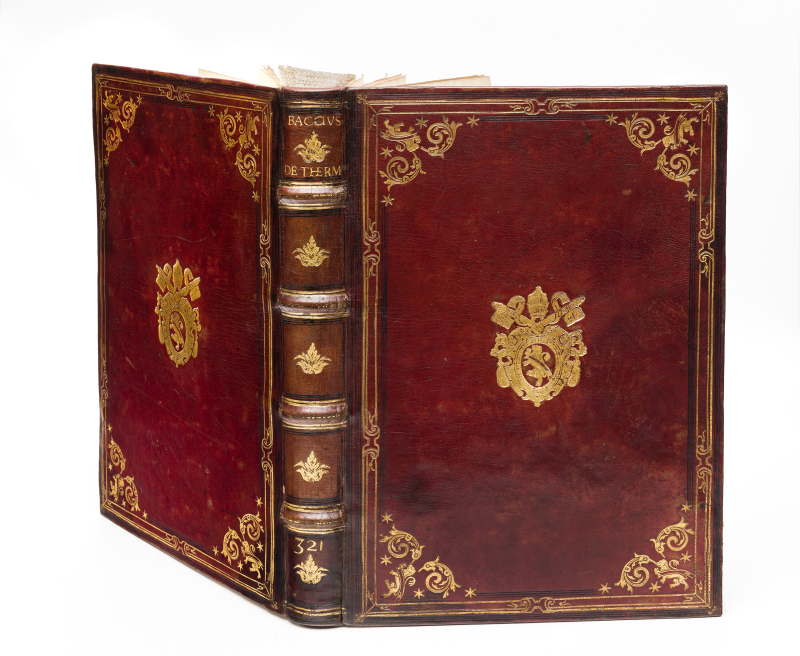
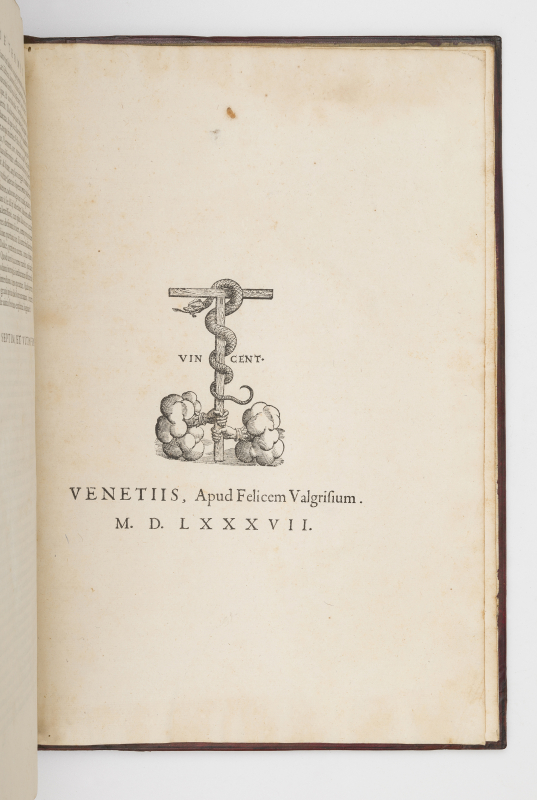
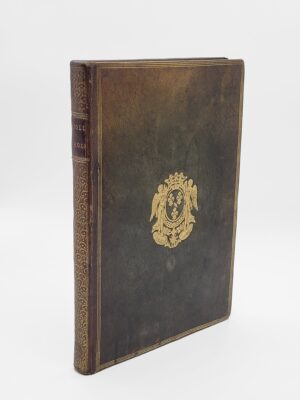
Folio (361 x 242 mm) 24 nn.ll., 492 pp., 1 nn.l. (printer’s device). Contemporary red morocco, decorative git and blind-stamped borders on covers, central coat of arms of Pope Sixtus V, large gilt corner pieces including the armorial device of Pope Sixtus V (a lion), spine with raised bands, compartments gilt with title and a large floral tool, gilt edges (some light wear, upper hinge partially split).
1 in stock
Durling, 427 ; Adams B-6 ; Carrère, 97 ; Neville, 55 (note). Voir Garrison-Morton 1986.2 ; Duveen, 35 ; Simon, Bacchica, 66 ; Wellcome, 600 (tous pour l’édition originale de 1571).
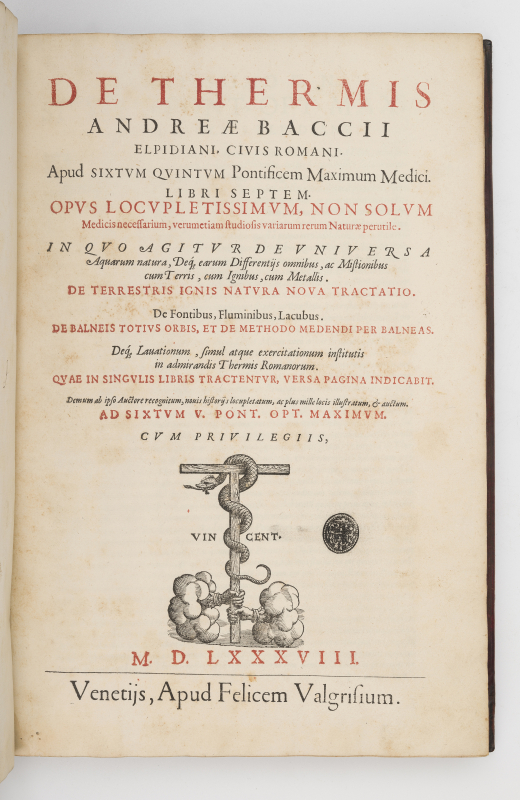
Second edition, the first to be dedicated to Pope Sixtus V (1521-1590), whose personal physician Bacci was. An exceptional presentation copy, bound with the arms of the Holy Father.
This edition is augmented by a treatise on terrestrial fire (De terrestris ignis natura) as well as a large number of additions by the author (…ab ipso auctore recognitum, novis historiis locupletarum ac plus mille locis illustratum, & auctum).
The text begins with a general study of the importance of water for life (‘Aqua primum omnium rerum principium’), followed by a description of oceans, seas, rivers and other aquatic places (“De mari, & ut ab eo communissima sit omnium aquaraum, ac Fluviorum origo”). Another chapter deals with the movement of water and its quantity in relation to the earth on the globe (“De motu aqua, situ, altitudine, & proportione cum terra”); Bacci also studies the ebb and flow of the seas in general (“Maris fluxus naturalis”; “Aestus fluxus et refluxus”) as well as local exceptions (“Persici maris” ; Atlanticum mare sine aestu’), followed by descriptions of disasters linked to earthquakes or other causes (“De maris Inundationibus”), describing floods in the British Isles, Flanders, Sicily, and other places, including descriptions of the damage caused by the overflowing of the Tiber in Rome.
The second part deals with details of the treatment of illnesses by mineral waters in general; part three discusses the remedies obtained by thermal waters, not forgetting the accidents that can occur; book four deals with the health benefits of sulphurised thermal baths; book five is devoted to the various mineral baths known since ancient times (“Aquarum mediorum mineralium conscribuntur”); chapter six deals with chemical composition (“historia aquarum ex metallis agitur”); the seventh and final chapter gives a history and details of Roman thermal baths since antiquity, as well as their uses, including private baths (“de balneis artificialibus privatis”). Swimming is also discussed (“De natatione”, p. 440), as are the medicinal effects of all kinds of baths, including the wine bath “De Balneis ex Vino” (p. 491).
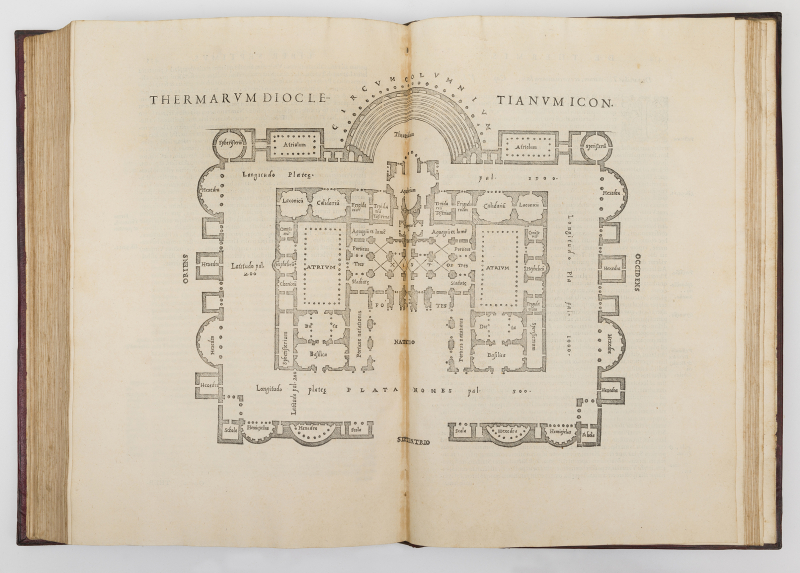
This work, perfectly printed by Valgrisi, is adorned with a large double-page woodcut plan with details of the Baths of Diocletian (between pp. 435/436). The illustration on page 443 shows details of a three-tiered boiler on which bathers could use hot, warm and cold water. This boiler was installed on the Hypocaust, which was an important part of the heating system in the baths.
“Cet ouvrage traite de la nature des eaux en général, de leurs différences, de leur mélange avec la terre, le feu & les métaux. On y trouve encore des notions sur la nature & les propriétés du feu terrestre, sur les fontaines, les fleuves, les lacs, & les bains de tout l’univers (au moins ceux que l’auteur connaissait) sur la manière de faire usage des bains pour la guérison des maladies, sur la manière de se baigner chez les Romains & leurs exercices, & sur les eaux thermales sulfureuses” (Carrère).
“Bacci ne donne pas seulement une liste des eaux thermales connues au XVIe siècle, mais il fait aussi l’éloge d’un certain nombre de vins” (Simon).
“A comprehensive study of mineral waters, dealing with all the spas of the then-known world. Besides exhaustive coverage of the baths of antiquity and of Bacci’s own time, the work gives considerable attention to wines, especially in relation to their medical use” (Garrison-Morton).
“The ‘classic work on mineral waters, dealing with all the spas of the then known world’ (Duveen).
“Bacci (1524-1600) of St. Elpidio in the Anconian Marches, was a professor of botany and physician to Pope Sixtus V, but he dissipated his fortune and was pursued by creditors until he sought asylum with cardinal Ascognio Colonna. By far his most chemically important book is the De Thermis. Bacci quotes many ancient authors and states that some mineral waters contains sulphur, alum, metals, salts, soda, vitriols, bitumen, and petroleum, while others contain gold, tin, lead, and zinc. Wines and their medicinal use are also discussed, as well as are analytical chemical tests” (Neville).
Presentation copy for Pope Sixtus V
A magnificent presentation copy, bound with the arms of Pope Sixtus V (1521-1590), to whom this work is dedicated. Sixtus V led a dynamic policy of public works in Rome. It was under his pontificate that the Egyptian obelisk, installed during the reign of Caligula, was moved to its current location in St Peter’s Square, adopting the project proposed by Domenico Fontana. It was also thanks to his initiative, and with the help of his favourite architect Domenico Fontana, that the dome of St Peter’s Cathedral was finally completed, having remained unfinished since 1573.
Binding slightly stained and with old restoration on the headpiece, upper joint partially split; pp. 363-372 inverted(quire H2).



Monday to Saturday
10am – 1pm and 2:30pm – 7pm
(6pm Monday and Saturday)
© 2023 All rights reserved.