Frank, I, 43-45; Jeanson, 36 ; Salvá, 2635 ; Heredia, I, 675 ; Maggs, Spanish Books (1927), n° 55 “very rare” ; Escudero (Sevilla), 726 ; JCB (3), I, 288 ; Alden, 582/4 ; Palau, 16167; Harting 242; Schwerdt I, 44; Souhart 23; Streeter 4080; Gutierrez de la Vega 115.
First edition of « the most indispensable book for a hunting library » (Salvà). It is the first Spanish book on hunting, and the first illustrated.
The work is divided into two parts. The first contains the three books of the treatise on hunting properly. The second contains a Discurso sobre el Libro de la monteria composed by Gonzalo Argote de Molina, as well as a long pastoral eclogue by Don Gómez de Tapia Granadino describing the woods of Aranjuez and celebrating the birth of the Infanta Isabel. The three books dealing with various hunting techniques were composed during the reign of Alfonso XI (1311–1350), based on a manuscript drawn up at the court of Alfonso X of Castile, known as ‘el Sabio’ (1221–1284). This monarch, a writer himself, had surrounded himself with Latinists, Hebraists and Islamists, a pre-humanist circle to whom we owe a considerable literary and scientific corpus that marks the origins of Castilian prose.
The Book of Hunting had to wait until 1582 before being published under the supervision of Gonzalo Argote de Molina (Seville, 1548 – Las Palmas, 1596), a writer, historian, genealogist and collector of precious manuscripts, and one of the very first Spanish medievalists. Argote de Molina corrected the Castilian manuscript, expanded it with numerous details on hunting in the Spanish colonies of the Americas – hunting of guanacos, vicunas, cougars, etc. in Peru, Mexico, Venezuela, Cuba. He also composed the Discurso on the reign of Alfonso XI, and dedicated the work to Philip II.
“Salvá describes this as ‘the most indispensable book for a hunting library and, without doubt, the rarest, not only because copies are always being diligently sought after, but because it was not reprinted for nearly three centuries… It is almost impossible to find a copy in perfect condition’… This work contains numerous chapters in each of the three ‘books’, on all forms of sport known to the writers at the time, and much interesting geographical information on the hunting districts of León and Castile in the fourteenth century” (Maggs).
“Harting describes this as one of the rarest Spanish books on the chase; Souhart as ‘a very rare book’. That it is held in high esteem is evidenced by Gutierrez de la Vega placing it at the head of all Spanish classics in his “Bibliotheca Venatoria”… The work is the earliest Spanish treatise on the subject, and the edition is the first recorded” (Schwerdt).
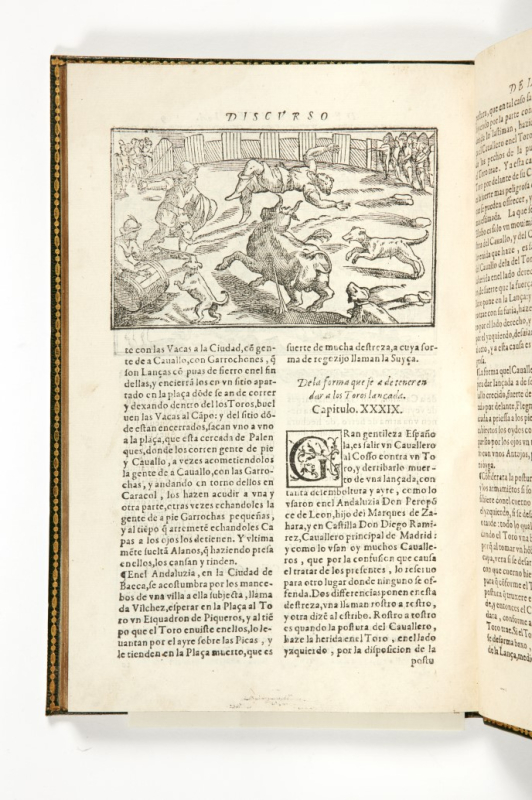
The illustrations consist of 35 half-page woodcuts, some of which are repeated, depicting the hunting of various animals (wolves, bears, deer, lions, tigers, elephants, etc.). We find 3 with the earliest American hunting scenes, also leopard and lion hunting in orient, and a bullfight scene, this is one of the earliest printed depictions of this spectacle. The text, set in round letters across two columns, is adorned with numerous wood-engraved headbands and initials.
This is a particularly nice copy, a rare occurrence, as the book was widely popular and well-read, copies normally appear lacking the colophon, here present; in the 19th century, bibliographer Salva writes about the near impossibility of procuring a copy in perfect condition.
An excellent copy, very clean and fresh.