
VENDU
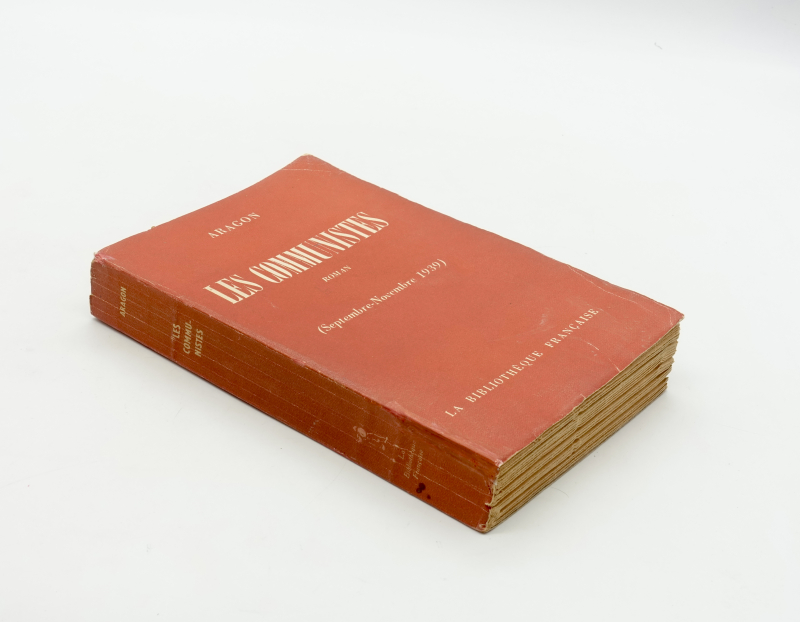
12mo (185 x 120 mm) of 364 pp and 2 nn.ll. (table and achevé d’imprimer). Original wrappers, under chemise and slipcase.
1 in stock
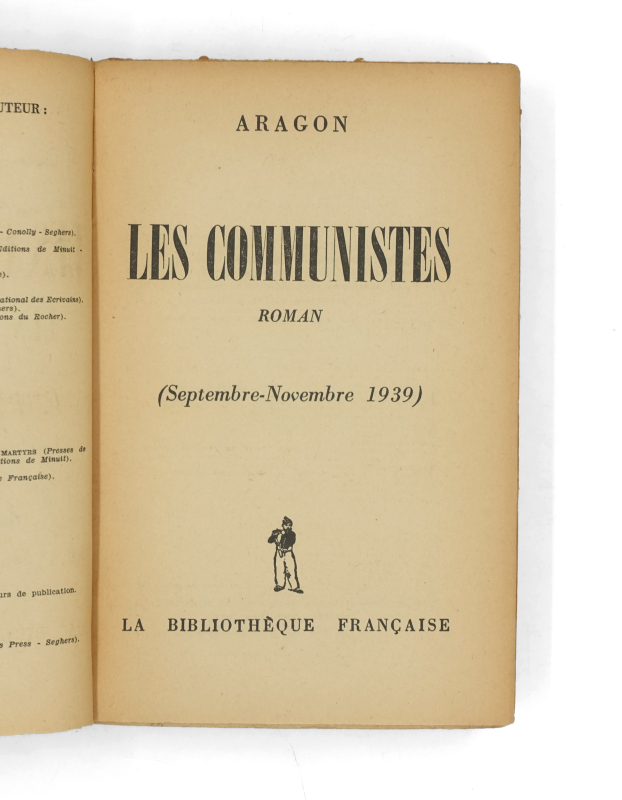
Frist edition of the second volume in Aragon’s Communists series.
This second part of Aragon’s novelistic fresco focuses on the consequences of the German-Soviet Pact and the repression of French Communist Party activists.
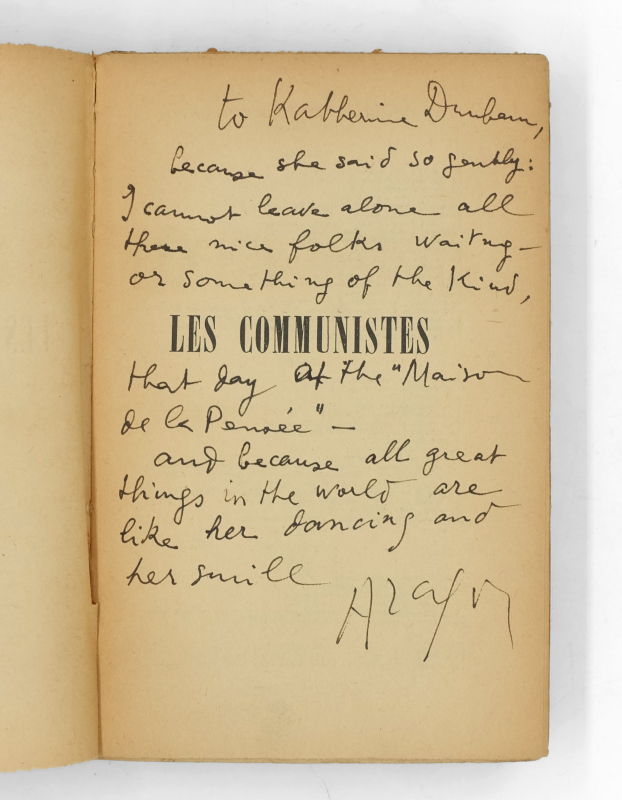
Important inscription from Aragon in English to Katherine Dunham :
“To Katherine Dunham,
because she said so gently :
I cannot leave alone all
these nice folks waiting –
or something of the kind,
that day at the “”Maison
de la Pensée”” –
and because all great
things in the world are
like her dancing and
her smile.”
Aragon composed this inscription at the time of the annual sale of the Comité National des Écrivains on 22 October 1949, which took place at the Maison de la Pensée. Aragon signed the second volume of Communistes with the help of Katherine Dunham. The dancer shared his stand and sold the author’s books.
The event caused quite a stir and was reported in various newspapers of the time, which highlighted the duo:
“Aragon signait ses livres (1400 dans la journée) sans cesser de converser avec Katherine Dunham dans une langue qui tenait de l’anglais”. (P. Gr, Libération, 24 octobre 1949, p.4. [Aragon signed his books (1,400 in one day) while conversing with Katherine Dunham in a language that resembled English.])
It seems that Dunham also signed Aragon’s work, and the newspaper Regards shared a photograph of the event with the caption “Katherine Dunham signait aux côtés d’Aragon dont la vente battit des records.” (27 octobre 1949, p.3-4. [Katherine Dunham signed alongside Aragon, whose sale broke records.]).
“Ajoutons, pour compléter cette nouvelle sensationnelle, que Catherine [sic] Dunham y vendra les livres d’Aragon. On laisse à deviner quelle foule il y aura pour recueillir, sur le deuxième volume des Communistes qui sera mis en vente ce jours-là, la signature de la vedette noire à côté de celle du grand romancier.” (Ce Soir, 19 octobre 1949, p.1. [To add to this sensational news, Catherine [sic] Dunham will be selling Aragon’s books there. We can guess that the crowds will be there to obtain the black star’s signature next to that of the great novelist on the second volume of Communistes on sale that day.])
“A la vente du C.N.E., l’écrivain communiste Aragon se trouvait dans le même stand que Katherine Dunham. Ce qui donna à Jany Holt l’occasion de faire un bon mot: “Dommage qu’ils ne vendent pas du Stendhal. Parce qu’on pourrait dire : ” Voici le rouge et la noire” !” (Tessier, Carmen, France-Soir, 26 octobre 1949, p.2. [At the CNE sale, the communist writer Aragon was on the same stand as Katherine Dunham. This gave Jany Holt the opportunity to say: “It’s a shame they’re not selling Stendhal. Because you could say, “Here comes the red and the black”!]).
Although many other writers and artists were present that day, it was the couple formed by Aragon and Dunham that attracted all the attention. Aragon had just been stripped of his civil rights for spreading false news in Ce Soir. Dunham’s appearances always caused a stir, especially when they were not directly linked to her ballets.
The inscription from Aragon is therefore a touching testimony not only to this shared event but also to the French public’s respect and love for the dancer.
Katherine Dunham is extremely popular in France. She found in Europe a refuge from the segregation she suffered in the United States, which forced her to cancel some of her performances in Kentucky.
Her ‘Rhapsodies caraïbes’ won over the public at the end of 1948. In February 1949, the Palais de Chaillot offered her the opportunity to reopen after having been the headquarters of the UN. Her shows were eagerly awaited and the reception was majestic.
André Breton wrote a preface to her ballets performed in October 1949 at the Théâtre de Paris. The critical and literary scene welcomed Katherine Dunham with open arms, not only as a dancer but also as an anthropologist. Several critics fervently demanded that her Negro Anthology be translated into French. (Lerminier, Georges, L’Aube, 27 October 1949, p.2)
It’s a love that Katherine Dunham returns to France on many occasions. After a series of adversities during her European tour in 1949, she told the press:
“Paris c’est un peu la ville-fétiche. […] J’ai l’impression qu’elle ne peut jamais rien réserver de fâcheux !” (Le Parisien libéré, 6 octobre 1949. [Paris is somewhat of a favourite city. […] I have the impression that it can never hold anything unpleasant in store!]).
She and her husband John Pratt also adopted a French child in 1949. Named Marie-Christine, the couple took her in from a convent in Fresnes.
Ultimately, this copy crystallises an important moment in Katherine Dunham’s life that resonates with the French art scene. It underlines the affection of the French and of Aragon, an outspoken advocate of anti-colonialism, for the American dancer and anthropologist.
The importance of this copy is dual. Firstly, inscriptions to Katherine Dunham are rare. Only two are listed at the Illinois University (inv FP-20-7-F1, boxes 54 and 105). In addition, Aragon only exceptionally wrote in English. His correspondence with his American translators Hannah Josephson and Sam Sloan includes a few letters in English. He also wrote a note in English in the corrected proofs of his Traité du style in 1928 (Christie’s sale, Daniel Filipacchi Collection, 29 April 2004, lot 27). Apart from these occurrences, and to our kowledge, there is no inscription from Aragon in English. These conditions make our volume an extremely rare copy.
Provenance :
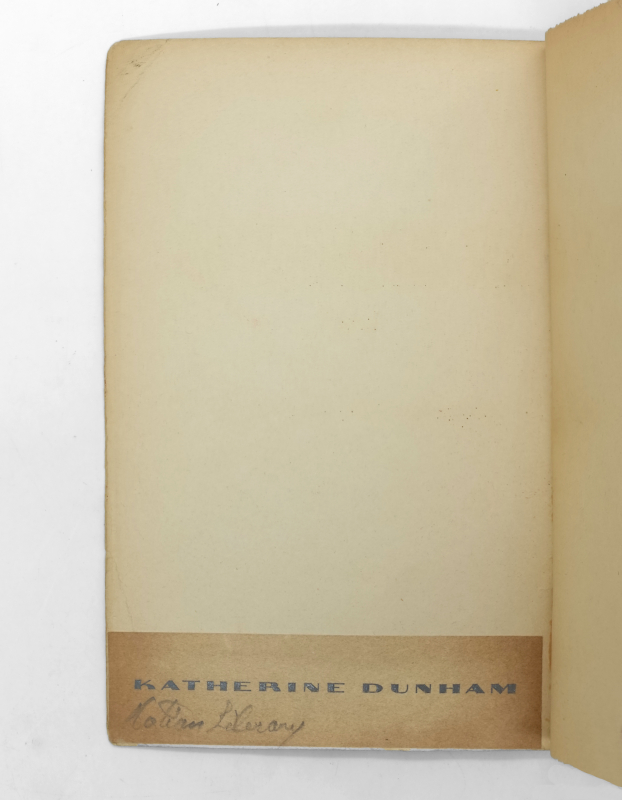
Katherine Dunham (bookplate) and a pencil inscription on the paper ‘Hatian [?] Library’. This could be a reference to Katherine Dunham’s Haitian library, which she had built in the 1940s in Martisssant, Haiti.
Marc and Michèle Saporta’s private collection
Minor restoration to spine.

Monday to Saturday
10am – 1pm and 2:30pm – 7pm
(6pm Monday and Saturday)
© 2023 All rights reserved.