Goff, E-112; Dibdin, III, 556; Proctor, 5644; IGI, 3720; Oates, 2213; Sander, 7110; Essling, 1184; Pellechet, 4629; GKW, 9426; BMC, V, p.580; Hain-Copinger, *6691.
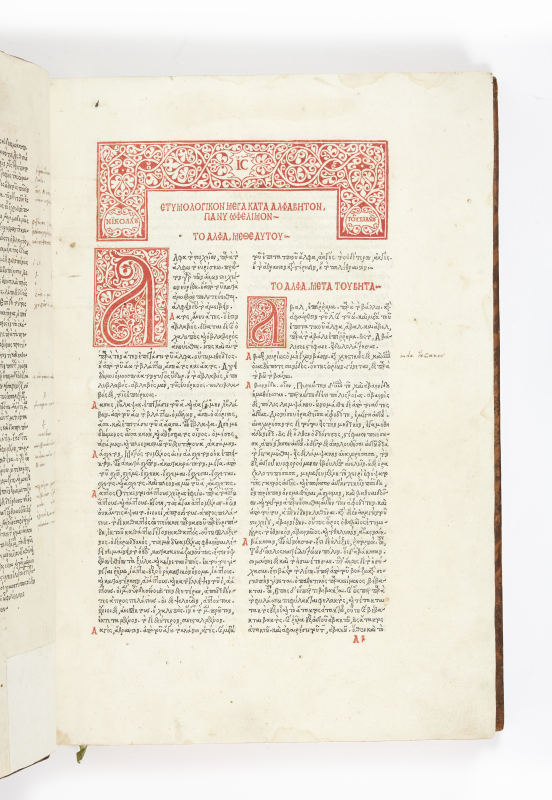
First edition, edited by Marcus Musurus.
A landmark in the history of Greek printing.
This work was compiled in Constantinople in the mid-12th century (around 1100–1150) by an anonymous Byzantine lexicographer. True to the scholarly tradition of Byzantium, the author conceived the work as a vast compilation of older lexicons, repertoires and grammatical treatises, many of which have now been lost entirely.
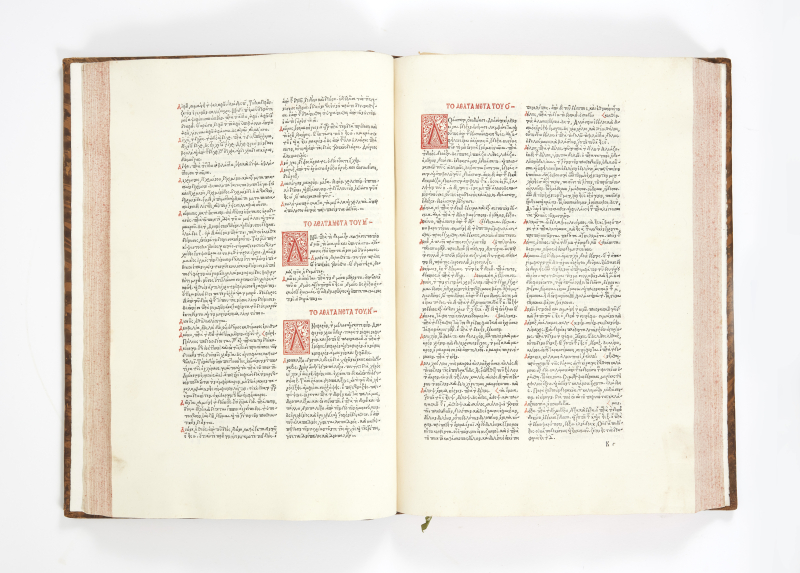
The work takes the form of a vast etymological and encyclopaedic dictionary containing nearly 10,000 entries arranged in alphabetical order. For each Ancient Greek term, the dictionary endeavours to explain its historical origin, morphology, declensions or conjugations, and exact meaning. In addition to definitions, the entries include a wealth of quotations from ancient authors (such as Homer) and Greek poets. For modern philologists, this book is crucial as it preserves unique fragments of works from antiquity whose original manuscripts have been lost.
“It is justly said by De Bure, ‘that the present is one of the most magnificent publications which ever issued from the press’. Whether the appearance of it damped the ardour, or rendered useless, the exertions of Aldus, we cannot perhaps accurately determine; but it is certain that his promise of publishing the ‘Etymologicum Magnum’… was never carried into execution…Even if it had been executed under the care of Aldus himself, it could not have been more correctly and perhaps so beautifully, printed; since, with all his zeal for the cause of literature…Aldus never produced any thing, for solidity and skill of workmanship, at all comparable with the Ammonius and Simplicius, the Therapeutica of Galen and the Etymologicum Magnum; each printed by Callierges in the XVth century. The frequent and successful introduction of the red letter, gives a splendour as well as peculiarity to the efforts of the printer whose work is now under consideration” Dibdin, Bibliotheca Spenceriana, III, p.65.
Callierges spent five years developing the Greek type which was first used to print the Etymologicum. It differed from the Aldine Greek type, which according to Nicolas Barker (Aldus Manutius and the development of Greek Script and Type, 1985) was modelled on the handwriting of Immanuel Rhusotas, in that it was cast in one piece with its accents, whereas the Aldine type needed separate accentuation. Callierges printed for the bookseller Nicolaus Blastos, a wealthy fellow cretan, who had already obtained in 1498 a privilege for all books printed with Callierges’s type.
Musurus’s elegiac poem on the first page is one of the earliest and most important documents about the technicalities of type-casting.(cf Proctor, The Printing of Greek in the Fifteenth century, Oxford, 1900, pp.120-124).
A very fine copy.
Provenance: St Benedict’s Library, Scotland (book plate).