
VENDU
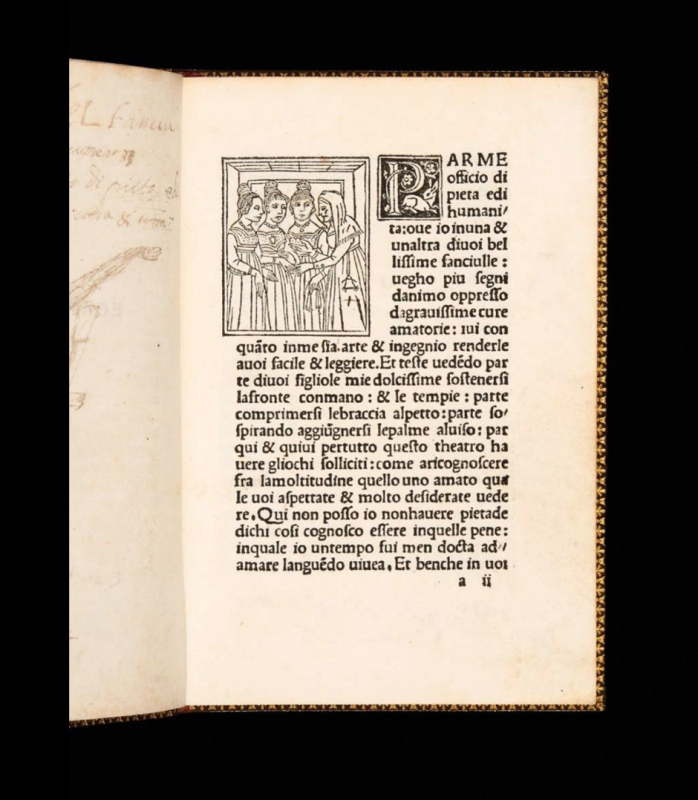
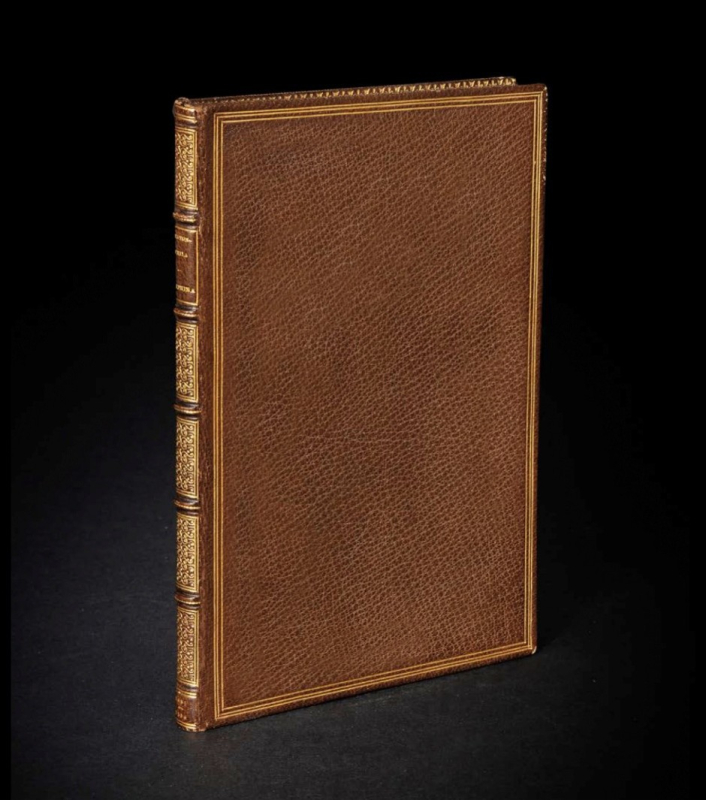
8vo (148×98mm) 24 un.ll. Collation: a–f4. [Bound with :] ALBERTI, Leon Battista. Deiphira di messer Leon Battista Alberto Firentino, ne la quale insegna amare temperatamente, & ne fa divenire, o piu dotti ad amare, o piu prudenti a fuggir amore, novamente stampata. Venice, per Francesco Bindoni, & Mapheo Pasini compagni, 1534. 8vo of 1un.l., 10–23, 1 un.l., title-page within a woodcut architectural frame, printer’s device on the last leaf. Brown Morocco, , triple gilt fillet border on covers, gilt-tooled spine in compartments with title and year, inner dentelles gilt, vellum endleaves, gilt edges (Bauzonnet-Trautz).
1 in stock
I : Sander, I, 147 ; BMC V, 465 ; Brunet I, 131 ; ISTC ia00214000 ; Goff A214 ; GW 00578 ; Hain 421 ; USTC 998095 ; Walsh 2372. II : BMSTC Italian p. 15 ; EDIT16 CNCE 714.
First illustrated edition, and second edition, of the Ecatonphyla bound with the sixth edition of the Deiphira, two early works in Italian by Leon Battista Alberti (1404–1472).
Their dates of composition are uncertain, with both works probably written in the late 1430s or early 1440s. They originally appeared separately in 1471, probably the first works of literature by a living author printed in Italian as Alberti died in 1472.
Leon Battista Alberti (Genova 1404-Rome 1472) is considered the embodiment of the Renaissance ideal of the universal man : he was a writer, painter, architect, art theorist, and mathematician. He was arguably the most influential Renaissance architect, and a prolific writer on painting, sculpture, architecture, mathematics, law and more, in both Latin and Italian. His early writings on love, heavily influenced by Ovid, Propertius and other Latin elegiac poets, have traditionally been neglected, but recent studies have recognised their originality. Works such as the Ecatonphyla and the Deiphira are far from conventional, and their underlying themes are the awareness of the great suffering that can come from love and the belief that a man of letters must necessarily overcome his amorous passions to achieve serenity.
Written around 1430, at roughly the same time as his Latin treatise entitled De commodis litterarum atque incommodis, (‘The Pains and Pleasures of a Man of Letters’, French translation), a work in which Alberti offers a scathing analysis of the plight of the intellectuals of his time, sharing the frustrations and sacrifices associated with the life of a scholar; and, like the latter, probably inspired by personal experience, the vernacular dialogues Deifira and Ecatonfilea explore the vagaries of love from various angles.
In Deifira, Filarco advises Pallimacro, who is desperately in love with Deifira, on the dangers of love, and on how the humanist – the ideal lover – should experience the intensity of love in his youth, without straying from the path that leads to the ‘dottrina’, that is to say, to scholarship.
In Ecatonfilea, a monologue set during the interval of a play: an elderly woman, an expert on matters of love, Ecatonphyla (‘loved by a hundred’), teaches the young women in the audience about the qualities of the perfect man. Her personal experience serves as an example to her listeners, who must avoid her past mistakes in order to find the ideal lover, win him over and build a lasting relationship. A summary of her speech is given in the following passage: ‘So, young ladies, love virtuous and modest men of letters, and live happily, honoured in a tender and eternal love. ’ The perfect lover is thus the humanist scholar, such as Alberti himself.
These two works bear witness to Alberti’s study of the ancient classics, through which he transforms the Ovidian model: the first is a humanist reworking of the Remedia amoris, the second an Ars amatoria. For the young Alberti, the ideal lover is above all a man of letters, capable of retaining his reason and avoiding the debilitating bonds of passionate love.
The very rare incunable edition of Ecatonphyla is illustrated with a beautiful woodcut of an elderly woman and three young girls on the opening page and four woodcut initials.
A scarce incunable edition of this important literary text.
Manuscript annotations in the first work, occasional spotting; overall a very fine copy with a distinguished provenance.
Provenance: Antoine-Augustin Renouard (book plate and vellum end leaves).



Monday to Saturday
10am – 1pm and 2:30pm – 7pm
(6pm Monday and Saturday)
© 2023 All rights reserved.