


VENDU
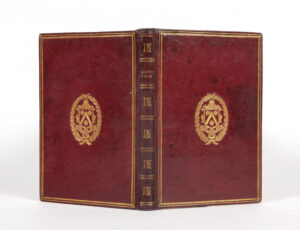
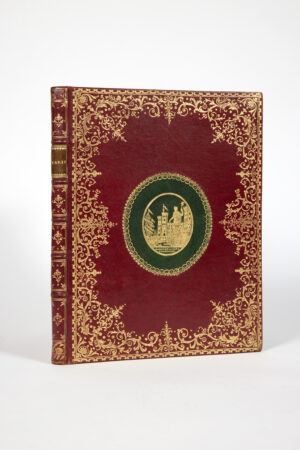
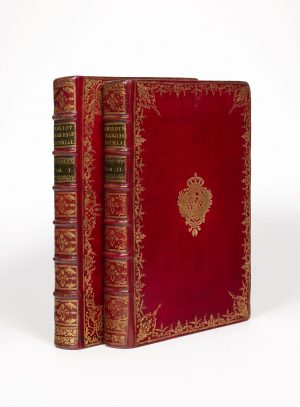
21 large folio volumes (625 x 450 mm). Contemporary blue morocco, double frame with triple gilt fillets, crowned gold letter in the corners, royal arms in the centre, spine decorated with gilt crowned letter and fleurs-de-lis, gilt edges.
1 in stock
André Jammes. Louis XIV, sa Bibliothèque et le Cabinet du Roi in The Library, Fifth Series, vol. XX, March 1965–Marianne Grivel. Le Cabinet du Roi, in Revue de la Bibliothèque Nationale, n° 18, Hiver 1985, 5e année–Georges Duplessis. Le Cabinet du Roi. Paris, Bachelin, 1869–Catalogue des volumes d’Estampes dont les planches sont à la Bibliothèque du Roy. Paris, Imprimerie Royale, 1743–Brunet, I, p. 1442-1444.
A monumental collection of engravings known as the Cabinet du Roi, the result of a huge undertaking to celebrate the power, splendour and glory of Louis XIV. An exceptional copy in blue morocco with the royal coat of arms from the Château de Vaux-le-Vicomte.
It is, relatively speaking of course, the equivalent of the graphic communication of the Palace of Versailles in the field of architecture. The Cabinet du Roi is the first and most significant of the great richly illustrated works published in the 18th and 19th centuries by European sovereigns to glorify their reigns.
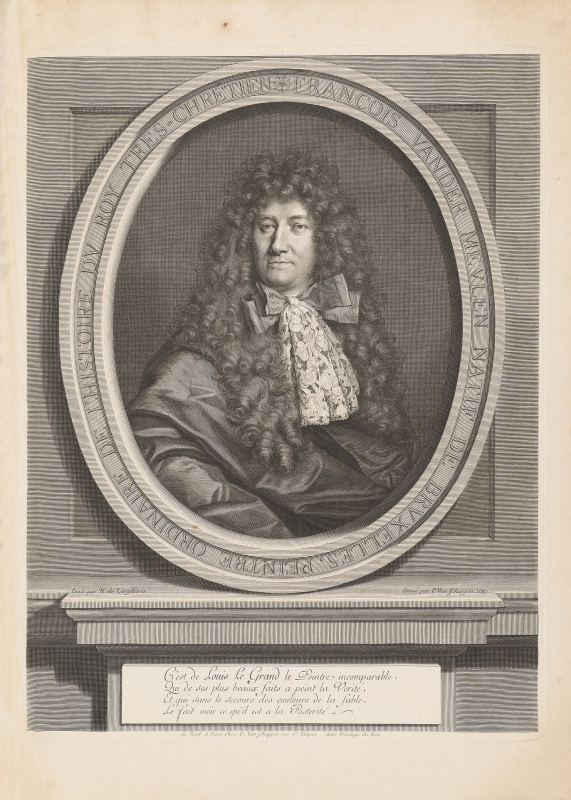
In 1662, at the instigation and under the supervision of Colbert, the best artists of the time were brought together for the project: Le Brun, Israël Silvestre, Van der Meulen, Jean Le Pautre, Sébastien Le Clerc, Claude Mellan and Gérard Edelinck. The engravings illustrated a variety of subjects: the king’s collections (paintings, tapestries, statues and medals); royal buildings and gardens (the Louvre, Versailles, Les Invalides, etc.); celebrations; and the military campaigns of the Sun King.
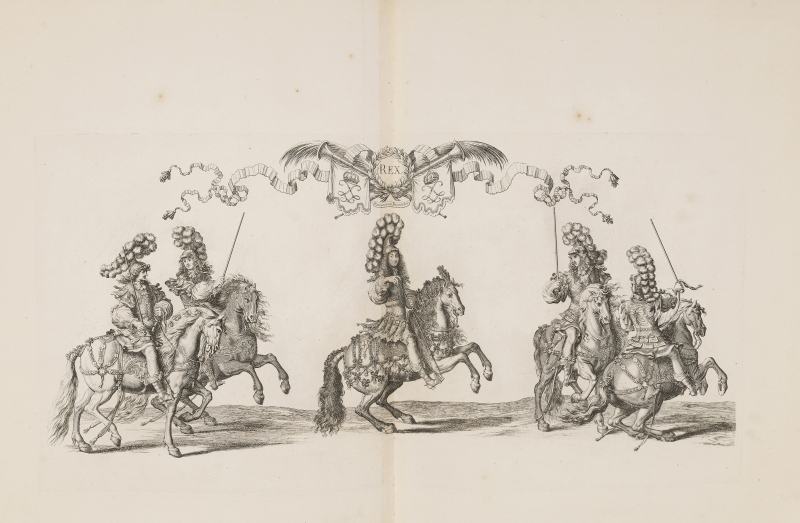
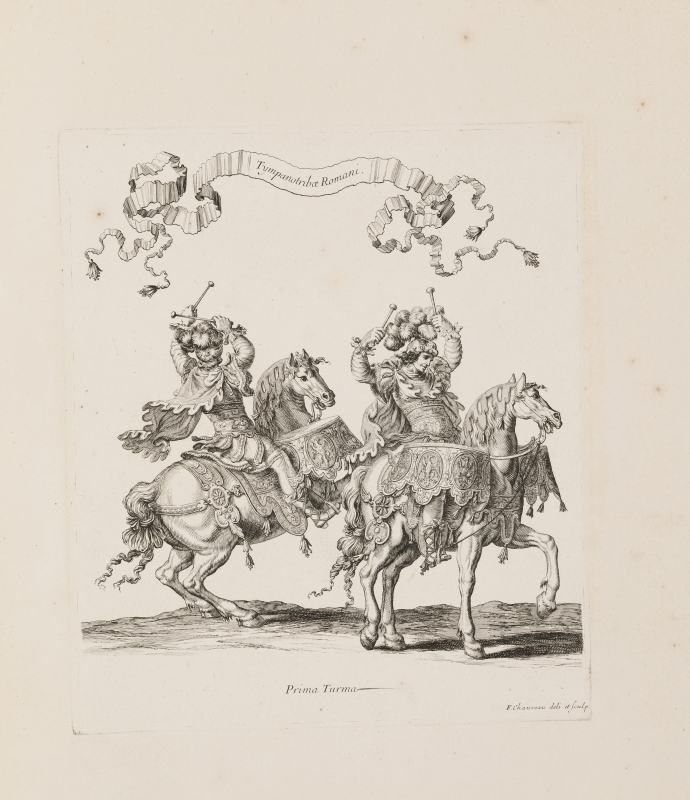
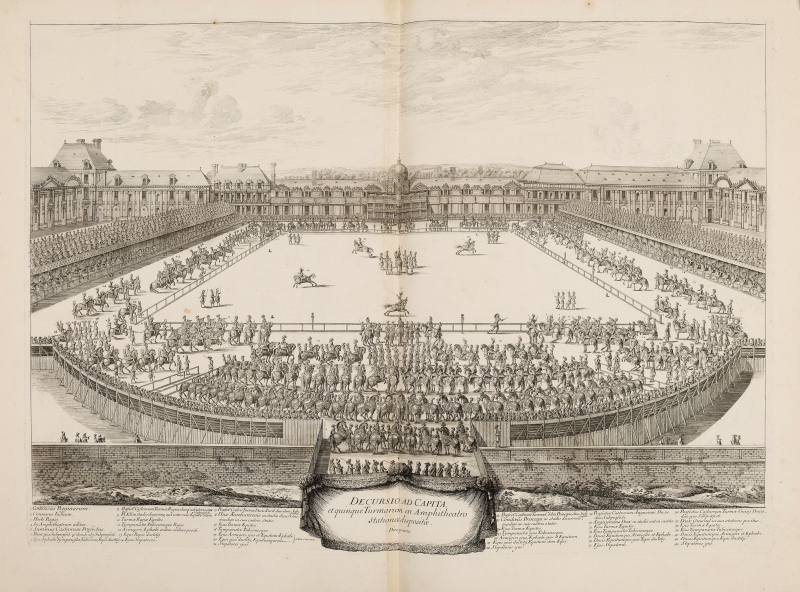
From 1670 onwards, when a sufficient number of engravings on the same subject became available, they were compiled into collections. Examples include the Courses de têtes et de bagues (Head and Ring Races) organised in 1662 and published in 1670, etc. The formats of these collections range from in-plano to in-8 (e.g. Le Labyrinthe de Versailles (The Labyrinth of Versailles)).
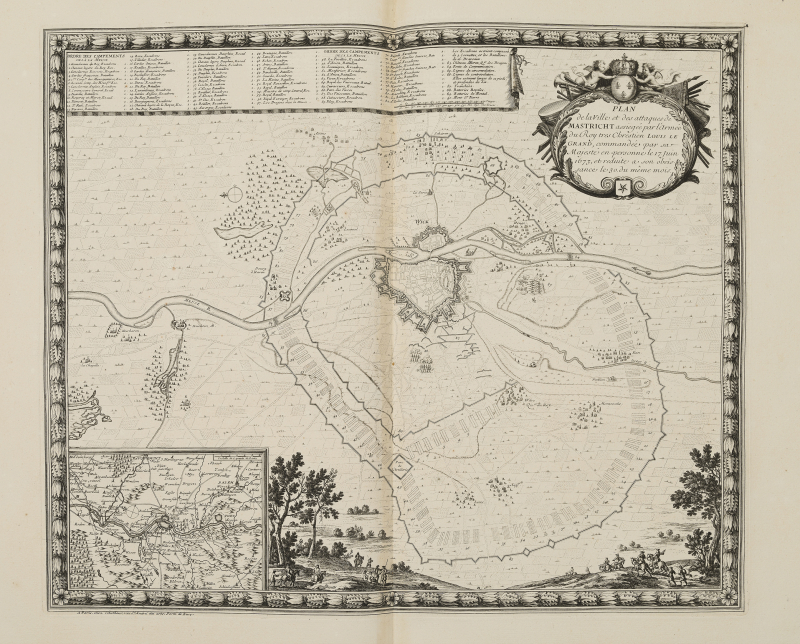
This collection was constantly expanded, at least until 1697. Louvois, Minister of War, was particularly interested in collections celebrating Louis XIV’s military campaigns.
The general intention of propaganda was deliberate and obvious. But it was also a form of patronage that enabled the French school of interpretive engraving to flourish. These engravings and collections were widely distributed. Some copies of the collections, luxuriously bound in red morocco leather, were presented to foreign sovereigns by the king’s ambassadors. They were also given to important figures in the royal entourage. The management of the engraved copper plates, prints, stocks and distribution was entrusted to the King’s Library.
At the beginning of the 18th century, the stocks of engravings were almost exhausted. In order to remedy this situation, and also to make a particularly costly, even ruinous, enterprise profitable, Abbé Bignon, the king’s librarian, decided to compensate for this shortage.
It was also undoubtedly a question of recalling the prestige of the dynasty to which the young sovereign Louis XV, who had recently ascended the throne, belonged.
From 1723 onwards, these disparate collections were therefore published in a uniform manner in 23 volumes, all in the same grand-aigle format and all on the same high-quality paper. The print run was small: around fifty copies (cf. Marianne Grivel, p. 13).
Thus, ‘the collection known as the Cabinet du Roi was not actually formed until around 1727, when the first catalogue was published. Until then, the plates engraved by order of the king were produced individually, and only a few works forming a homogeneous whole had been published as a body of work’ (Georges Duplessis).
Although we know that the presses assigned to the king’s prints operated until 1788, it is not known whether new complete prints of the entire collection were made after 1727.
The bindings of the twenty-one volumes in blue morocco leather denote, by their luxury, particular attention.
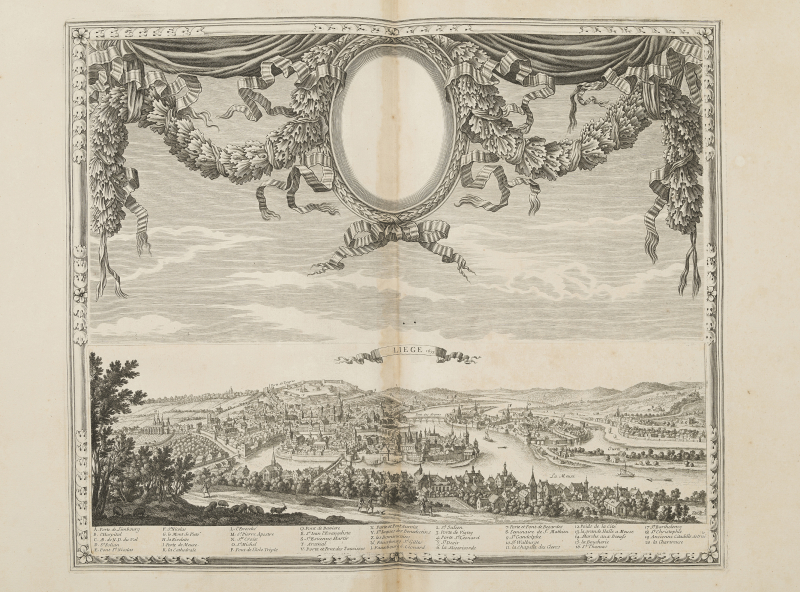
This copy, complete with all 139 engravings after Van der Meulen, in which the Tableaux and Statues are separated, probably belongs to this extremely rare initial print run undertaken from 1723 onwards.
Total number of illustrations: 794 engravings on 666 sheets.
Details of the volumes :
I. Tableaux du Roy. Representing seven subjects from the Old Testament, twenty-two from the New Testament, five from fables, one from secular history, and three allegorical subjects. 35 engravings (out of 38)
II. Missing. Tableaux du Roy. Depicting five subjects from the history of Alexander the Great, engraved after Le Brun.
III. Médaillons antiques. 41 engravings by La Boissiere, with as many numbered half-sheets (tiny tear on plates 1 and 35, explanatory half-sheets missing, replaced by 19 handwritten explanatory half-sheets).
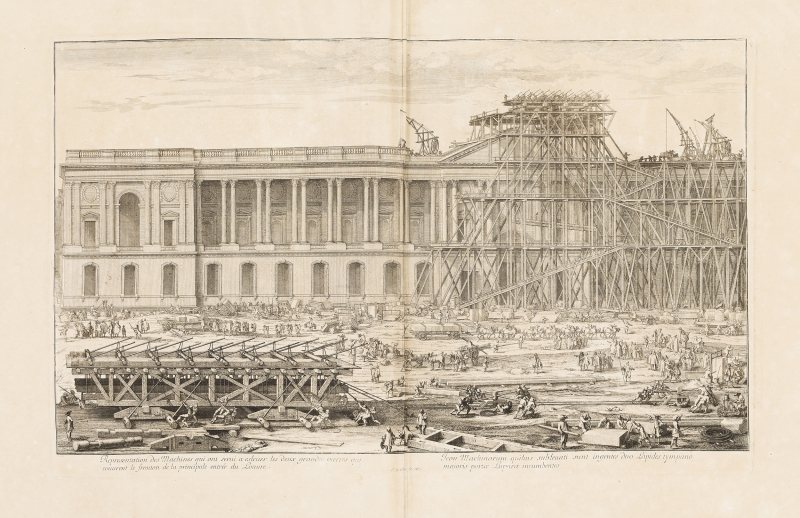
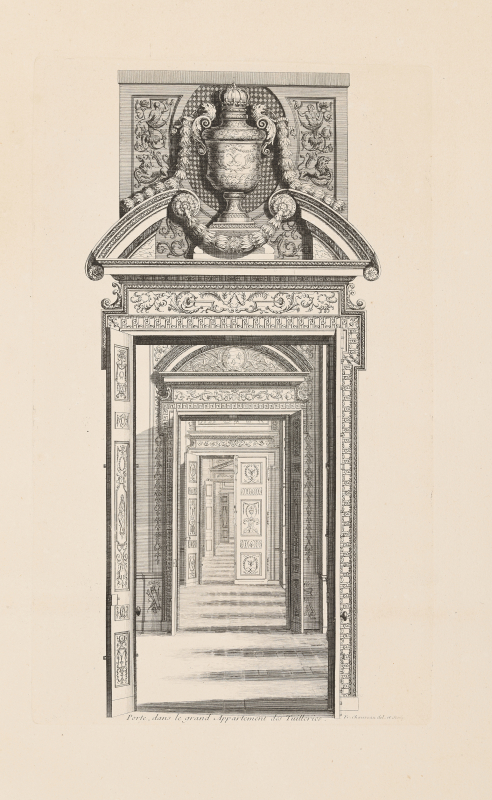
IV. Plans, élévations et vûes des châteaux du Louvre et des Tuileries. 40 engravings.
V. Plans, élévations et vûes du châteaux de Versailles. 29 engravings including ”La Franche Comté conquise pour la seconde fois, 1674″ par Simmoneau.
VI. Missing. Grotte, Labyrinthe, Fontaines et Bassins de Versailles.
VII. Statues du Roy antiques et modernes, engraved by Edelinck, Audran, Le Pautre, Chauveau, Mellan and Baudet. 48 engravings.
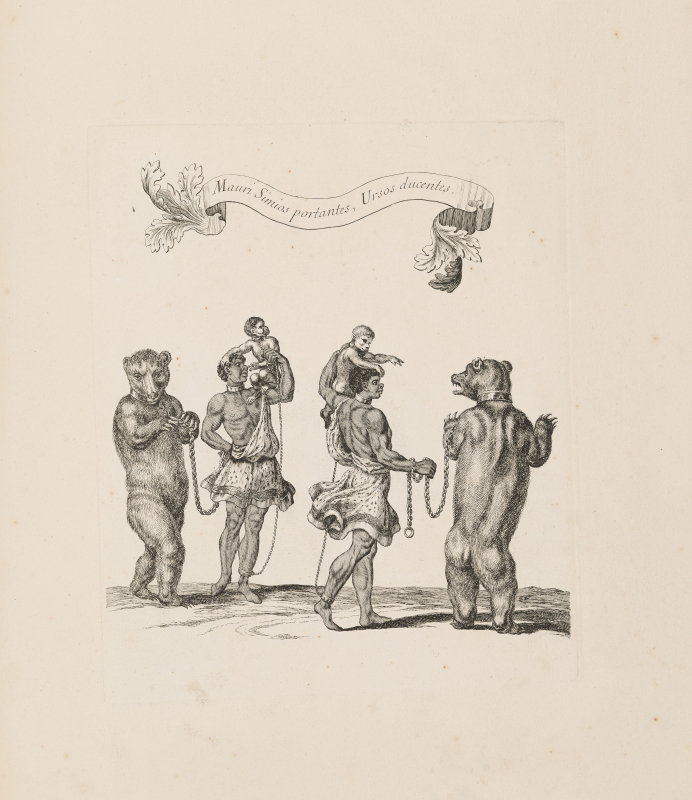
VIII. Termes, Bustes, Sphinx et vases du Roy, engraved by Le Pautre, Mellan, Baudet. 51 engravings.
IX. Tapisseries du Roy, gravées d’après Le Brun par Sébastien Le Clerc. 48 engravings on 32 sheets.
X. Carrousel. Courses de têtes et de bagues. 97 engravings on 43 sheets.
XI. Festes de Versailles. 20 engravings.
XII. Plans, élévations, vues, coupes et profils de l’Hötel Royal de Invalides, gravés par Marot, Le Pautre et Scotin. 23 engravings.
XIII. Plans, profils, élévations et vûes de différentes Maisons Royales, gravés par La Boissiere, Marot, Brissart, Sylvestre, Dorbay. 26 engravings.
XIV. Profils et vûes de quelques lieux de remarque, avec divers plans détachés, de villes, citadelles et châteaux, gravés par Audran, Sylvestre, Le Pautre. 19 engravings.
XV. Plans et profils appellez communement les Petites Conquestes servant à l’histoire de Louis XIV gravés par Châtillon, Colin, Le Clerc, Marot et Dolivart. 40 engravings.
XVI. Vûes, marches, entrées, passages et autres sujets servant à l’Histoire de Louis XIV gravés d’après Van der Meulen. 18 engravings.
XVII. Vûes, entrées et autres sujets servant à l’Histoire de Louis XIV gravés d’après Van der Meulen. 23 engravings.
XVIII. Paysages, Morceaux d’études…, gravés d’après Van der Meulen par Baudoins, Huchtenburgh. 98 engravings on 40 sheets.
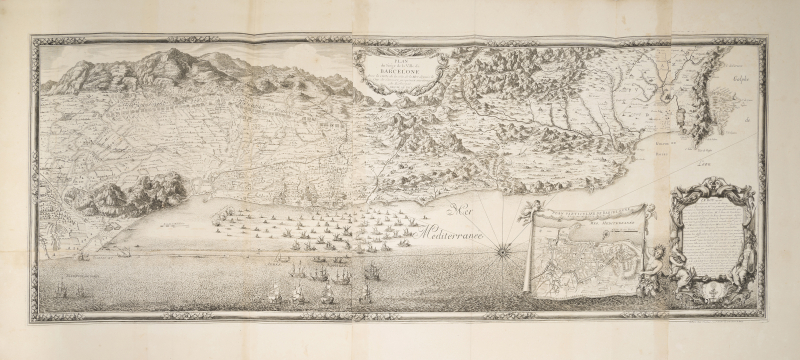
XIX. Plans, profils et vûes de camps, places, sièges et batailles servant à l’histoire de Louis XIV engraved after Beaulieu by Colignon, Cochin, Perelle. 24 engravings.
XX. Plans, profils et vûes de camps, places, sièges et batailles servant à l’histoire de Louis XIV gravés d’après Beaulieu. Année 1645. 28 engravings.
XXI. Plans, profils et vûes de camps, places, sièges et batailles servant à l’histoire de Louis XIV engraved after Beaulieu Année 1646-1648. 31 engravings.
XXII. Plans, profils et vûes de camps, places, sièges et batailles servant à l’histoire de Louis XIV engraved after Beaulieu. Année 1650, 1654-1659. 28 engravings.
XXIII. Plans, profils et vûes de camps, places, sièges et batailles servant à l’histoire de Louis XIV engraved after Beaulieu. Année 1662, 1668, 1673, 1674, 1676-1677, 1684-1685, 1688, 1691-1694, 1697. 27 engravings.
Light wear to the binding (some spines faded, defects to head, foot and hinges). Some pages browned.
Provenance : Edme Sommier – Patrice de Vogüé (château de Vaux-le-Vicomte)- French private collector.

Monday to Saturday
10am – 1pm and 2:30pm – 7pm
(6pm Monday and Saturday)
© 2023 All rights reserved.