Hunt, 392; Pritzel 9423; Nissen 1976.
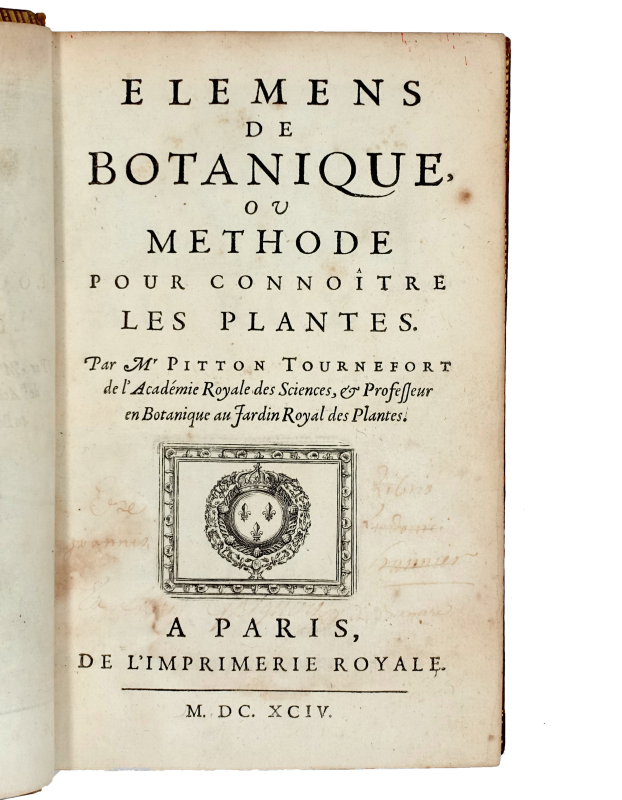
First edition.
Joseph Pitton de Tournefort (1656–1708), born in Aix-en-Provence, was one of the most eminent botanists of the 17th century. A major precursor to Linnaeus, he devoted himself to botany from 1677 onwards and, whilst collecting plants in Haute-Provence, began to compile a herbarium which he would continue to expand throughout his life. He continued this work in the Dauphiné, in Savoy, in Montpellier (where he studied at the Faculty of Medicine), in the Pyrenees, in Spain, in Portugal, in England and in the Netherlands. His reputation grew to such an extent that he soon had students and was chosen by Fagon, Louis XIV’s physician, to succeed him at the King’s Garden in 1683.
In this seminal work, Tournefort proposed one of the first methods of systematic classification (as opposed to the subjective methods of the past), based on two levels: genus, determined by the flower and the fruit, for which he identified 22 different genera; and species, determined by the flowers (primarily the corolla), the leaves, the roots, the stems and the flavour, for which he defined 700 species. This method, which enabled the classification of over 8,000 specimens, spread throughout Europe and was only superseded by Linnaeus’s system, which paid tribute to Tournefort’s efforts towards clarity and precision.
In 1701, he was commissioned by Louis XIV to undertake a scientific expedition to the Levant in order to search for ‘plants, metals and minerals, to learn about the diseases of those countries and the remedies in use there, and everything relating to medicine and natural history’. On his return two years later, he brought back a vast botanical collection comprising several thousand plants. This rich haul enabled him to compile a supplement to his *Institutiones*, illustrated with 13 new plates and added to the posthumous edition of 1717.
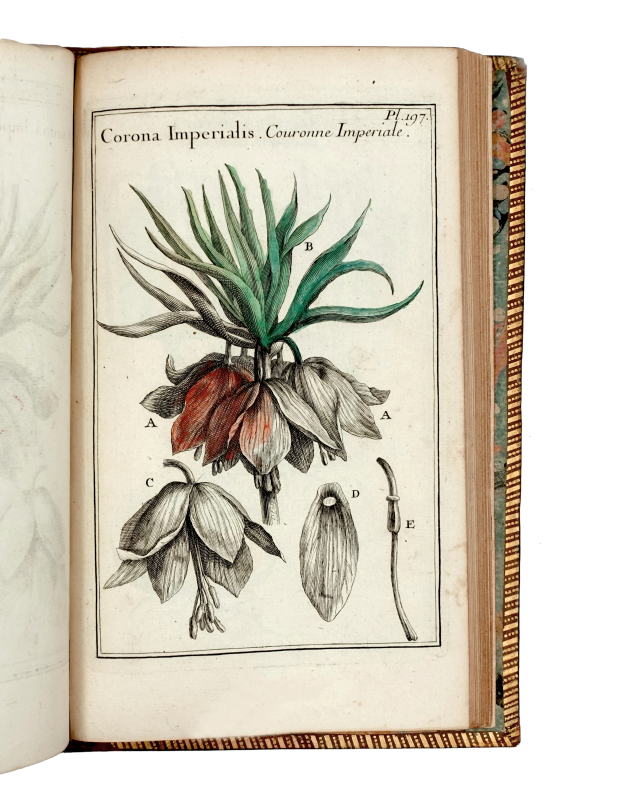
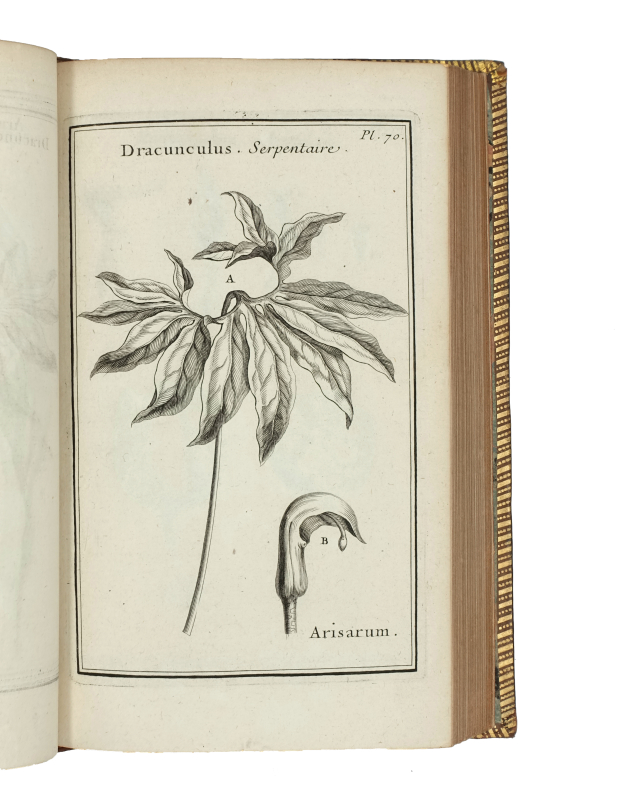
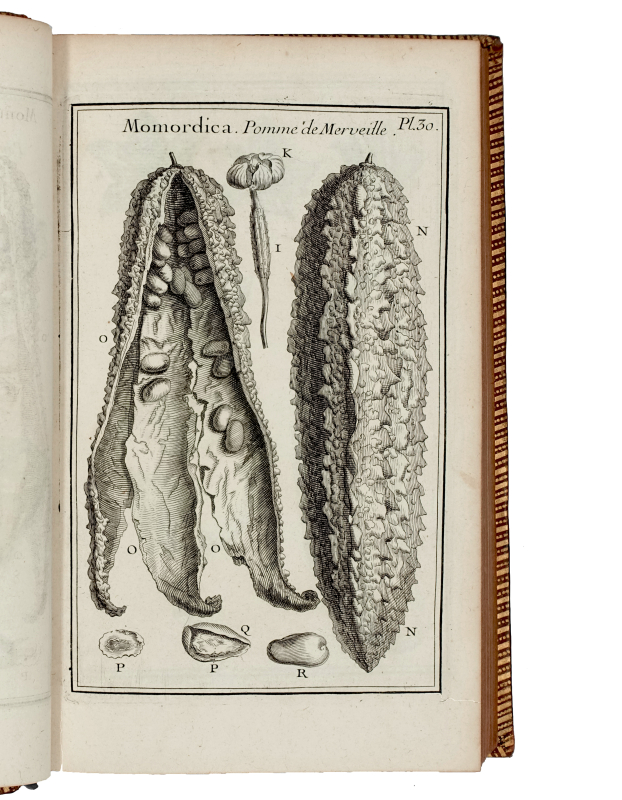
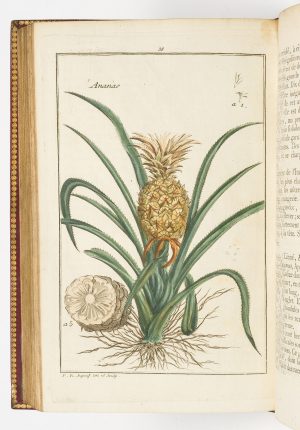
The work is illustrated with 451 plates drawn by Claude Aubriet. A painter of animals and flowers, Claude Aubriet (1651–1742) was appointed painter to the King’s Cabinet and Garden in 1700 following this publication. He accompanied Tournefort on his journey to Asia Minor (1700–1702), sketching the naturalist’s discoveries, and also provided plates for Sébastien Vaillant’s *Botanicon parisiense* (1727).
Tournefort died prematurely in an accident at the age of 52, leaving behind an indelible mark on the science of botany. Bernard de Fontenelle, in his posthumous eulogy, stated that Tournefort had brought order to the ‘magnificent confusion’ of nature. Furthermore, although his system was abandoned in favour of that of Carl von Linné, his classification laid the foundations for the Swedish botanist’s work on binomial nomenclature.
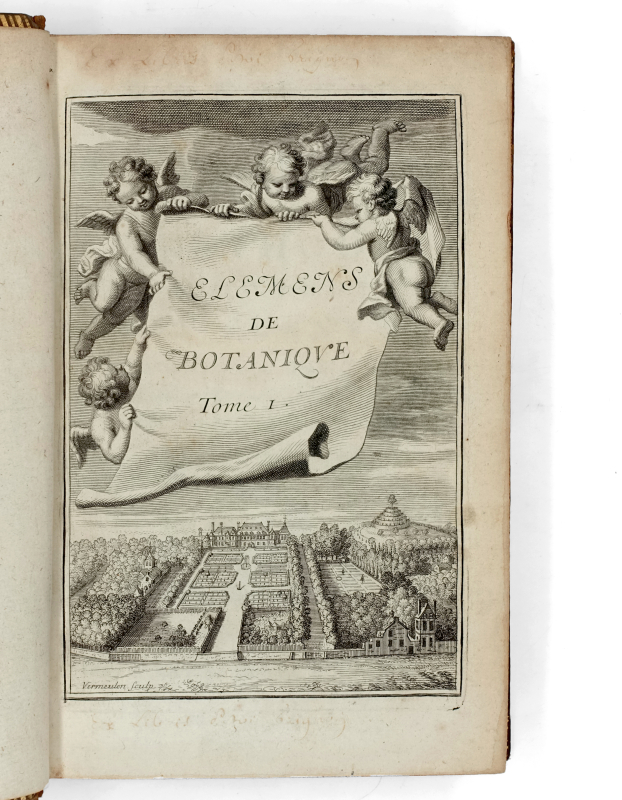
The volumes also feature three title pages engraved by Cornelus Vermeulen depicting the King’s Garden.
Ff section of Volume I bound in the wrong order. Plate 197 of Volume II partially coloured; plate 447 of Volume III with a slight tear.
Manuscript bookplate partially erased on the engraved title pages of the three volumes. [Ioannis Ludovici Grignon?] – François Chrétien (bookplate).
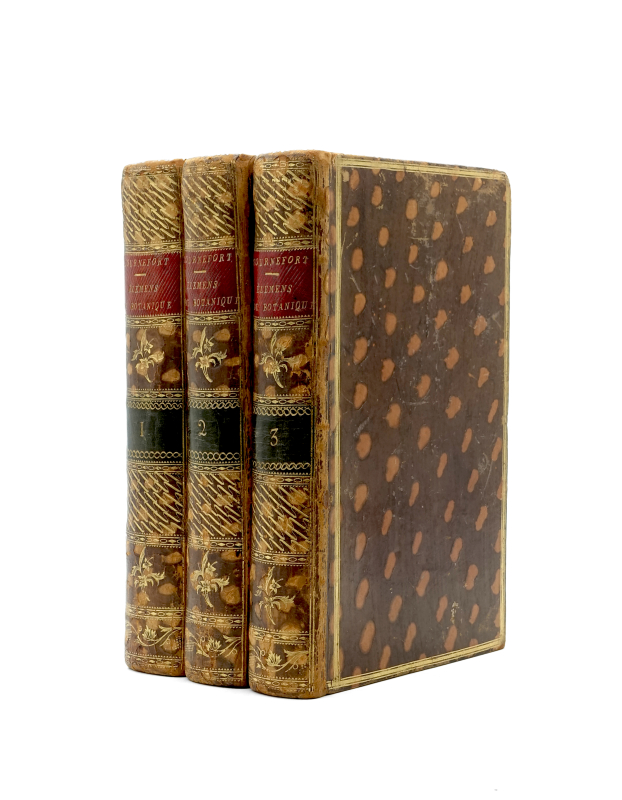
A very fine copy of this monumental work of botany, containing all 451 plates as required.