“LAGRANGE Joseph Théorie des fonctions analytiques contenant les...” has been added to your cart. View cart
PASTEUR Louis Études sur le vin, ses maladies, causes qui les provoquent.
VENDU
Paris, Imprimerie impériale, 1866
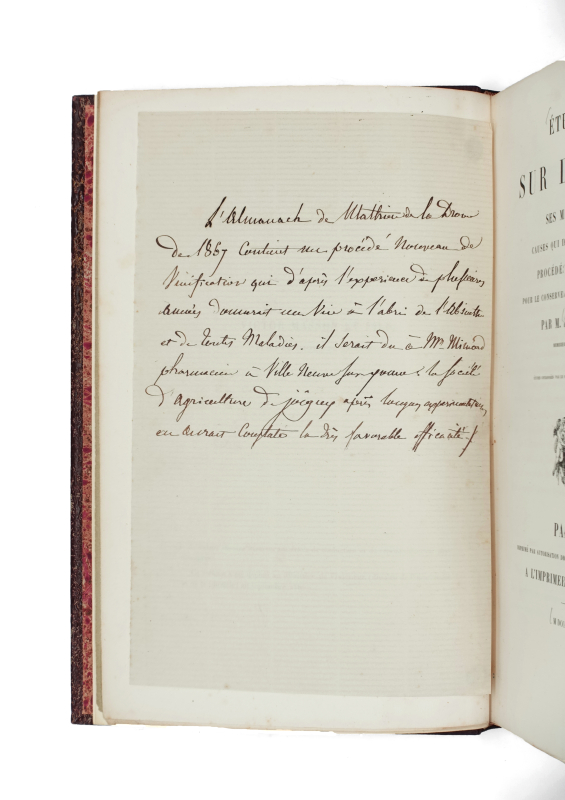
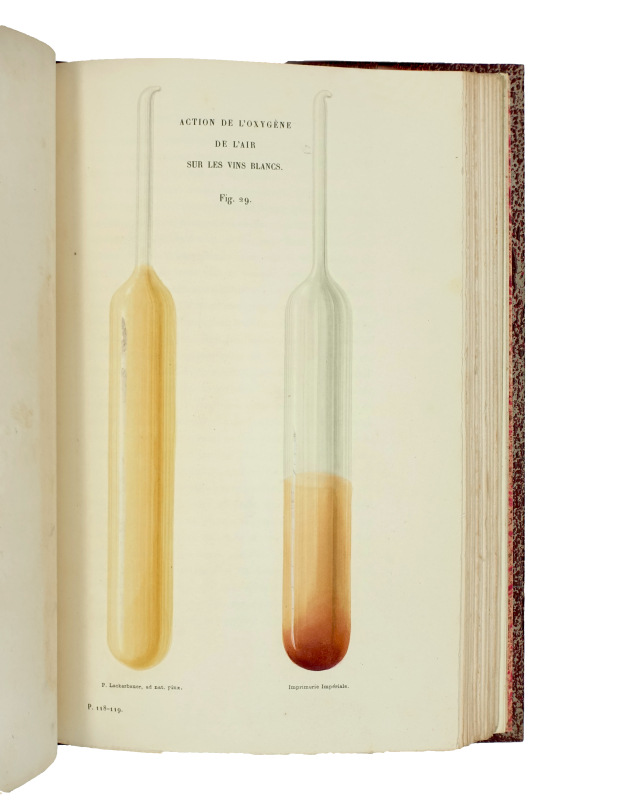
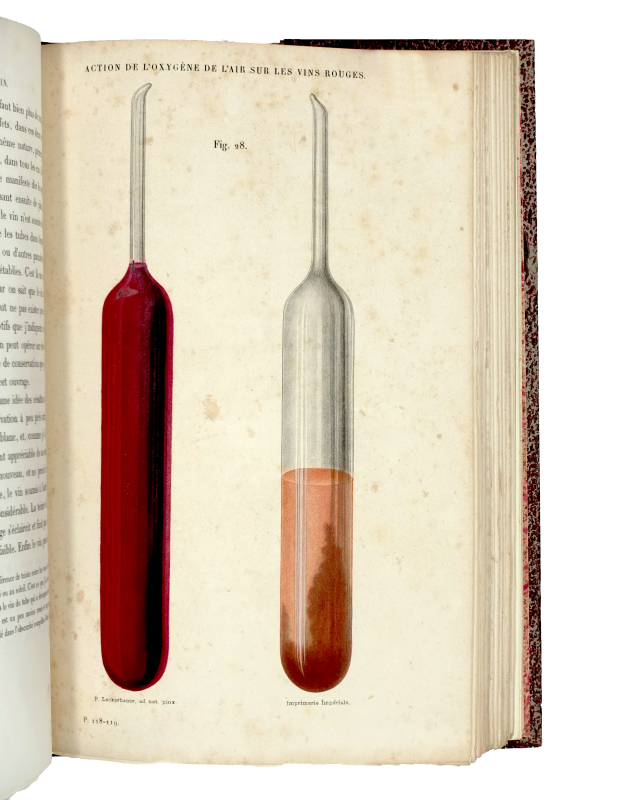
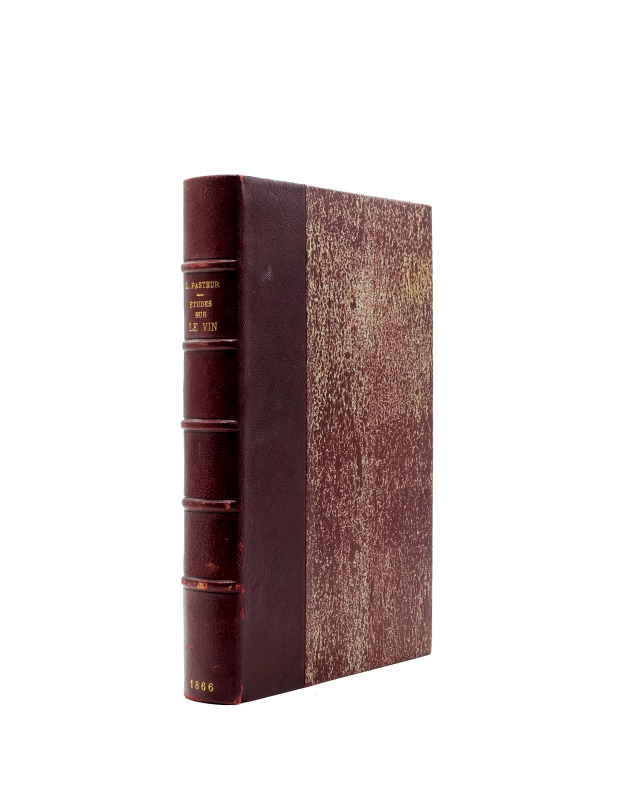
4to (235 x 151 mm), 4 unn.l. (blank leaf, half-title, title, dedication), 204 pp., 32 lithographed plates, some in color. Brown half-sheepskin, spine with raised band, with a handwritten leaflet added regarding a new winemaking process; cover and spine preserved (20th-century binding).
Duveen 460; DSB X, 366; Garrison-Morton 2479; Norman 1655.
First edition.
In the mid-19th century, viticulture was already a pillar of the French economy, but it remained vulnerable, as wine could be spoiled by various diseases. Emperor Napoleon III therefore turned to Louis Pasteur and commissioned him to conduct a study on wine
Pasteur’s first observation was that alcoholic fermentation is caused by a living organism, the yeast, and that wine diseases result from defective fermentation. Pasteur demonstrated that each wine disease is caused by a specific yeast that can spoil the wine by making it sour, off-flavored, stringy, or bitter. To combat the development of these diseases, he developed a protocol: the wine must be heated in the bottle or barrel to between 55°C and 60°C for 1 to 2 hours. The advantage of this method is that at this temperature, the wine does not spoil and retains its bouquet.
This method is known today throughout the world as pasteurization.
The process would bring Pasteur both fame and torment. Some scientists point out that Pasteur was merely reviving the process developed by Appert at the beginning of the century. Indeed, Appert is the father of the can; he asserted that heating food allows for its preservation. The two processes are indeed similar; however, while Appert’s approach was relatively experimental, Pasteur developed a rigorous and precise scientific protocol.
Thanks to his approach and his work, Pasteur won the Grand Prix at the 1867 World’s Fair.
A fine copy. Foxing on a few plates; cover and spine damaged.