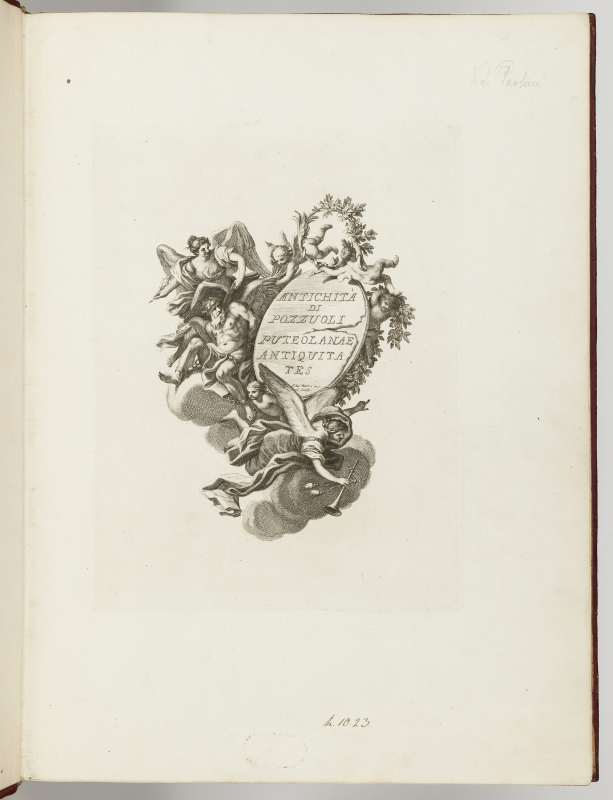
First edition of the most important and by far the most beautiful antique work devoted to the description of the ancient remains of the city of Pozzuoli and its surroundings on the edge of the Gulf of Naples. A superlative copy bound for Pope Clement XIII (1693–1769).
Dedicated to Ferdinand IV, King of Naples, it is the work of archaeologist and historian Paolo Antonio Paoli (1720–1790), who also wrote a book on the antiquities of Paestum. Paoli lived in Naples for several years to examine the monuments unearthed during excavations in the region, particularly in Herculaneum and Pompeii.
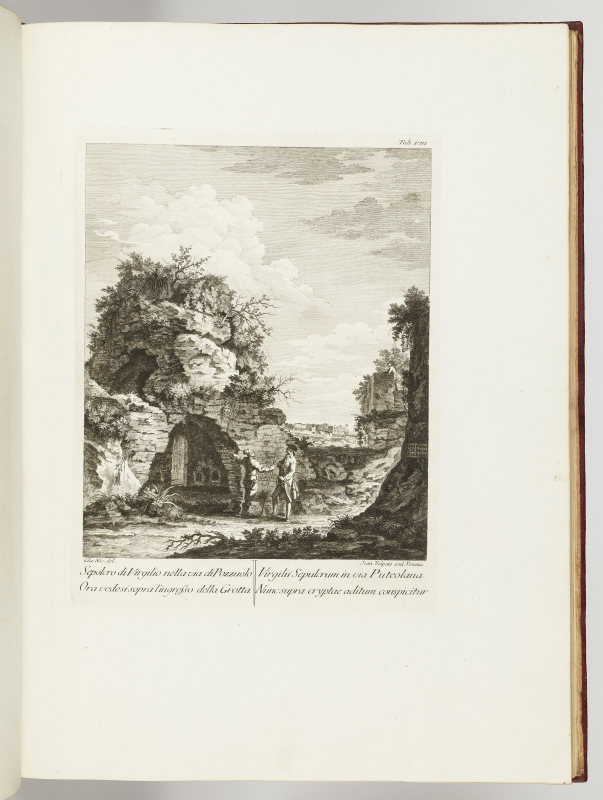
Founded in the 6th century BC by Greek colonists, the future Pozzuoli, then called Dicearchia, came under Roman rule at the end of the 4th century, along with the entire region of Naples. A Roman colony was established there in 194 BC. Renamed Puteoli (‘little well’, perhaps in reference to the many springs on the site), the city then built a port which, until the founding of Ostia, remained the most important in the Tyrrhenian Sea, becoming the hub of Italian trade with the entire Roman world. Its pleasant location and climate also made it a favourite holiday destination for the elite, hence the presence of many important monuments. The dictator Sulla had his villa there, where he died in 78 BC. According to tradition, Virgil’s tomb is located in a building at the entrance to the Pausilippe Cave, a long tunnel dug into the hill of the same name, connecting ancient Naples to the bay of Pozzuoli. It was also here that Saint Paul landed in Italy around the year 61, founding the country’s first diocese in the city.
Larger than it is today, the city has suffered over time from the volcanic activity characteristic of this region known as the Phlegraean Fields. The first excavations, contemporary with those of Pompeii and Herculaneum, were undertaken in the 1730s on the initiative of Charles of Bourbon (1716–1788), King of the Two Sicilies and future King of Spain. Among the main remains unearthed are the Flavian Amphitheatre, built under Emperor Vespasian at the end of the first century AD, the third or fourth largest in Italy, as well as the food market, the ‘macellum ‘ (1st or 2nd century), formerly named the Temple of Serapis after the statue of the god found there, a remarkably well-preserved site.
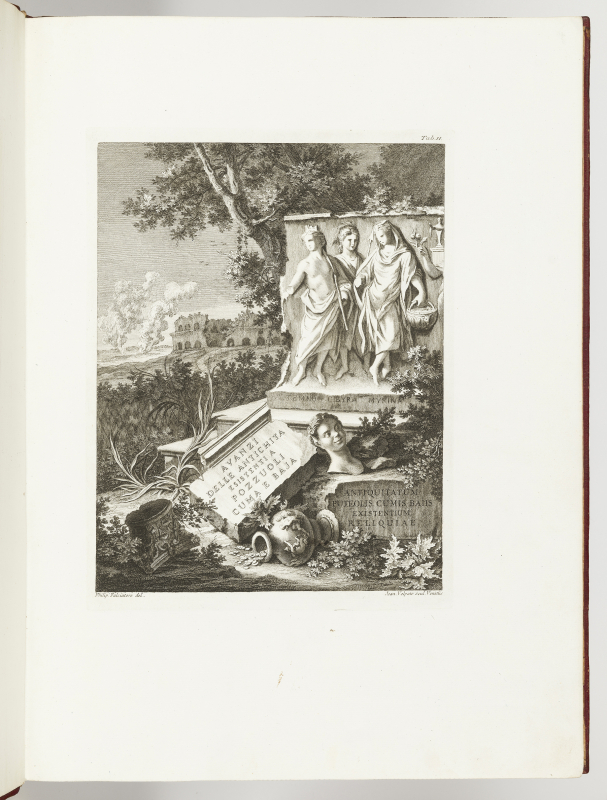
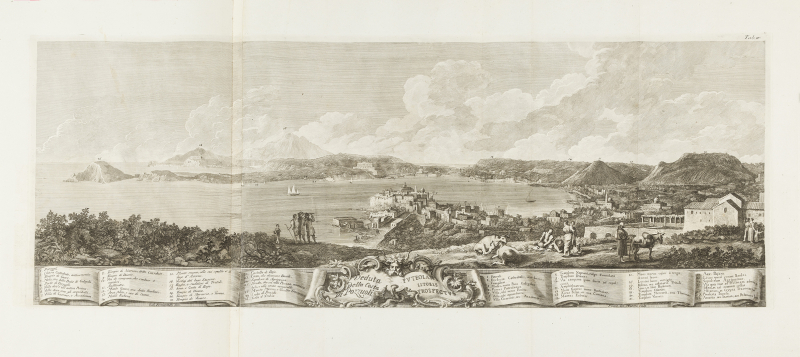
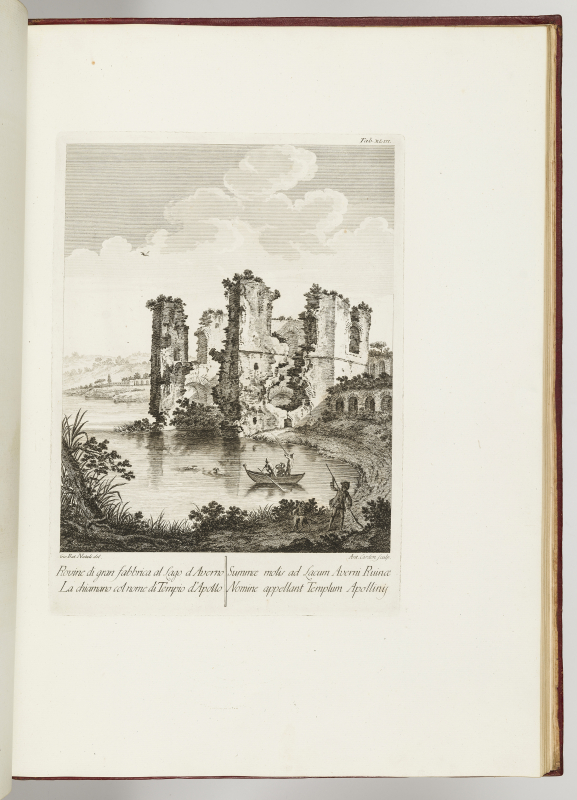
This beautiful work, entirely engraved, with text in Italian and Latin, is remarkably illustrated with 69 plates, including a large and superb fold-out panorama giving a representation of the entire site. Delightfully animated with figures, the views were engraved by G. Volpato, Ant. Cardon, Niccolo Forillo and Fr. La Mara after drawings by local artists Gianbattista Natali, Tommaso Rojola, Ricciarelli and Magri.
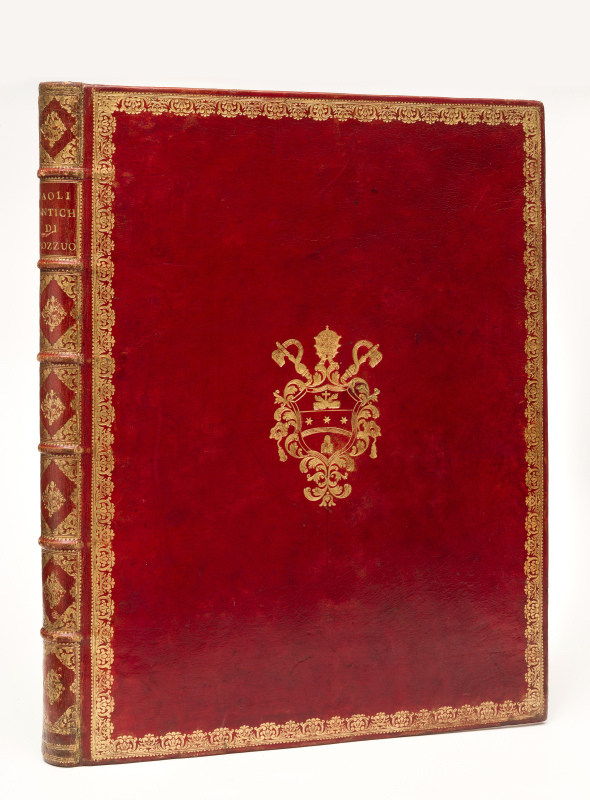
An exceptional copy, certainly one of the finest and most prestigious known, bound at the time in red morocco bearing the arms of Pope Clement XIII (1693–1769).
Elected pope in 1758, he was a member of the powerful Venetian della Torre di Rezzonico family. His pontificate was marked in particular by his support for the Jesuit order, then in conflict with most of the European Catholic courts, whose expulsion from the Kingdom of France in 1768 he was unable to prevent. In terms of architecture, Clement XIII distinguished himself by embellishing the Pantheon, draining the Pontine Marshes and rebuilding the port of Civitavecchia, the maritime gateway to the Papal States. It should also be noted that he was the first pope to come from the Pontifical Ecclesiastical Academy, of which Paolo Antonio Paoli was one of the presidents. The oldest diplomatic school in the world, the Academy, founded in 1701 by Clement XI, was intended to train the diplomatic staff of the Holy See.
From the libraries of Charles Filippi and Charles Edouard Wesem, architect, with their book plates.