Sabin, 51399 ; Alden, J.E. European Americana, 568/24 ; Borba de Moraes, II, p. 602-603.
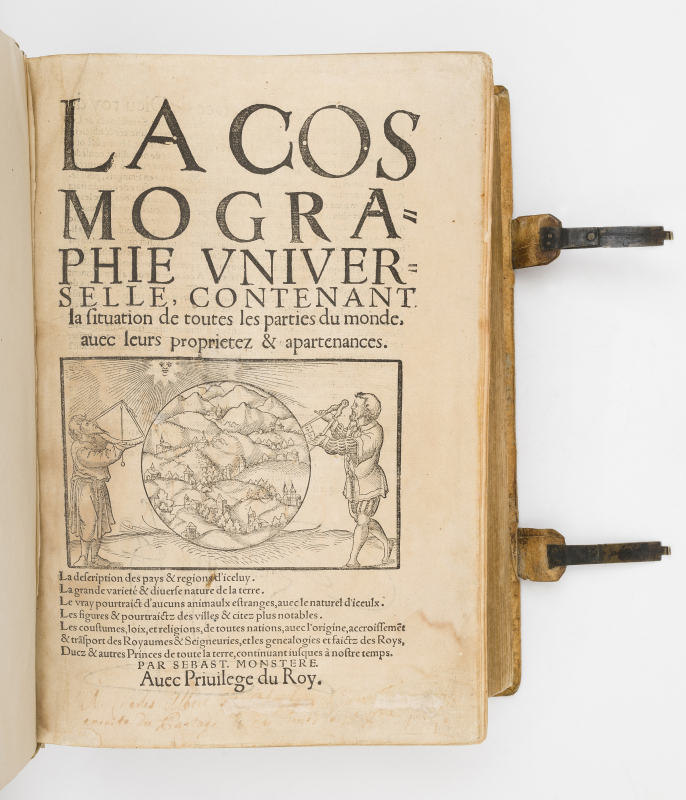
Rare French edition translated by François de Belleforest of the first universal geography written in German by a Protestant.
Sebastian Münster (1488-1552), a German Catholic priest who converted to Protestantism in 1529 after meeting Luther, was a distinguished geographer, cartographer and publisher, and the editions of Ptolemy that he published are rightly held in high esteem.
His Cosmography, first published in 1544 in Basel, is the first universal geography written in German by a Protestant. Composed as a tool for popularising geographical knowledge, it was widely distributed: 21 German editions appeared between 1544 and 1568, 5 Latin editions between 1550 and 1572, and 6 French editions between 1552 and 1575.
“Three main types of sources can be identified in the Cosmographia: Münster’s own travels, his reading of ancient and modern authors, and letters sent by correspondents. (…) During the years in which the Cosmographia was being written, Münster’s travels became more systematic, as he took advantage of the free time afforded him by his teaching duties to travel. The area covered by these trips was, all in all, fairly limited. It was mainly the regions neighbouring Basel that were explored: Switzerland in particular, Alsace and southern Germany. (…) Münster’s scholarly sources are considerable in number. According to the Catalogus of authors to which Münster explicitly refers, more than thirty names are cited, albeit unevenly, in the composition of the Cosmographia. These authors are both ancient and modern (…). The Cosmographia is the work of a network of scholars and erudites that Münster takes care to maintain repeatedly, and whose cartography he continues to draw up in the various editions of the work.” (Besse, Jean-Marc. ‘Chapter Five. Cosmographic description: the space of sources’. Les grandeurs de la Terre, ENS Éditions, 2003).
It is illustrated with 14 maps on double pages (two world maps—the first based on Waldseemüller’s, incorporating Florida and America, the other based on Ptolemy’s—maps of Europe with Spain, France, Germany, Switzerland, Bavaria, Bohemia, Greece, Asia, and the Americas). These maps were reproduced from the edition of Ptolemy published by Munster in 1540.
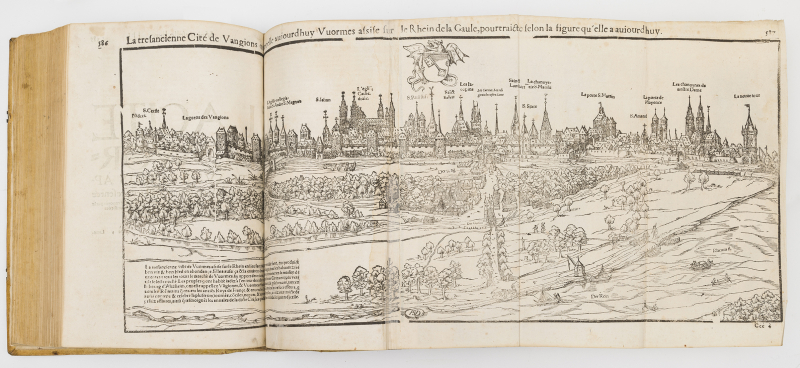
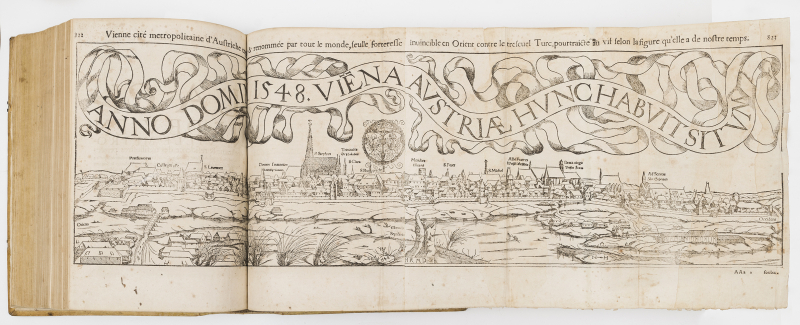
The illustrations also include numerous plans and views of cities (including three fold-outs on pp. 586-587, pp. 744-750, pp. 822-823), carefully drawn by eminent artists of the time especially for this work: ‘They were based on first-hand information gathered from the local officials of each town or place described, and were some of the earliest large-scale plans of cities to be published.’ (Baltimore Museum of Art, 1952: The World Encompassed, 272).
It features Metz, Paris, Rome, Venice, Florence, Bern, Baden, Basel, Ruffach, Worms, Cologne, Lindau, Vienna, Constantinople, etc., as well as numerous woodcuts in the text (some repeated) depicting characteristic features of the regions described: portraits, costumes, medals, picturesque scenes, fauna, mythical animals, flora and landscapes.
Although these illustrations combine medieval sources and modern knowledge, Munster’s Cosmography was for a long time — in fact, until the publication of Varenius’ Geographia Generalis in 1678 — the most authoritative work on geography in existence.
This edition contains a large section devoted to America, providing one of the first accounts in French of Christopher Columbus’ voyages (book V, p. 1321 ff.) and the four voyages of Vespucci (book V, p. 1333 ff.).
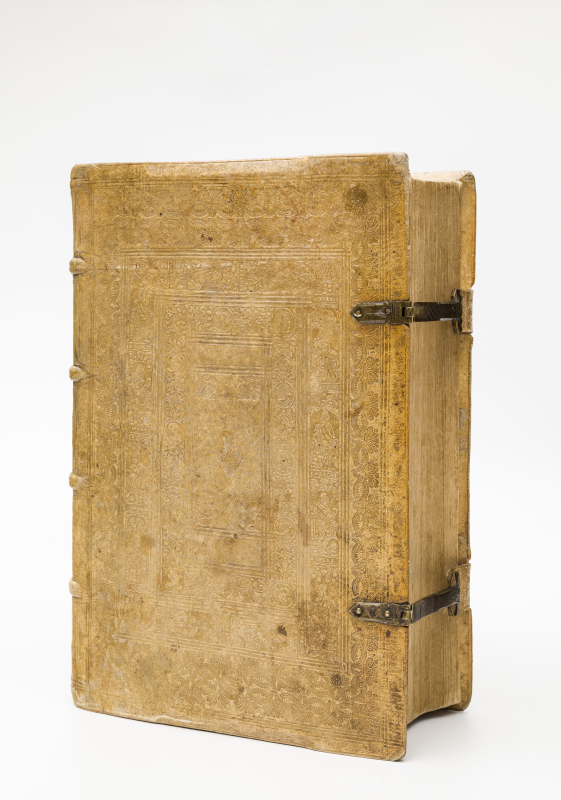
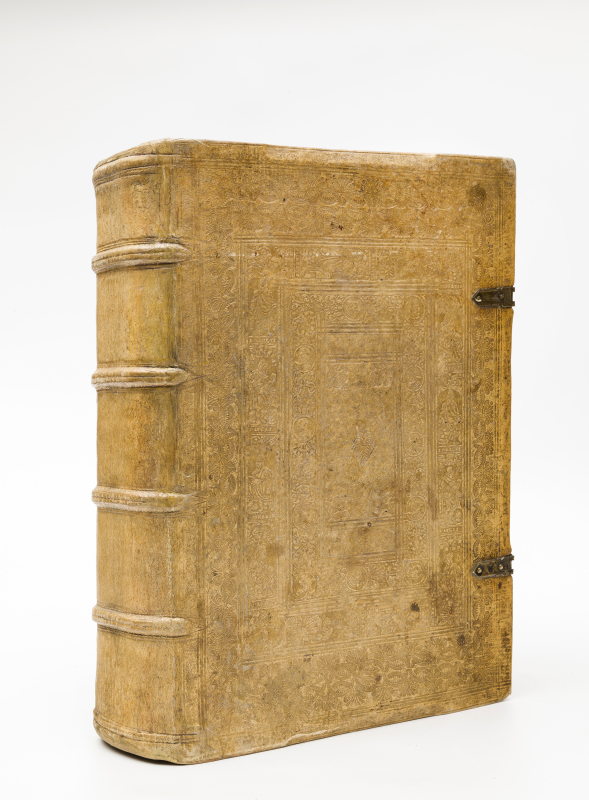
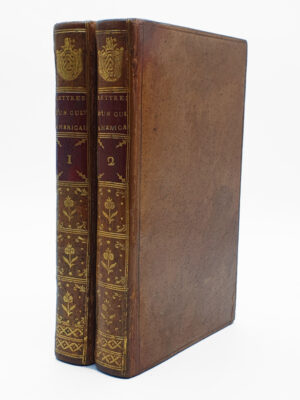
Magnificent copy bound in contemporary pigskin.
Pale waterstains in the margins of sections L and M, then pp. 1313 to the end; sheets uniformly foxed, some scattered foxing (more noticeable in certain quires such as AAaa, IIii) and stains (pp. 101, 617, 683, 929, 1102, 1309); pagination errors (including f. X, which is incorrectly numbered and not included in the pagination, and the pagination jump from 549 to 560); restoration at the fold of the map of the city of Vangions (now Worms) pp. 586-587; slight oxidation of the ink on some woodcuts, appearing as brown marks on the reverse (e.g. pp. 809, 1147, 1307, 1321, 1334, 1360, etc.); marginal tear with no loss on p. 1086. Discreet restoration to the binding.
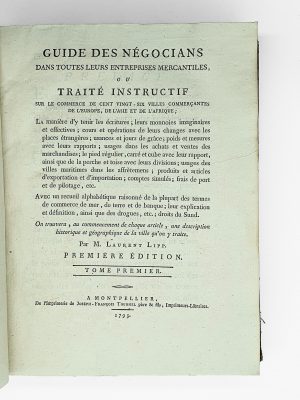
Provenance: Old manuscript provenance scratched onto the title page: ‘à Charles Albert…’ (to Charles Albert…) – Giannalisa Feltrinelli, with her book plate and embossed stamp repeated on the first two leaves (Christie’s sale, Part VII, 11 December 2001, no. 2023).