
VENDU
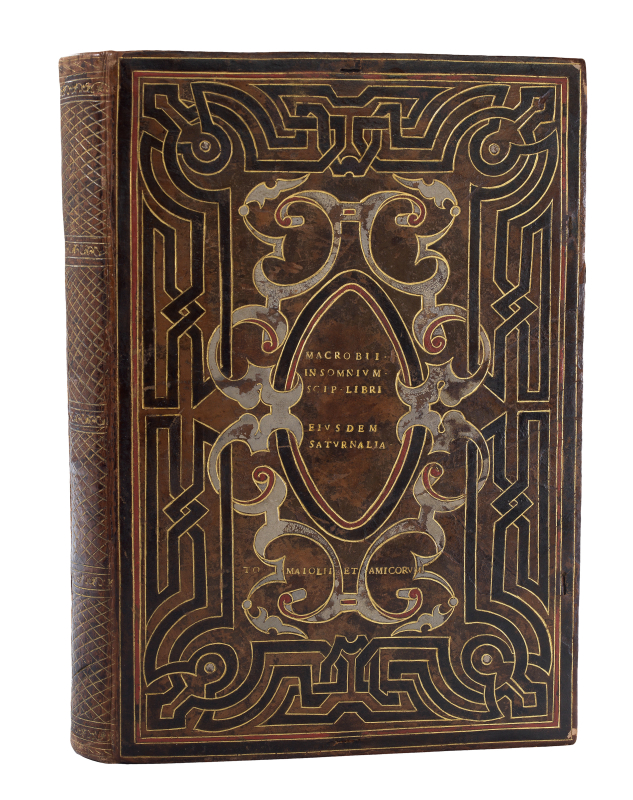
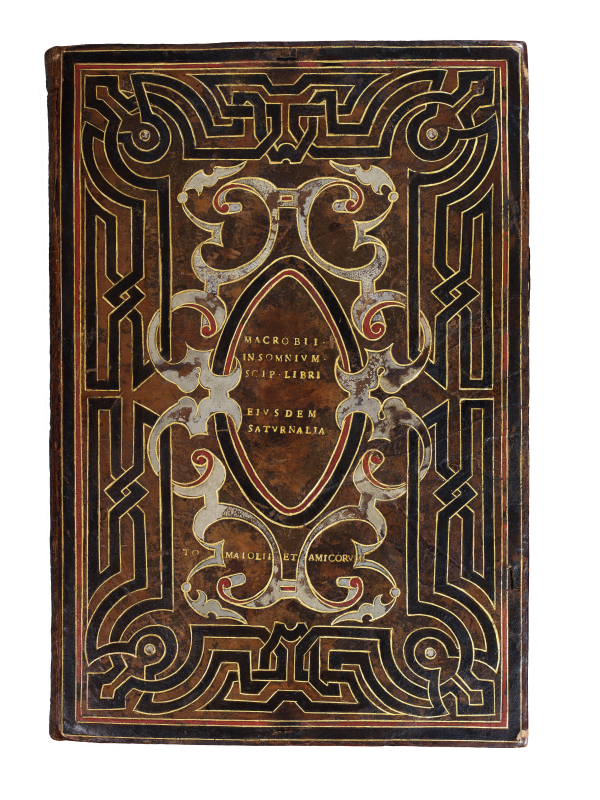
Folio (294 x 205 mm) 20 un. ll., 334 pages, 1 un.l. Contemporary brown calf, broad interlacing decoration gilt and painted with wax in different colours, central cartouche with gilt inscription: “Macrobii- In somnium Scip Libri- eiusdem Saturnalia” and “To Maioli et amicorum” on the upper cover and on the lower cover Maioli’s motto: “Ingratis servire nephas”, flat spine with gilt decoration of crosses, gilt edges (Parisian binding by the Grolier Cuspinianus binder, circa 1550).
1 in stock
Shirley, 13 (note); Myriam Foot, The Henry Davies Gift, t. I, p. 186 ; Adams, Maioli, p. 452; VD16 ZV 20513; G.D. Hobson, Short-Title List of Books Bound for Thomas Maioli. An original article from the Library, a Quarterly Review of Bibliography, 1925, n° 72 ; Dibdin 2,220: ‘under the care of the celebrated Camerarius, and by the help of several important MSS. there was hardly a verse in the poets quoted but what received very considerable emendation. (.) A volume, thus intrinsically valuable, will not fail to find a purchaser at a reasonable price’.
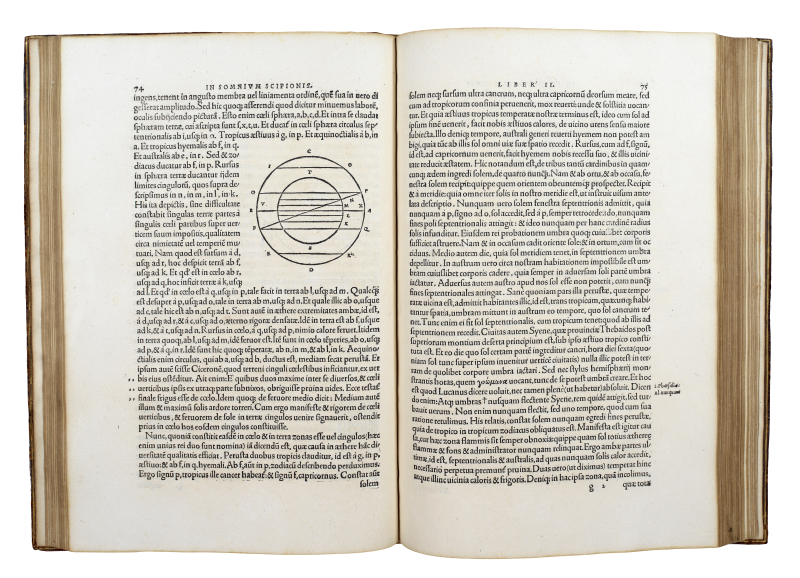
A very interesting edition of Macrobius’ works, given by Joachim Camerarius, illustrated with a newly engraved map and bound for the celebrated book collector Thomas Mahieu.
Ambrosius Theodosius Macrobius, a Roman senator and a classical scholar of the early 5th century A.D. ‘was a notable link between the cultures of antiquity and the Middle Ages’. This edition contains his 2 most important works, the Saturnalia and his Commentarii in Somnium Scipionis, the ‘Dream of Scipio’, a commentary on a part of De Republica of the Roman orator Cicero.
The Saturnalia is a learned compilation in 7 books cast in dialogue form, in which the cultural life of the former generation is idealized. Macrobius’ aim was to provide his son with all the necessary hard to come by scientific knowledge.
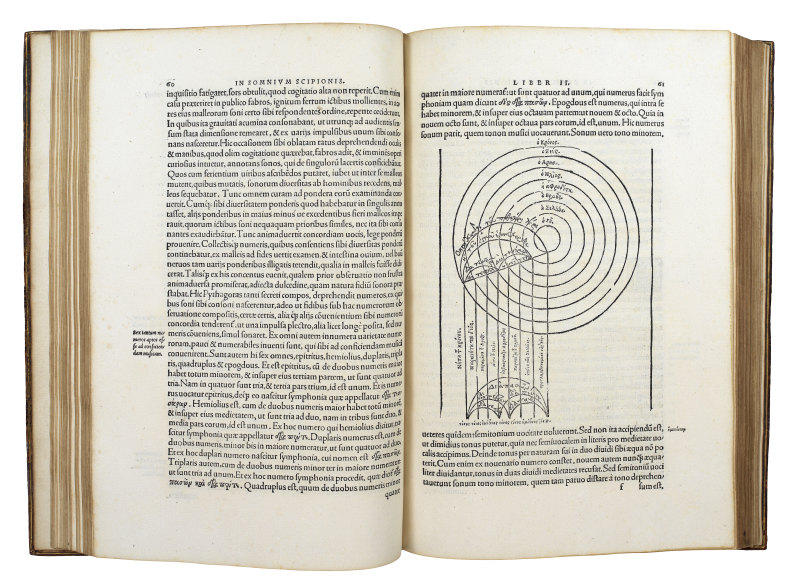
More influential in the Middle Ages and Renaissance was the commentary of Macrobius on the Somnium Scipionis. Macrobius uses Cicero’s De Republica as the starting point for a thoroughly Neoplatonic treatment of (especially) cosmology and the soul’s ascent to the One, with direct debts to Porphyry and Plotinus.’ Discussed are matters of mathematics, physics, cosmology, astronomy, geography and ethics. He thus forged a kind of compendium of science and philosophy, which transmitted classical knowledge to the medieval world, and was to hold a central position in the intellectual development of the West during the Middle Ages. His books belong to the basic sources of the scholastic movement and of medieval science. His work left traces in the works of Dante, Chaucer, Vives and Spenser. (Source for M. and the quotations: ‘The Classical Tradition’, Cambr. Mass., 2010, p. 553).
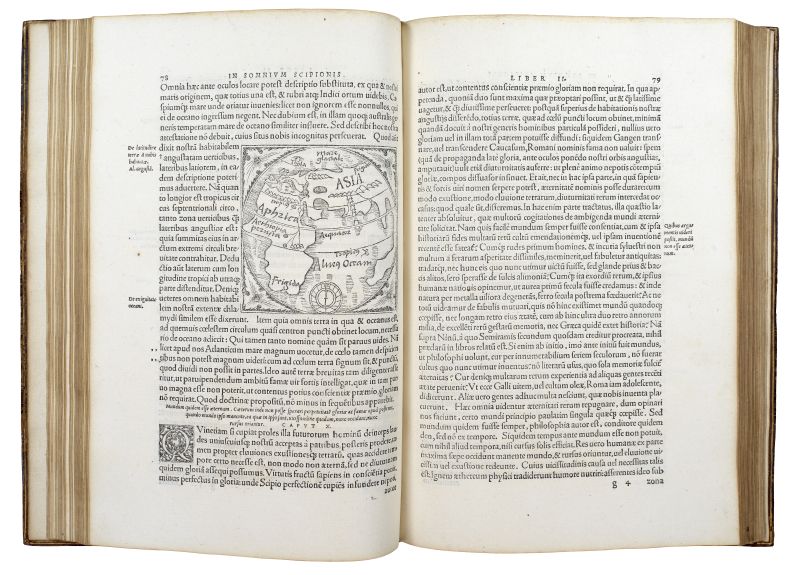
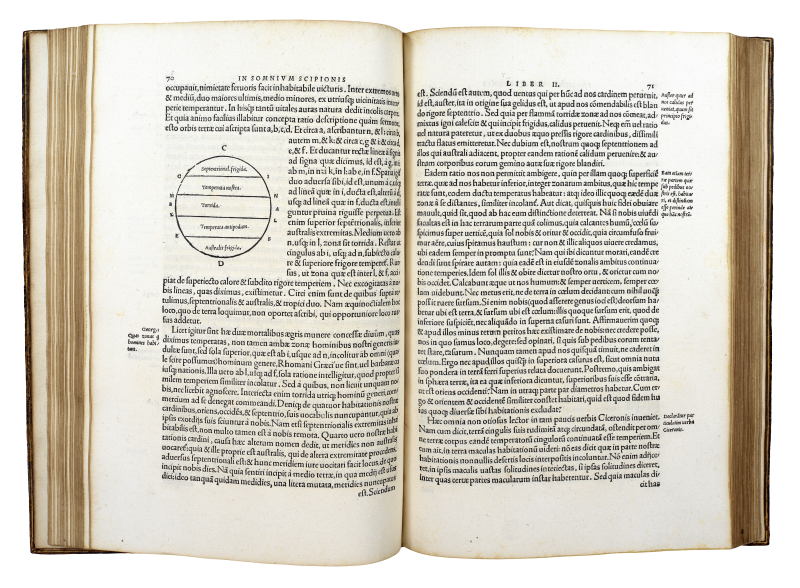
In Antiquity, the Middle Ages, and the early Renaissance, the world was thought to be divided into climatic zones: in the simplest form of this theory, there was an uninhabitably hot Torrid Zone near the equator, habitable Temperate Zones to the north and south of the Torrid Zone, and uninhabitable Frigid Zones near the North and South Poles. These zones were often depicted on medieval maps, particularly on zonal maps, the most common of which illustrate manuscripts of Macrobius’ Commentary on the Dream of Scipio.
The hemispheric maps of Macrobius, drawn in Spain and later reproduced in the works of the Venerable Bede, Lambert of St. Omer and others, show the habitable world of the northern hemisphere and the uninhabited world of the southern, marked with climatic zones derived from Ptolemy’s clima, and, unlike many other European medieval maps, they are oriented with North at the top instead of East.
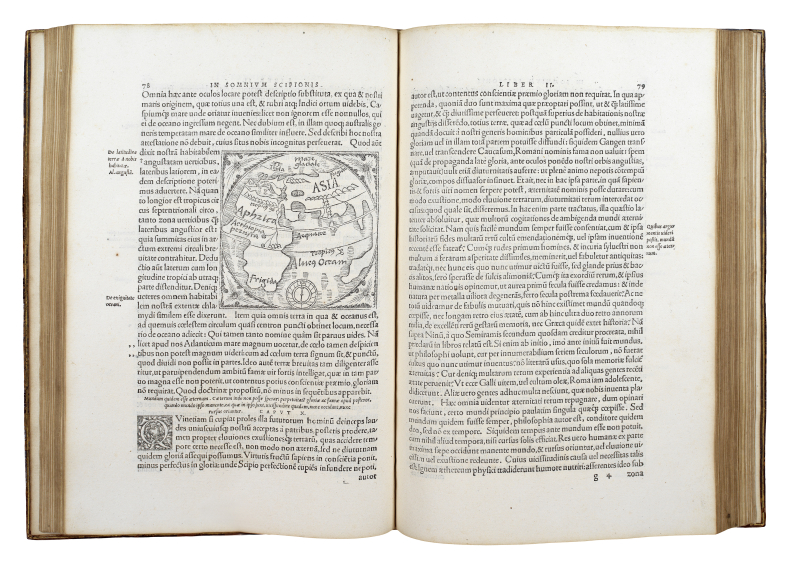
Chapter IX of Book II contains a description of the earth, and the text refers to a world map, which is in fact found in most of the manuscripts, from the oldest, in the 9th century, to the end of the 15th century.
“His neoplatonic commentary on Cicero [the `Dream of Scipio’ from Book VI of De Republica], includes among many references to the pseudo-sciences, a geographic concept which is different from that of Ptolemy. The inhabited World north of the Equator is balanced by a southern continent and divided by water” (Shirley).
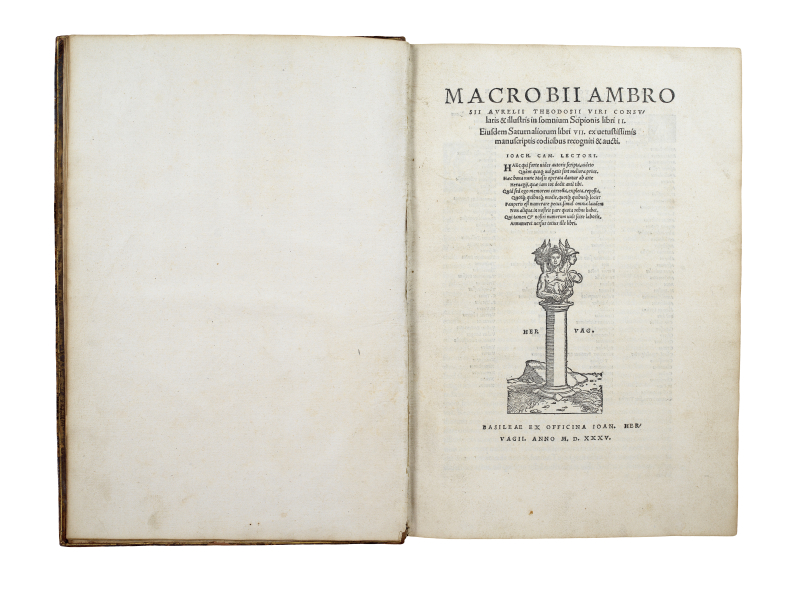
The first printed edition of Macrobius appeared in 1483, published in Brescia. This 1535 Basel edition contains a newly engraved map with a more modern outline of Africa shown.
This important edition is given by Joachim Camerarius, who holds one of the foremost places among the German classical scholars of the 16th century. Gudeman calls him even ‘der bedeutendste Philologe Deutschlands im 16. Jahrh.’ (Grundriss der Geschichte der klassischen Philologie, Lpz. 1909, p. 216) He held professorships at Nuremberg, Tübingen and Leipzig. ‘His numerous editions of the Classics, without attaining the highest rank, are characterized by acumen and good taste’. (Sandys, ‘History of Classical Scholarship’ 2, p. 266/67) Camerarius was a man of vast knowledge. He also wrote on history, theology, mathematics, astronomy and paedagogy. He seems to have been just the man for editing the encyclopaedic works of Macrobius.
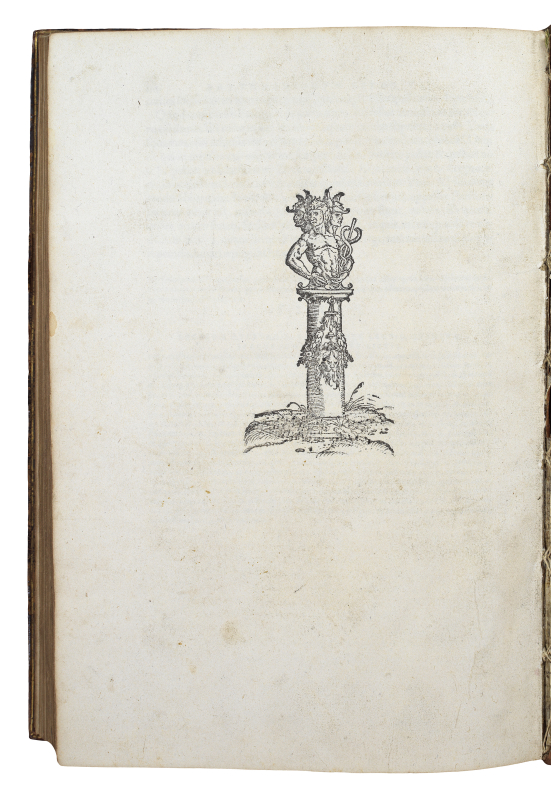
Large printer’s mark of Hervagius (Johann Herwagen the elder) on the title, and a different one on the verso of the last leaf, both depicting a three headed Hermes on a pillar. Woodcut initials, 8 woodcuts and a woodcut map of the world in the text.
A marvelous copy, without doubt the nicest extant, of this important edition, bound for Thomas Mahieu or Maioli.
With Henri II and Jean Grolier, Maioli belongs to the greatest bibliophiles of the sixteenth century to have patronised the leading Parisian bookbinders of the day. Due to the inscription Tho. Maioli et amicorum that was gilt on the front covers of his books, it was long thought that Thomas Mahieu was Italian and that his bindings had been made in Italy. It was Geoffrey Hobson who first showed in 1926 that Thomas Mahieu was French, he was the son of Jean Mahieu (d. 1527), Receveur de Beauvais in the office of Jean Grolier, Trésorier général de Milan, during the six years of the second French occupation (Veyrin-Forrer, “Notes sur Thomas Mahieu,” pp. 321–349). It is supposed that he was educated in Milan, and that Italian was his native language. In 1547, he was appointed Conseiller secrétaire du Roi, probably through the influence of Grolier, and from 1549–1560 was principal secretary to Queen Catherine de’ Medici of France secretary and it is from this period that the finest bindings commissioned by him date. Like Grolier, he added the words ‘et amicorum’ and a motto to his name, in this case ‘Ingratis servire neplas’ (it is bitter to serve the ungrateful).
Antony Hobson has catalogued 112 splendid bindings from his library, which appears to have been dispersed in Orléans after his death. This one, listed under no. 72, was made in Paris around 1557.
Some skillful restorations, rebacked conserving the original spine.
Provenance: Thomas Maioli ; Sotheby’s London, 27 December 1951, n° 172 ; Librairie Lardanchet, cat. 57, n° 202 ; Otto Schäfer, n° 359 ; European private collection.


Monday to Saturday
10am – 1pm and 2:30pm – 7pm
(6pm Monday and Saturday)
© 2023 All rights reserved.