
VENDU
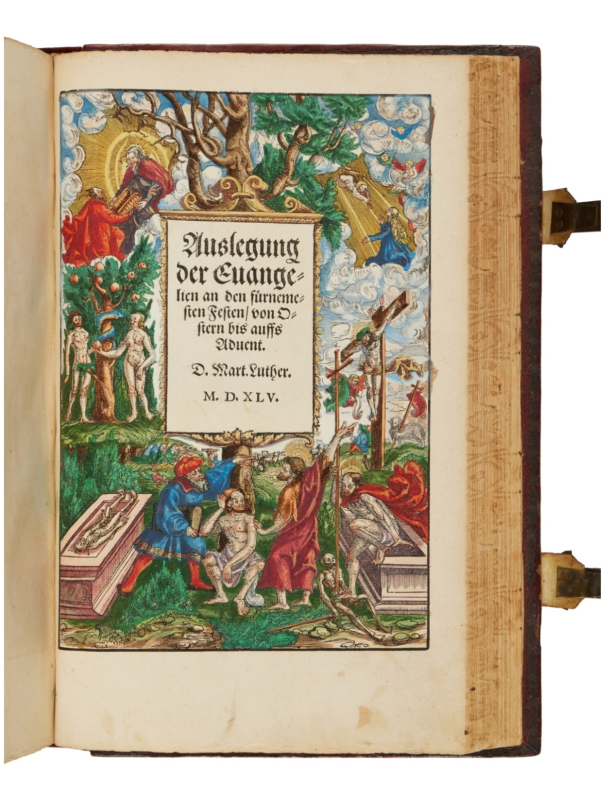
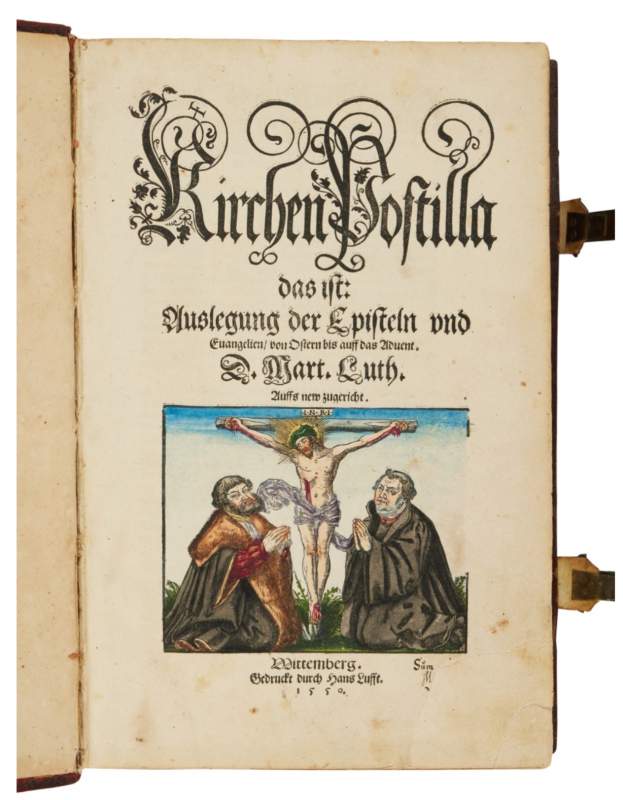
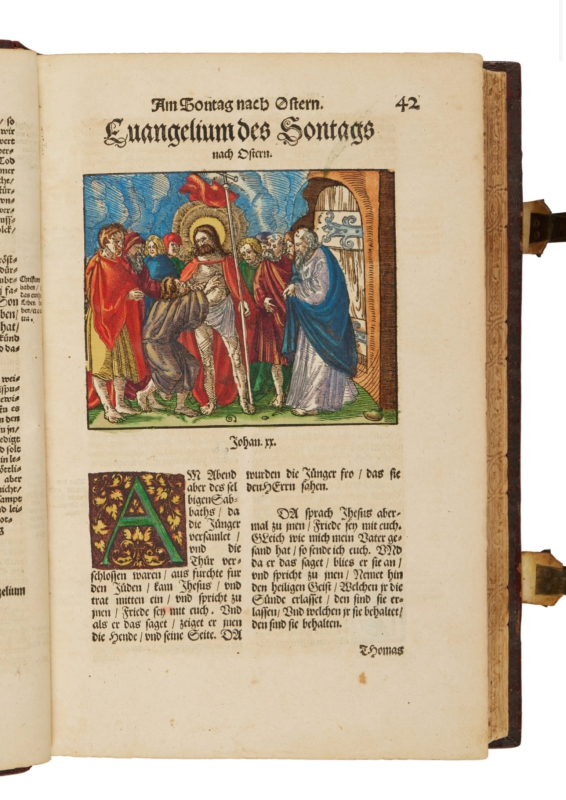
[bound with]: LUTHER, Martin. Auslegung der Euangelien an dem fürnemsten Festen, von Ostern bis auff Aduent. Leipzig, Nikolaus Wolrab, 1545. Folio, (315 x 203 mm). 406 ff. (Tt4 blank, last two signatures of index bound at front like in most copies); including a woodcut on title-page, 40 large woodcuts in text (15 by Hans Brosamer), all woodcuts and initials colored by a contemporary hand, some heightened in gold; II: final quire signed *8 headed “Register”), historiated woodcut title-border, 9 woodcut illustrations by Hans Brosamer, 11 by another hand, all also colored by a contemporary hand. Contemporary marvelous Dresden red morocco (326 x 222 mm), dated 1552, by Jakob Weidlich for Georg von Ebeleben, full details below.
1 in stock
(I) VD16 L-5616; USTC 669930; The New Hollstein: Hans and Martin Brosamer II, p. 84; B. Gotzkowsky, Die Buchholzschnitte Hans Brosamers in Werken Martin Luthers, p. 118, no.5; (II) VD16 L-3992; Benzing, Lutherbibliographie, no. 1127; The New Hollstein, p. 39; Gotzkowsky, pp.225–226, no. 1. For this and related bindings, see Foot, “A Leipzig Binding for Nikolaus von Ebeleben,” in The Henry Davis Gift: A Collection of Bookbindings, Volume 1: Studies in the History of Bookbinding (London, 1978), p. 276; Fliege, “Die Bibel des Nikolaus von Ebeleben im Besitz der Staatsbibliothek zu Berlin—Preußischer Kulturbesitz,” in Mitteilungen der Staatsbibliothek zu Berlin N.F. 7 (1998), pp. 267, 289: “Die Staatsbibliothek hat sich sehr bemüht, dieses wertvolle Stück zu ersteigen, wurde jedoch in der Auktion weit überboten”).
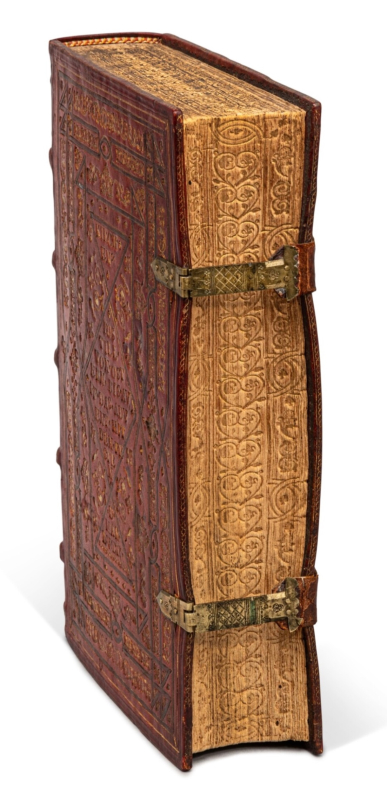
An extraordinary mix of binding, colour, and provenance, the luxurious Von Ebelen copy of Luther’s Kirchen Postilla and the Auslegung der Euangelien, with all woodcuts in brilliant vibrant contemporary colour by a German hand, often heightened in gold, covered by the exquisite German binding by Jakob Weidlich, richly tooled and in exceptional condition.
The first work that comprises this sammelband is a collection of sermons for the Sunday epistle and gospel passage, from Easter through the 26th Sunday after Advent (“Sommerteil”). They are not sermons from Luther’s own pen, but collections made by Stephan Roth of notes taken by listeners in Wittenberg, originally published without Luther’s participation or permission in 1526, here revised with Luther’s approval by Kaspar Creutziger, and dedicated to Georg III von Anhalt-Plötzkau, at Wittenberg, in 1544. In 1545, Nikolaus Wolrab reprinted at Leipzig Roths Festpostille, his compilation of gospel periscopes on the saints’ and festival days for the entire year, in two parts (winter and summer). Bound-in here is the summer volume too.
Illustration:
Both works are copiously including a woodcut on title-page, 40 woodcuts illustrations, of which 15 by Hans Brosamer, woodcut initials, all woodcuts and initials coloured by a contemporary German hand, some heightened in gold; II: final quire signed *8 headed “Register”), historiated woodcut title-border incorporating various Biblical scenes, 9 woodcut illustrations by Hans Brosamer, 11 by another hand, woodcut initials, all also coloured by a contemporary German hand, some heightened in gold.
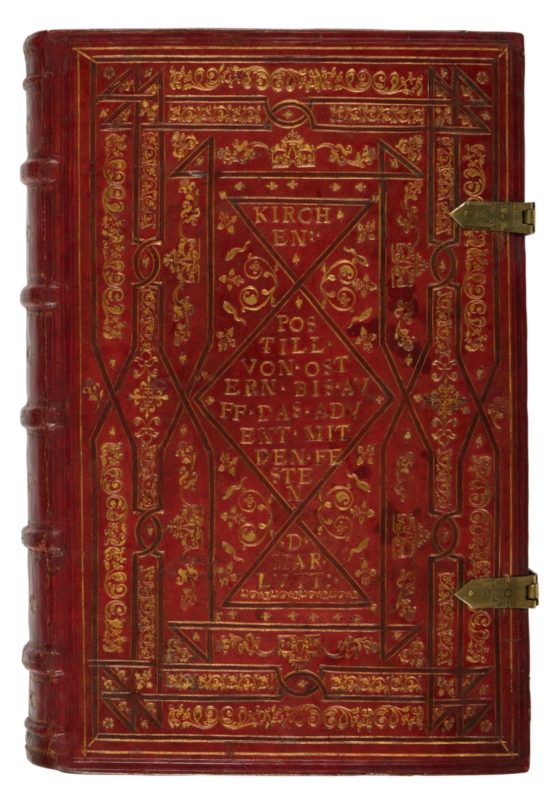
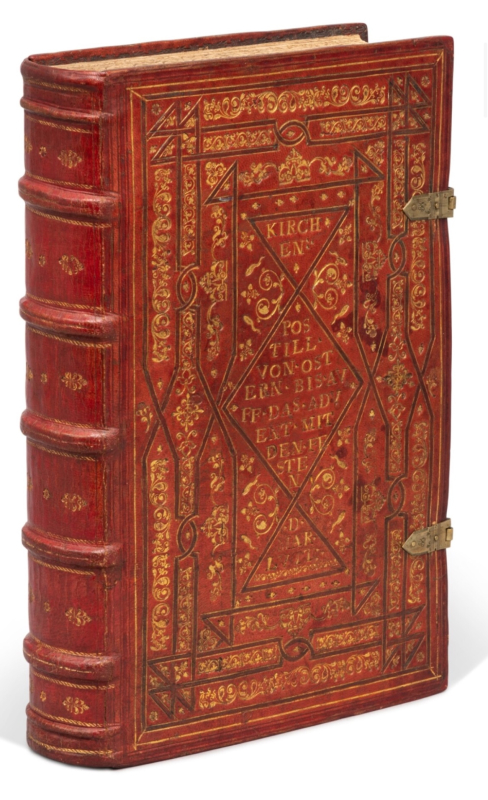
Binding:
Contemporary marvelous Dresden red morocco (326 x 222 mm), dated 1552, by Jakob Weidlich for Georg von Ebeleben, double fillets forming an intricate strapwork design of intersecting rectangles, enameled black, interspersed with a large variety of solid ornamental and floral tools, in center interlacing strapwork lozenge with 2 triangular finials, all filled with title in gold letters on upper cover and “IORG VON EBELEBEN M:D:LII” on lower, 2 clasps, spine with 5 full and 2 half bands, compartments decorated in gilt, edges gilt and gauffered;
This exceptional binding is a fine example of the diffusion of Italian Renaissance bookbinding styles, in this case from Bologna to Dresden. The binder, Jakob Weidlich settled in Dresden sometime before 1550, found work at the kursächsischen Hof, and in 1564 cofounded the local bookbinders’ guild (Einbanddatenbank, workshop w003975). According to Ilse Schunke, Weidlich was a binder “adaptable and receptive to everything new” (Leben und Werk Jakob Krauses, p. 62). Two bindings now in Weimar executed by Weidlich ca. 1549–1550 might be Nikolas von Ebeleben’s first commissions. About 1553, Nikolas commissioned Weidlich to bind Luther’s works in German. Eight (of twelve) volumes of this set have survived: five in red goatskin bindings by Weidlich, these imitating Bolognese styles, and three in brown goatskin bindings by Thomas Stelbogen of Leipzig, in German style. Altogether, eleven bindings by Weidlich for Nikolas are known (Einband Forschung 18 (2006), pp. 25–33; 19 (2006), pp. 26–37).
The owner of the present volume, Georg (Jörg) von Ebeleben (ca. 1500–1554), was Nikolas’s brother. Five volumes from a Wittenberg edition of Luther’s works (published 1550–1552) are said to be bound similarly, in red goatskin, with “Iorge Von Ebeleben” and date 1552 lettered on the lower covers (Foot, Henry Davis Gift, 1, p. 276). Either this set was a gift from Nikolas to Georg, or Georg commissioned Weidlich to copy bindings he admired in Nikolas’s library. Another brother, Hans (ca. 1500–1569), was late to the party: his set of Luther’s works in German was bound in 1560 by Stelbogen (Foot, p. 277).
Nikolas and Georg and Hans were three of seven sons of Apel von Ebeleben (ca. 1460–1528) and Agnes von Löser. Unlike Nikolas, who matriculated at six universities (the last Ferrara, in 1546), and married late (1555), Georg skipped university, and ca. 1530 married Margarethe Zenger von Thanstein. After the death of her father, they came into possession of Hofmark Thanstein, and it remained an Ebeleben seat for one hundred years. Georg entered the service of the Schwarzburg-Leutenberg, became a councilor in Neumarkt, later a Palatine bailiff in Waldmünchen. In 1552, he was in the entourage of Kurfürst Friedrich II von der Pfalz; in 1553, he was appointed Hofmeister of Neunburg. Georg died 5 December 1554. Shortly after his death this book seems to have left the possession of his family.
Weidlich’s binding for Georg is not an exact copy of those he executed on Luther’s works for Nikolas. Georg’s volume has five raised bands on the back, whereas Nikolas’s uniformly have four; the geometric bandwork on Georg’s binding is painted black, and the covers on Georg’s binding are closed by clasps (stamped “PB”). Such differences led Jutta Fliege to suggest that our volume might perhaps have emanated from a different shop (Einband Forschung 4, p. 52).
Minor repair to spine and corners. Lower fore-edge corner torn from first title-page, d5 in first work with long repaired tear into text, c1.6 and h1.6 in second work very browned, occasional browning and marginal soiling.
Provenance: Georg von Ebeleben’s (1505?–1554) supralibros on boards; inscription “Melcher von Swarewock” (?) ”Aller Iurã un vagesso” (?) and date (1567, or 1561?); Venator & Hanstein, Auktion 75, Cologne, 14–15 October 1996, lot 687, purchased by an unidentified owner; Reiss & Sohn, Auktion 86, Königstein im Taunus, 15–18 October 2002, lot 1239; T Kimball Brooker, American collector.

Monday to Saturday
10am – 1pm and 2:30pm – 7pm
(6pm Monday and Saturday)
© 2023 All rights reserved.