“FREUD Sigmund Die Traumdeutung.” has been added to your cart. View cart
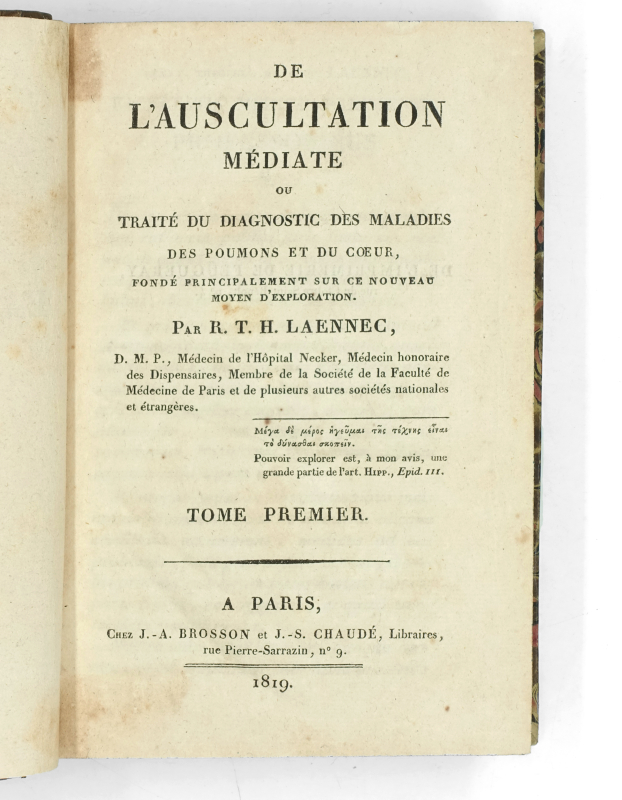
LAENNEC R.T.H De l’Auscultation médiate ou traité du diagnostic des maladies des poumons et du coeur, fondé principalement sur ce nouveau moyen d’exploration.
VENDU
Paris, J.-A. Brosson & J.-S. Chaudé, 1819
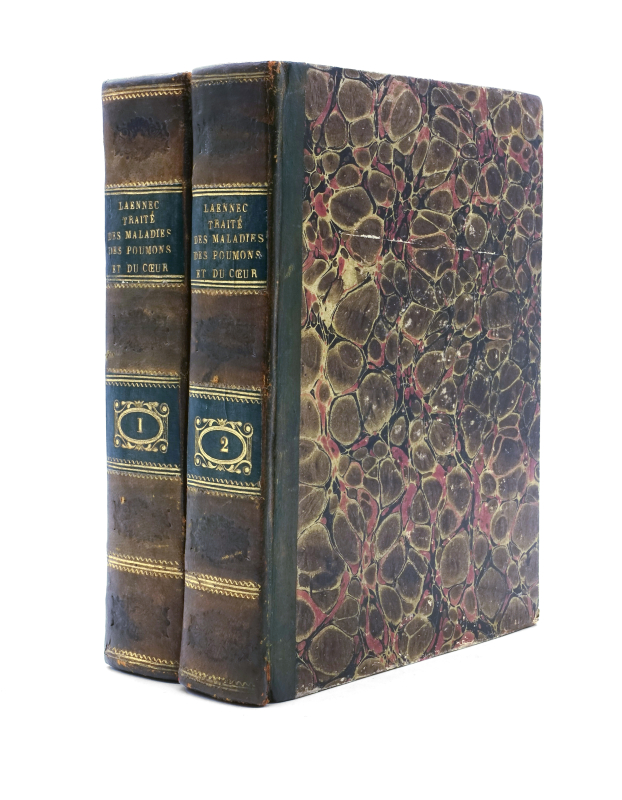
2 volumes 8vo (191 x 124 mm) de XLVI (mis numbered XLVIII), 456 pp., 4 nn.ll., 4 engraved foldiong plates for volume I; XVI, 472 pp. for volume II. Contemporary green half-sheep over marbled boppards, flats spine gilt, blue speckled edges.
Garrison-Morton, 2673; PMM, 280; Norman, 100 books famous in medicine, 57; Norman cat. 1253; Heirs of Hippocrates, 1364.
First edition, first issue.
The publication of this work marked the first major revolution in the study of chest diseases. Auscultation, using the stethoscope, was in fact the first rigorous and objective method of examining a patient. Hippocrates had described chest sounds, but Laënnec was at a loss as to how to amplify them to improve the quality of auscultation. During a walk in a public garden, he was inspired by a children’s game in which a beam was used to transmit the sound of scratching to one of its ends; he immediately used this technique to examine a patient using a rolled-up notebook. He soon mastered auscultation and classified symptoms.
“Laennec’s invention of the stethoscope provided the first adequate method for diagnosing diseases of the thorax, and represented the greatest advance in physical diagnosis between Auenbrugger’s percussion and Röntgen’s discovery of x-rays” (Norman). “Laënnec was undoubtedly the most prominent French internist of his day. His ingenious use of a roll of paper as a first stethoscope opened an entirely new field of physical diagnosis, and by this means he virtually created the physical diagnos of pulmonary diseases, giving clear, concise definitions of phtisis, pneumothorax, emphysema, etc.” (Heirs of Hippocrates).
“Laennec made his name immortal by his invention of the stethoscope in 1819 (at first only a cylinder of paper in his hands), and by the publication of the two successive editions of his Traité de l’auscultation médiate in 1819 and 1826. This work placed its author among the greatest clinicians of all ages and had better luck than Avenbrugger’s, for it was immediately taken and translated everywhere. It is the foundation stone of modern knowledge of diseases of the chest and their diagnosis by mediate auscultation” (Garrison, History).
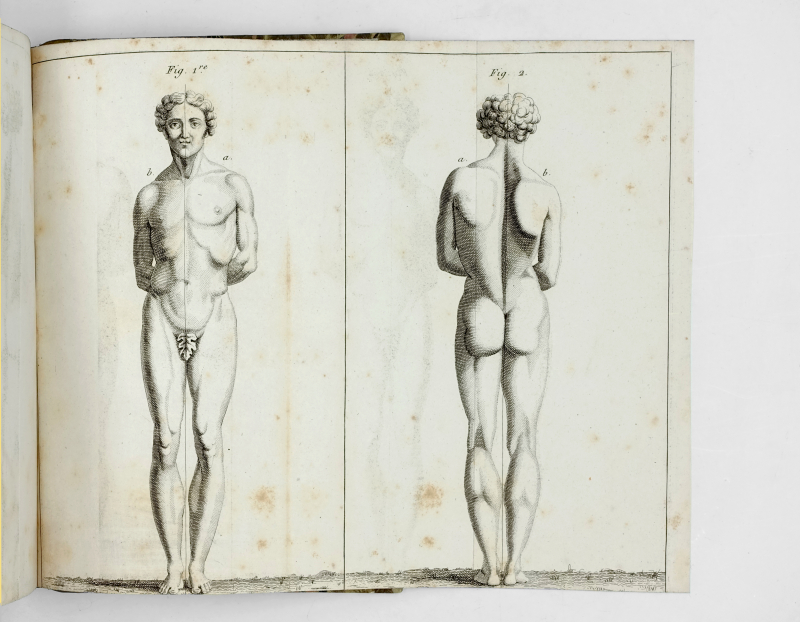
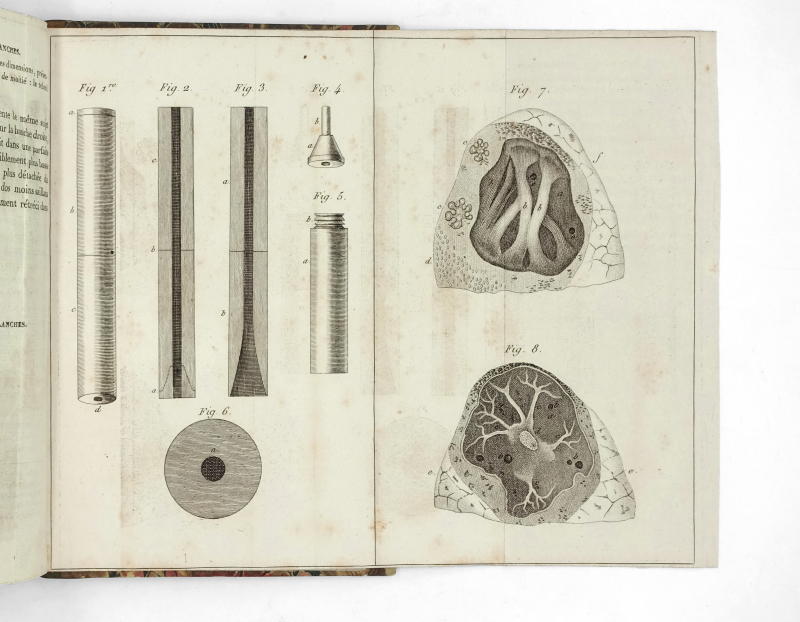
The four plates show the stethoscope, pathologies of the lungs and deformations of the thoracic cage.