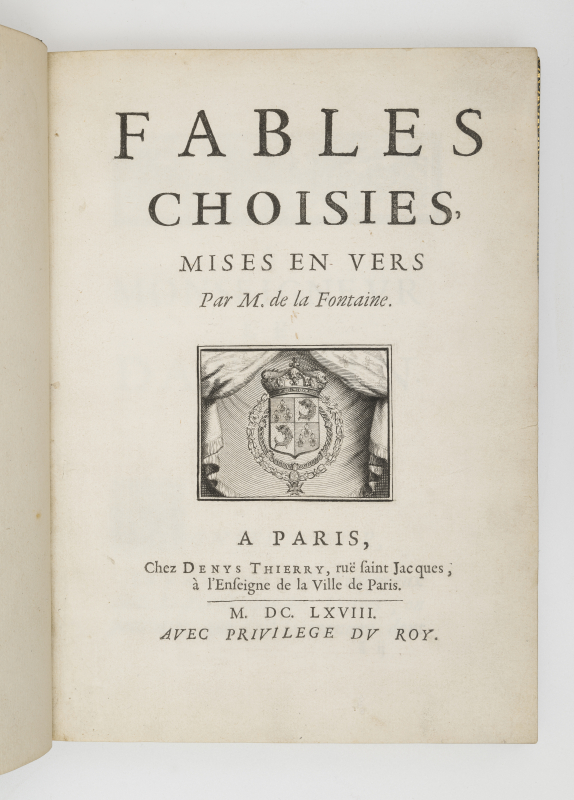
Rochambeau, no. 1 – not in Desprès, Bibliography of Illustrated Books of La Fontaine’s Fables. – Tchemerzine, III, p. 866.
Rare first edition of the first six books of the famous La fontaine’s Fables
The work was published in association with Claude Barbin; the privilege is dated 6 June 1667.
Inspired by Aesop, Phaedrus and the humanist fabulists, La Fontaine renews this tradition thanks to the flexibility of his verses, the psychological finesse and the moral scope of his stories. “In these early fables, charm, flavour, colour, liveliness and topicality give striking visual (and mnemonic) relief to the old “Aesopian” plots, which are more or less comic, more or less tragic, but which, in the poet’s choice, paint a multifaceted, comic, tender, but more often than not singularly dark.” (Marc Fumaroli, Le Poète et le Roi. Fallois, 1997, p. 352).
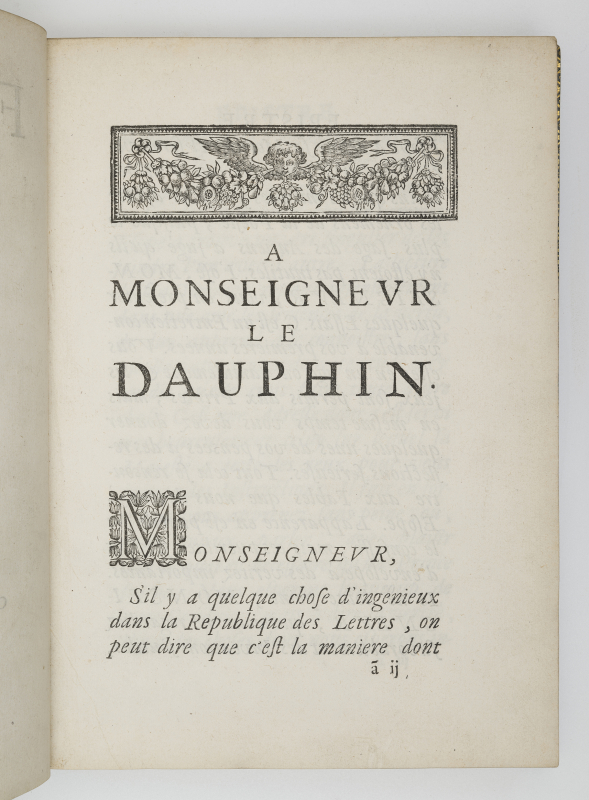
La Fontaine completed these first 124 fables — dedicated to the Grand Dauphin — with books VII to XI, published in 1678-1679, then with book XII in 1694.
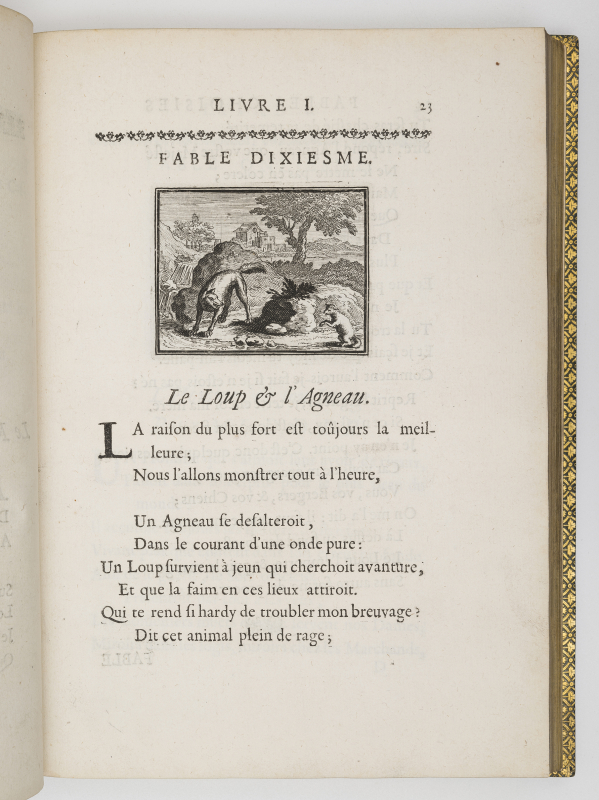
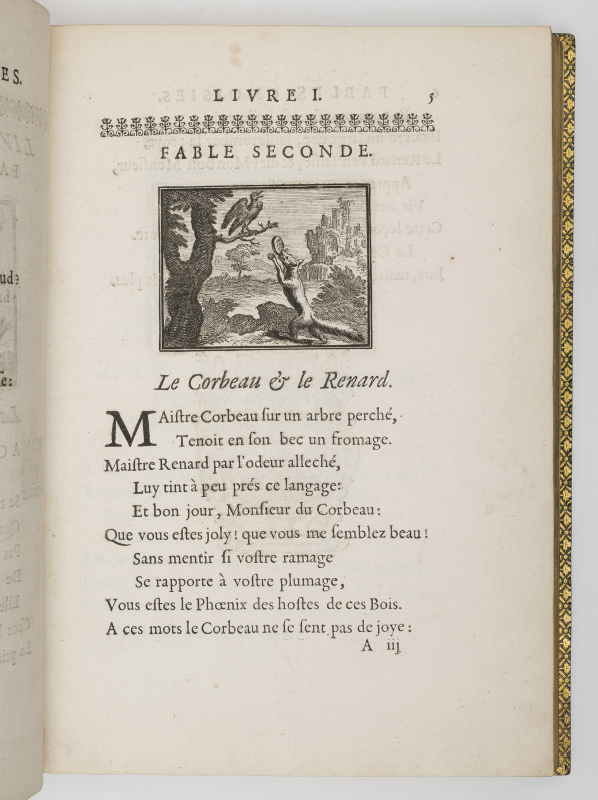
This first edition is decorated with 118 vignettes engraved in intaglio by François Chauveau. This series contributed greatly to the immediate success of the collection and was reused and supplemented in subsequent editions.
Alain-Marie Bassy, in Les Fables de La Fontaine, quatre siècles d’illustration (Promodis, 1986, pp. 41-42), highlights Chauveau’s hesitations between tradition and modernity. ” None of Chauveau’s animals wear clothes or human attributes. While these engravings remain, as we shall see, inspired by a bourgeois spirit, they never verge on the burlesque. (…) In his illustrations for the Fables, Chauveau drew on Italian influences for the ancient costumes he dressed La Fontaine’s human characters in (…). In his illustration of the Fables, Chauveau showed himself to be a ‘classicist’. The hieratic nature of the characters, the rejection of violent or disorderly scenes, the constant presence of man and human measure at the centre of the universe, the obligation he imposed on himself to respect the unity of place and time, his determination not to question the definitional categories of human nature in relation to the animal species, and his obedience to principles — nature, reason and truth — which are those of classicism itself: these are all significant features.
The fact that Chauveau rejected the Italian style of Faërno’s edition of the Fables or that of the Mythology proves one thing: that he felt that such a style was reserved for works other than those of the fabulist, and that he made a distinction between a major genre and a minor genre. The great genre, that of tragedy or heroic poetry, deserved all the pomp of art, that is to say, properly speaking, an art in the major key. It seems that from the outset he accepted that the Fables were a minor genre, lyrical if you like, but one which, in any case, required only a little support for the flights of imagination.
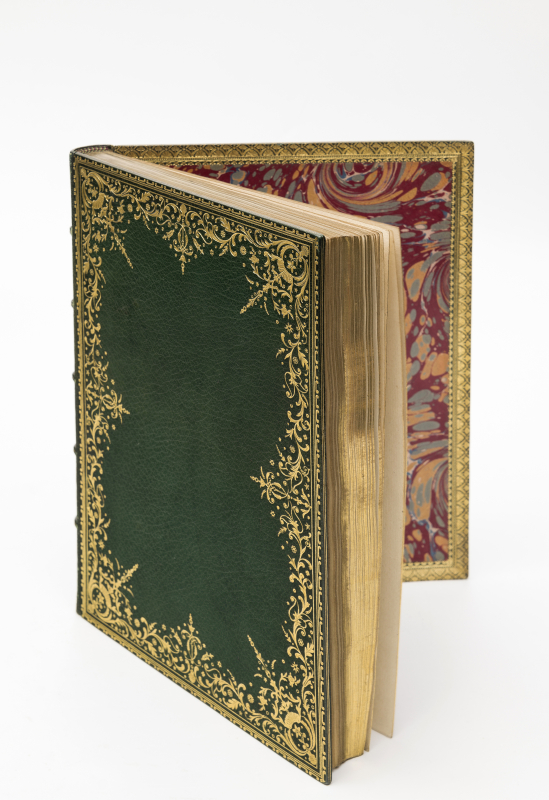
F. Oii (Life of Aesop) hardcover, as described in Tchémerzine. Copy washed, with discreet marginal restorations on several pages. Minimal rubbing.
Provenance : Jean Siegler (bookplate) – Jean A. Bonna (book plate).