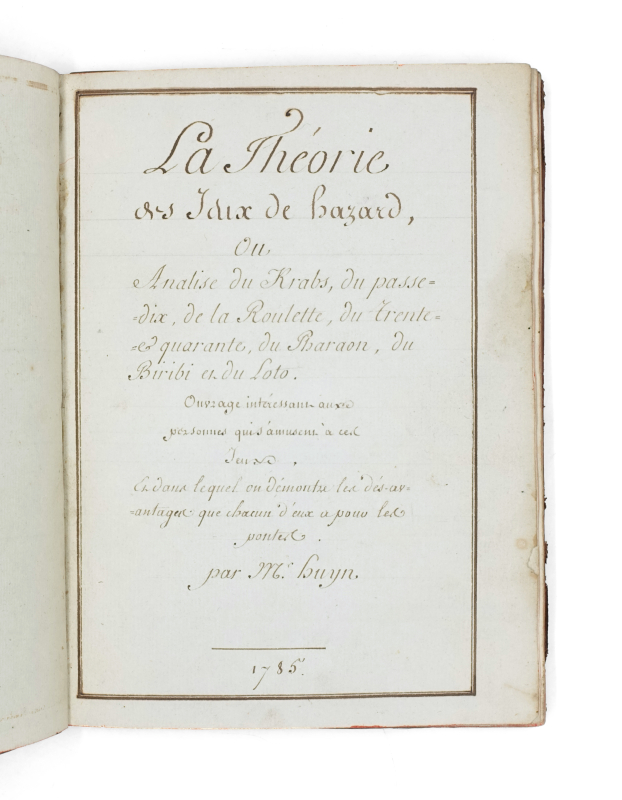
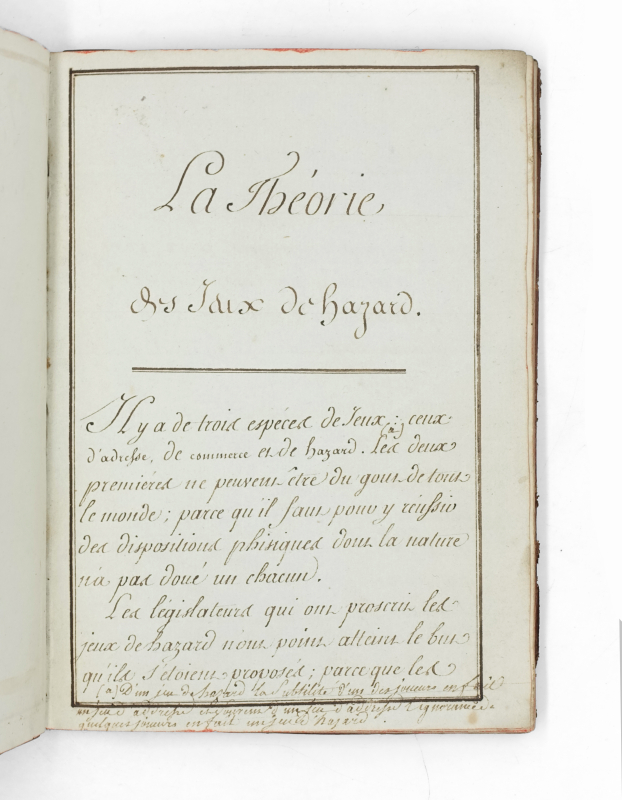
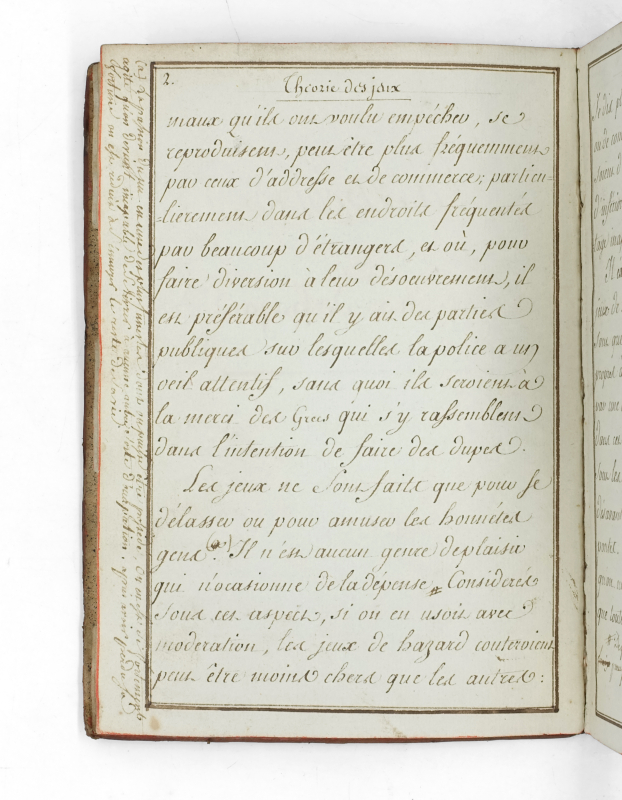
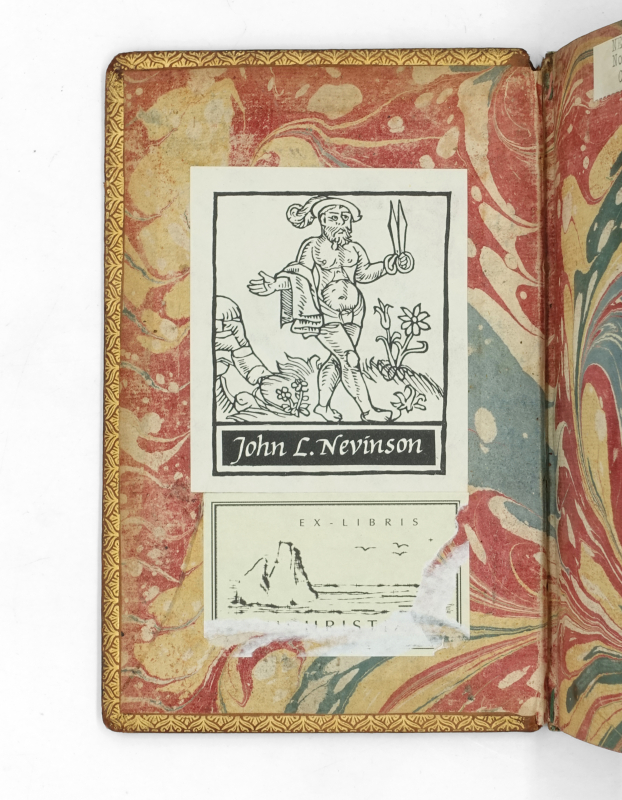
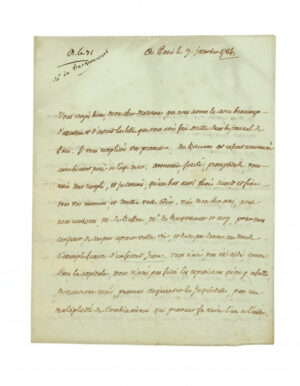
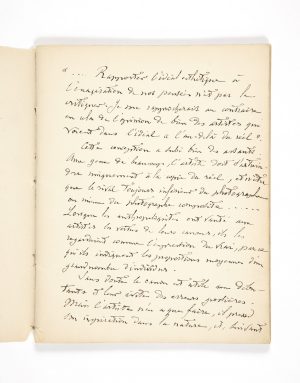
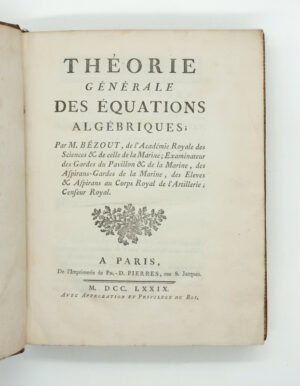
An exceptional manuscript, likely in the author’s own hand, devoted to games of chance.
The lottery was introduced in France by the illustrious Giacomo Casanova (1725–1798) who, during his stay in Paris, proposed—to finance the construction of the military school in honour of Louis XIV—the creation of a new system to increase state revenue: this involved a National Lottery to fund the establishment of the national military school. The project was finally approved by two official decrees (15 August 1757 and 15 October 1757). Transformed into the Royal Lottery of France in 1776, the state held a monopoly that enabled it to collect between 5 and 7 per cent of its annual revenue. ‘The royal lottery was, alongside the bank, the first instrument of public administration established in ancient political regimes’ (Presses universitaires du Septentrion).
Father Huyn’s manuscript examines the probable gains and losses of players, and bears the subtitle ‘A work of interest to those who enjoy these games, and in which the disadvantages each presents to the bigwigs are demonstrated’. His manuscript begins with an overview of the ‘Theory of games of chance’. “There are three kinds of games: those of skill, of trade, and of chance…. In this work I set out the theory of those that are most widely played and demonstrate the real disadvantages that each of them presents for the house” (pp. 1–3).
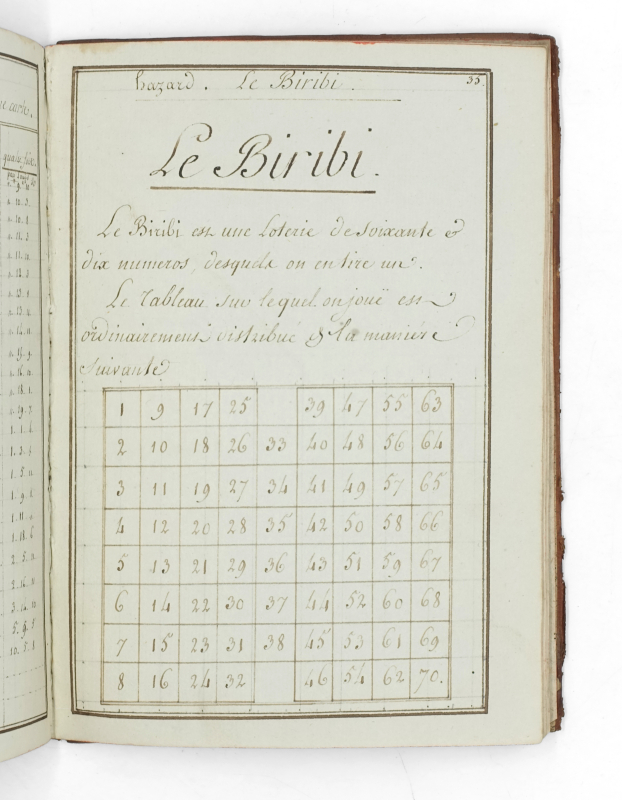
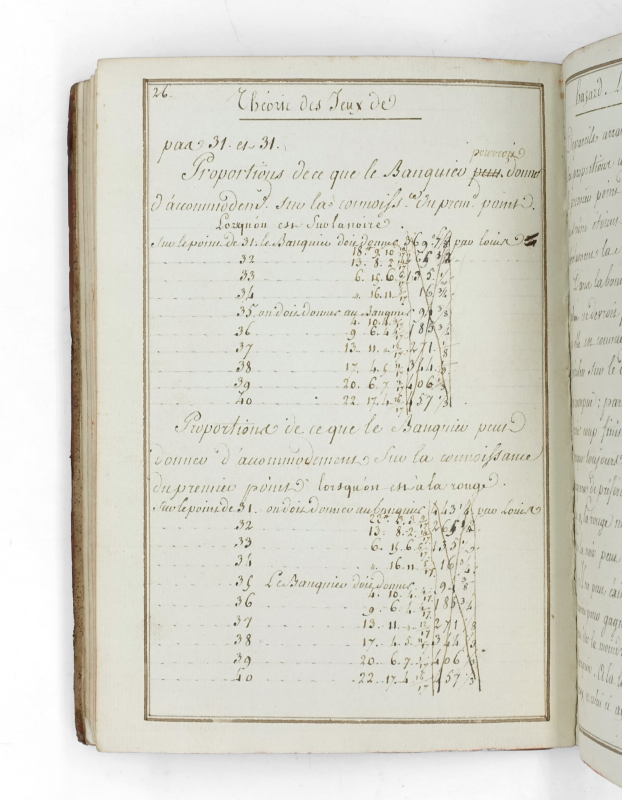
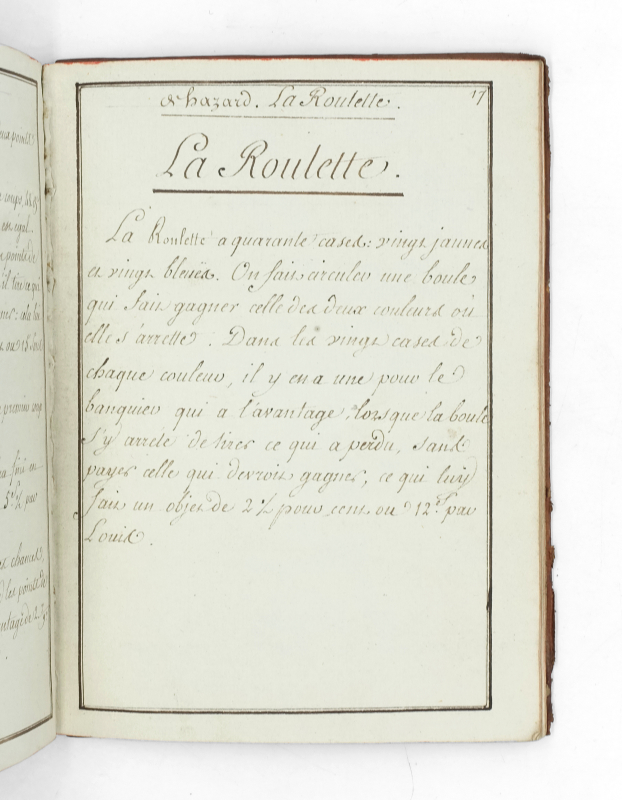
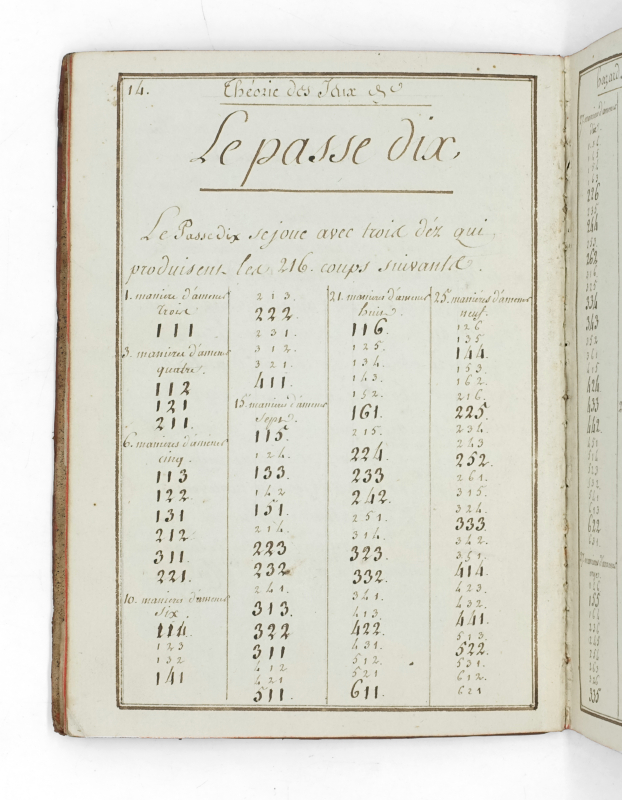
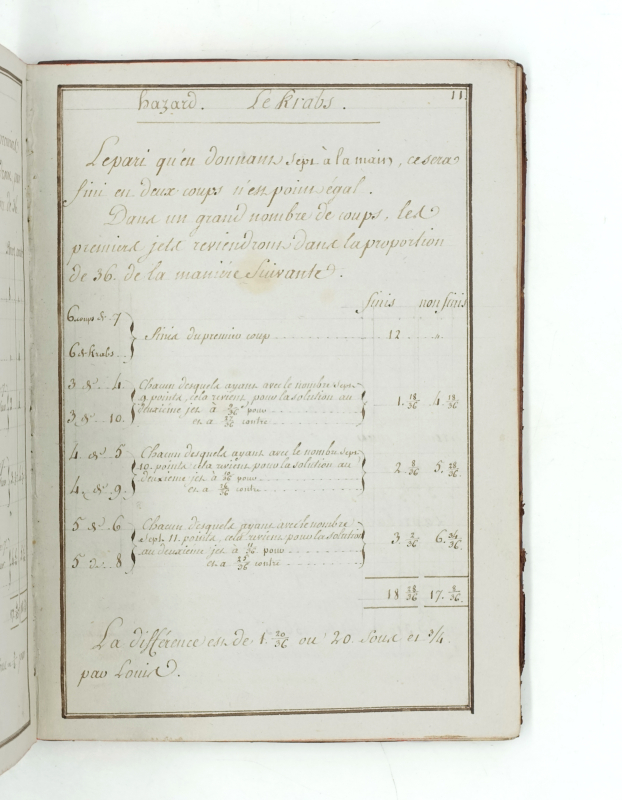
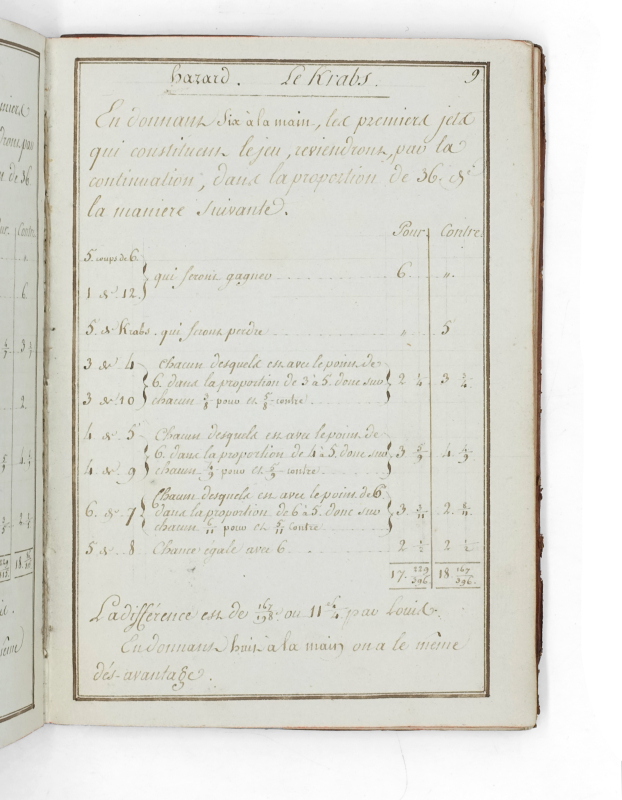
This is followed by explanations of games such as: Krabs, Passe Dix, Roulette, Trente et Quarante, Pharaon, Biribi, and Loto. The author first sets out the rules of the game, followed by precise tables for calculating the probabilities of winning. These calculations are genuine statistics, the aim of which is effectively to convince people not to indulge in games of chance, as demonstrated by the figures provided.
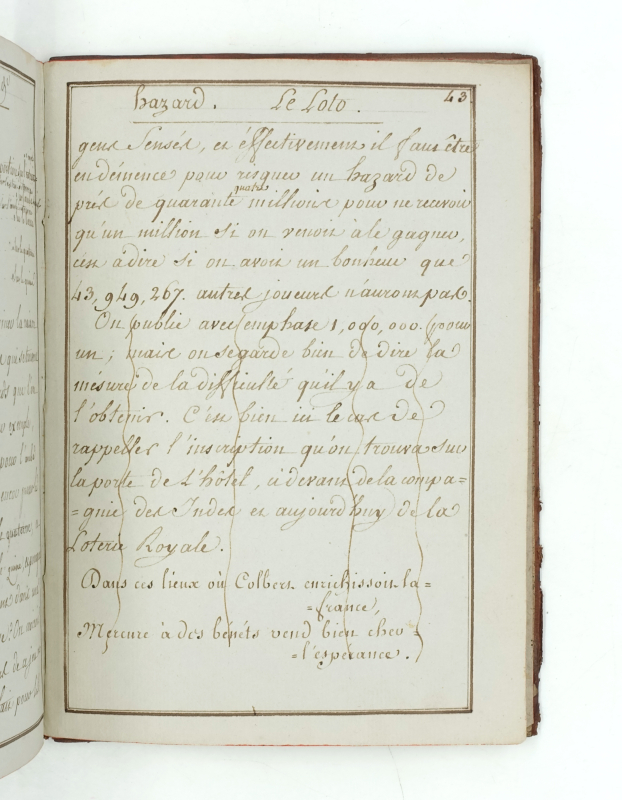
This manuscript differs significantly from the book printed in 1788. Some of the footnotes are phrased using different vocabulary. The chapters are not structured in the same way. Certain passages present in this manuscript were not included in the printed version (for example, in the chapter on Le Biribi, two paragraphs were removed). The end of the printed version contains a long paragraph on the harmful effects of lotteries which is not present in the manuscript. On the other hand, the latter contains – like the printed version – a reflection on the ethics of lotteries: ‘It is indeed appropriate here to recall the inscription found on the door of the hotel, formerly of the Compagnie des Indes and now of the Royal Lottery: In these places where Colbert enriched France / Mercury sells hope dearly to fools’.
A very fine manuscript, the printed version of which is not even held by specialist collections such as Kress, Goldsmith’s or Einaudi.