
VENDU
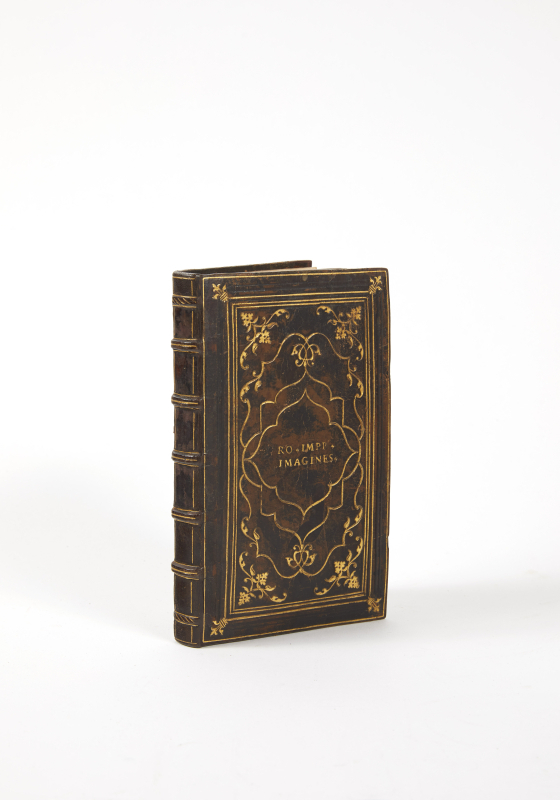
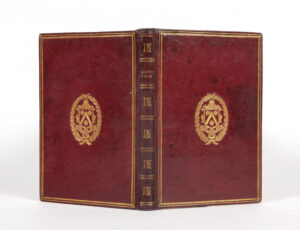
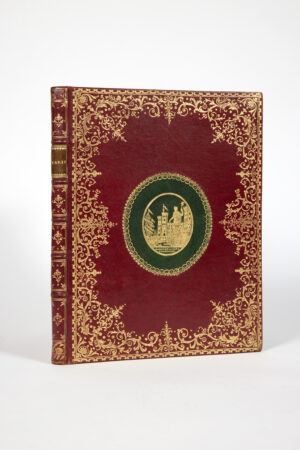
8vo (165 x 100 mm) 8 unn.l., 82 [i.e. 89] num.l., 3 unn.l; contemporary calf, covers richly within gilt borders, upper cover with gilt title ‘Ro.Impp.Imagines’, lower cover with the gilt indication ‘Grolierii et Amicorum’, spine gilt with raised bands, gilt edges, modern slipcase.
1 in stock
VD-16, H-6473; Austin, 237; for a smiliar binding see : BNF, Reliures, Smith-Lesouef R-274 (for a Sallust. De conjurationes. Venice, Aldus, 1508); Hobson, Renaissance Book Collecting, p. 224, n° 237 & p. 58.
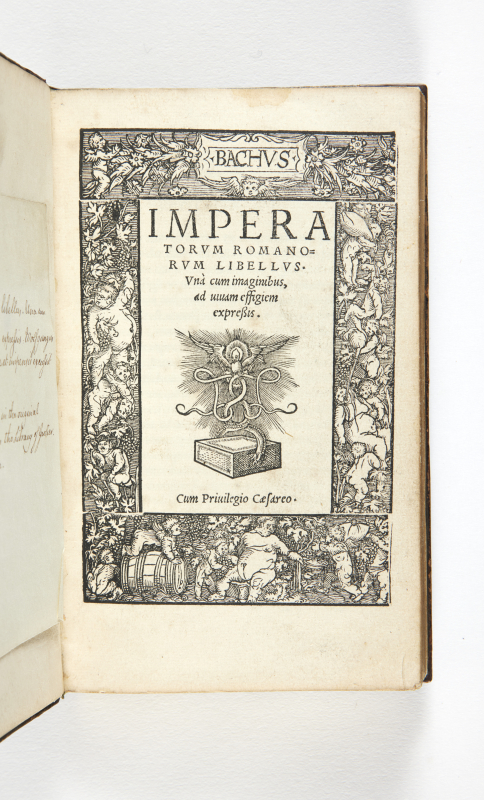
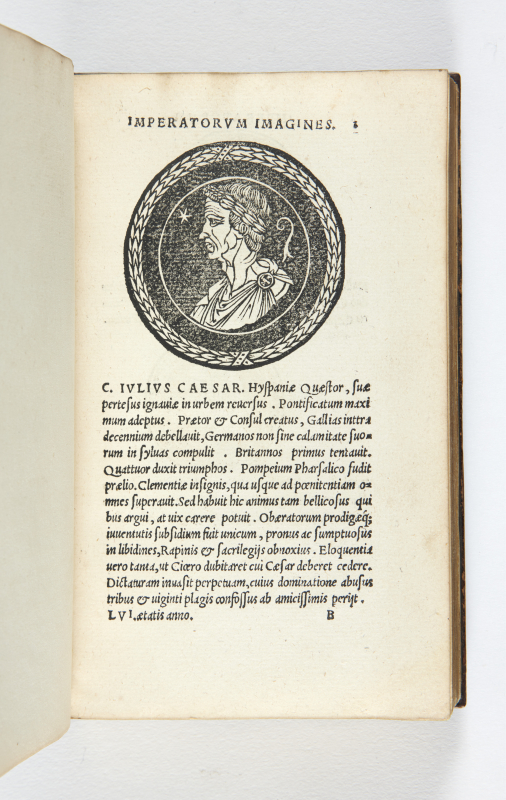
Second edition of this magnificent numismatic work, elegantly produced by Köpfel, Johannes Huttich’s history of the Roman emperors, from Julius Caesar to Holy Roman Emperor Ferdinand I. Exceptional copy bound for Jean Grolier
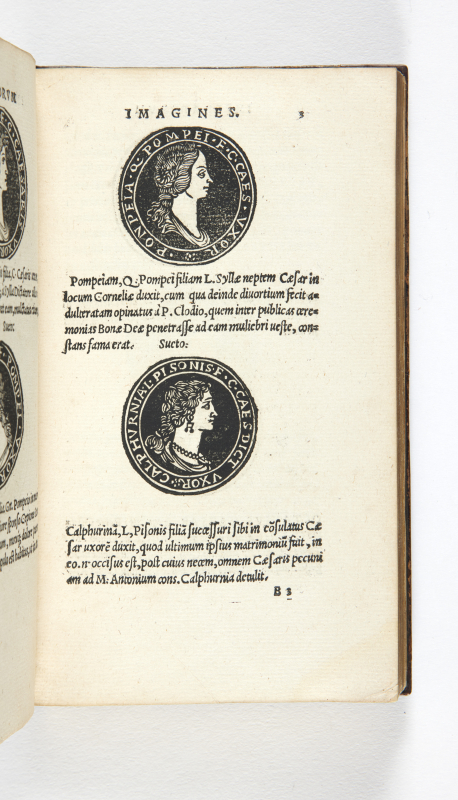
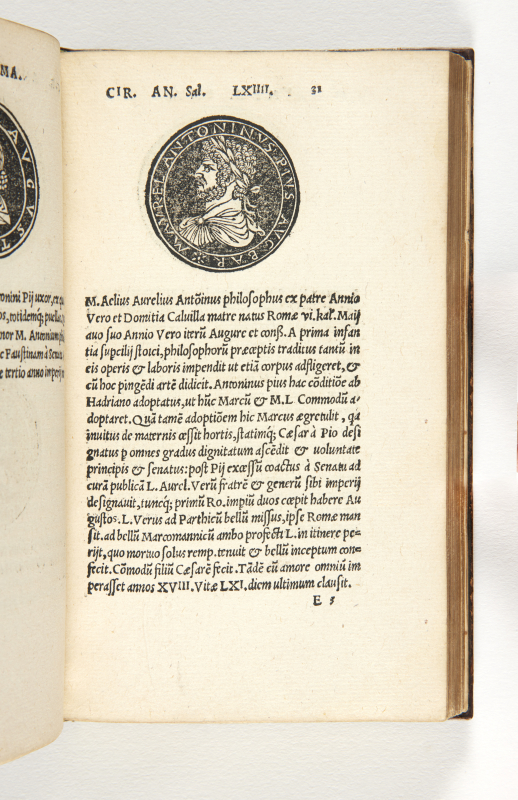
A native of Mainz, humanist, antiquarian and archaeologist Johannes Huttich (1490-1544) was the first person north of the Alps to write on numismatics. He was a friend and correspondent of Erasmus and Ulrich von Hutten. This edition is a reprint of the first of 1525, but the characterful title border by Hans Weiditz, depicting a bacchanalia, is new to this edition (see A.F. Johnson, German Renaissance Title-Borders, no. 40). Emperors and their wives are illustrated in roundels and described beneath, accorded anywhere between two lines and a full page of biography. Of the 263 medallions here, 78 have been left empty; the remaining 185 contain striking woodcut portraits executed in intaglio, i.e. the portraits themselves are white on a black, printed ground. Some of these portraits are copied from those in Andrea Fulvio’s Illustriu[m] ymagines, Lyon, A. Blanchard, 1524, in turn copies of those used by Jacopo Mazzocchi, based on coins and medals in his collection, for the first edition of Fulvio’s work in 1517 (Mortimer, French I, no.242). Huttich continues the portrait series beyond the emperors of classical time to medieval emperors of the Hohenstaufen and Hapsburg lines. Many of the portraits in the republican and medieval sections are imaginary; only those of the imperial period have a claim to authenticity being based on contemporary coins. The last five portraits, illustrating the Holy Roman Emperors, are based on contemporary paintings or commemorative medals. Most of the illustrations here are by Hans Weiditz; the final, larger five are particularly distinctive as they are based on actual likenesses of the people depicted, down to Charles V’s characteristic Habsburg chin. The influence of these portraits on the decorative arts in northern Europe is well attested; artists used the book as a pattern book. (cf. E.P. Goldschmidt, The Printed Book of the Renaissance).
Jean Grolier’s copy bound by the ‘Fleur-de-Lis-binder’
This lovely work, one of the finest devoted to numismatics in the 16th century, was bound for Jean Grolier, the most esteemed bibliophile and numismatist of his time. Treasurer Grolier’s collection of coins and medals was considered the most prestigious in France at the time. It was intercepted at the last minute by King Charles IX as it was leaving France for Italy upon Grolier’s death. Acquired at a high price for the royal collections, it was nevertheless dispersed during the pillaging by the League at the end of the 16th century, and its trace was unfortunately irretrievably lost.
Produced in the early 1540s, this binding belongs to Jean Grolier’s last library, assembled in Paris after 1536, when his second library was dispersed by order of Parliament. After having been wrongly accused for embezzling taxpayers’ money in the early 1520′ Grolier was sent to prison in the 1530′ but was released in 1538.
“The fact that he was guiltless was widely recognized. Bandello commended the prudence and constancy with which he had suffered the raging blasts of misfortune, his heroism in submitting to its battering and his wisdom in opposing the shield of innocence to its poisonous darts.
Grolier had been reinstated in his office of Treasurer of France by April 1538. As soon as he was released, he began to rebuild his library.
He bought another copy of the Aldine Livy; two copies of Huttich’s series of emperor portraits based on the Roman coinage; books published in Lyons during his imprisonment – Marliani’s topography of Ancient Rome, Lazare Baïf on Roman clothing, Sadoleto on the fiftieth Psalm; he bought Latin poetry by Pontano and Sannazaro and Vida. He had them bound by, and probably bought them from, a man known in the literature as the ‘Fleur-de-lis binder’” (Hobson)
« Pierre Roffet, Grolier’s first Parisian bookbinder, had died in 1533. His equipment was inherited by his eldest son Etienne, who was appointed bookbinder to King Francis I in 1539 and printer of his Ordonnances sur le faict des monnoyes in 1540, copies of which, bound in his workshop, provide us with precise information about the gilding equipment used by this legendary bookbinder, who created sumptuous bindings for the king’s Bellifontaine library and for Jean Grolier. It is interesting to note, when comparing the tools used on our copy with those used on a binding of the Ordonnances produced at the same time (Esmerian I, 1972, lot 66), we can see that Huttich’s leafy accolade tool is a very close variant of the one used in the same way on the official bindings of the Ordonnances by Etienne Roffet. Similarly, the small fleur-de-lis repeated on the inner edges is a copy of the fleur-de-lis stamped on the back of the Ordonnances and not the tool used by Pierre and Etienne Roffet. The question arises as to whether this binding might have come from the workshop of Jean Picard, who at that time was an importer for the Aldine workshop in Paris (from 1540 to 1547) and a bookbinder, and was in constant contact with Jean Grolier, a friend of François d’Asola and himself a great lover of Aldine editions, to whom he showed his accounts on a monthly basis. Overtaking Claude de Picques in terms of the number of works attributed to him, Jean Picard established himself as one of Jean Grolier’s main Parisian bookbinders during the 1540s. In 1547, heavily in debt to the printing house, Picard disappeared; he was replaced that same year by Gommar Estienne, who was already binding books for Grolier (from 1537 to 1550). Upon the death of Etienne Roffet in 1549, Gommar Estienne was appointed bookbinder to the king for ten years until 1559, when Claude de Picques took over. At that time, Picard and Estienne were Grolier’s two main bookbinders, but not the only ones. Anthony Hobson, in his study of the great collectors of the Renaissance, cites this binding as one of Grolier’s first acquisitions upon his release from prison, and attributes it to the unidentified bookbinder known as ‘à la fleur de lis’. It should be compared with a binding with very similar decoration, Aldus’ Polybius, 1521, from the Michel Wittock collection, with which it also shares some tools. »Annie Parent-Charon, ’Nouveaux documents sur les relieurs parisiens du XVIe siècle” in Revue française d’histoire du livre, no. 36, 1982, pp. 389 to 408.
A superlative copy of prestigious provenances.
Provenance: Jean Grolier (1479–1565; copy bound for him; The Library of Jean Grolier, no. 237); Robert Heathcote (1775–1823; his sale, Sotheby’s London, 8 April 1802, lot no. 742); Richard Heber (1773-1833; sale no. IX, lot 1604, acquired at this sale by Thorpe; Thomas Thorpe, bookseller in London (1791-1851); George Vernon, 5th Lord (1803-1866). Sold most of his library in the 1840s to Robert Holford; Robert Holford (who wrote the note) (1808-1891; his sale, Sotheby’s London, 5 December 1927, lot no. 395, purchased at this sale by); Baer, bookseller in Frankfurt. His catalogue, no. 770, 1930, no. 100; Anonymous sale, 24 November 1936, Karl & Faber, Munich, lot no. 27, with reproduction; Major John Roland Abbey (1894-1969; book plate, his sale, Sotheby’s London, 20 June 1967, lot no. 1933, sold for £800 to Heilbrun); Georges Heilbrun (1901-1977) ; Pierre Malle (1897-1990) ; Bernard Malle (1929-2008).

Monday to Saturday
10am – 1pm and 2:30pm – 7pm
(6pm Monday and Saturday)
© 2023 All rights reserved.