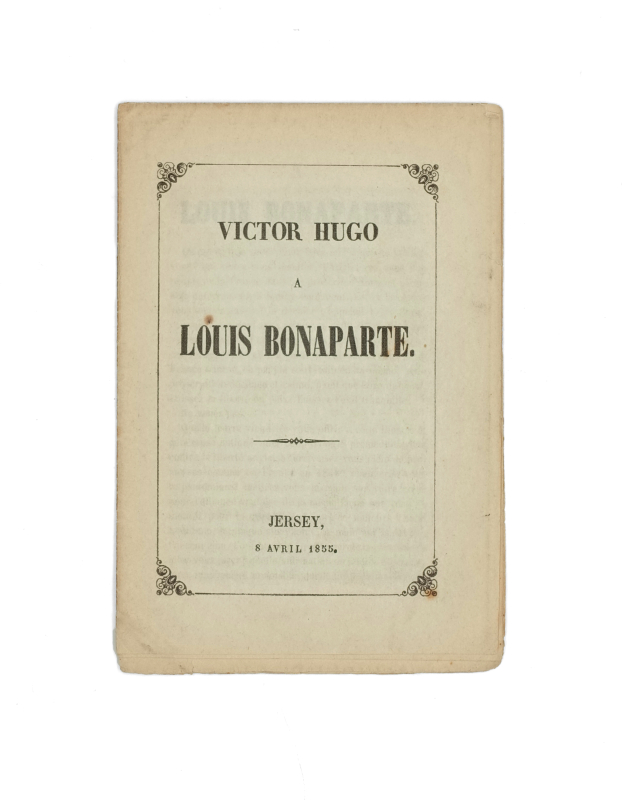
First edition, extremely rare Jersey printing during Victor Hugo’s exile.
“À Louis Bonaparte” is a satirical poem by Victor Hugo, a fierce diatribe against Louis-Napoléon Bonaparte (the future Napoleon III) who betrayed the Republic by organizing the coup d’état of December 2, 1851, calling him “Napoleon the Little” and denouncing him as a vain usurper, betraying the greatness of his uncle.
This pamphlet is part of a long opposition in which Hugo, initially favorable to Louis Napoleon, became his most virulent critic after the coup d’état, turning him into the target of all his politically engaged poems.
Following the coup d’état, Victor Hugo took the lead in the opposition and went into hiding. With a price on his head, he decided to flee and went to Belgium shortly before his official expulsion from French territory, promulgated by decree on April 9, 1852, along with some sixty other opposition deputies.
After a short exile in Belgium, Victor Hugo, now a proscribed figure, joined other banished personalities in Jersey. The island became a haven for exiles, who in 1853 began publishing L’Homme, journal de la démocratie universelle, which served as their political forum.
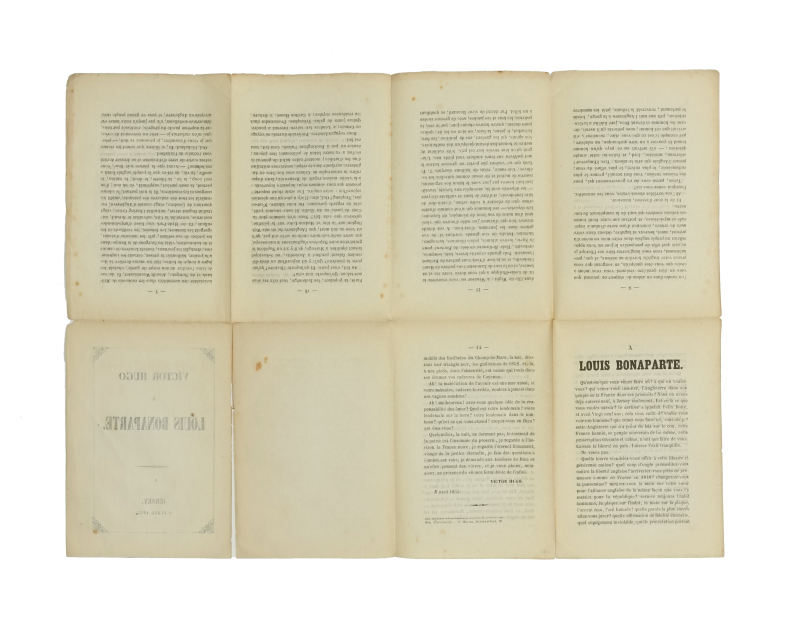
It was Napoleon III’s visit to England that reignited the conflict and prompted Hugo to write this pamphlet. Printed on the newspaper’s presses, Hugo varied the format to maximize its impact. Thus, this text exists not only in the form of a libel but also as a poster (Maison de Victor Hugo – Hauteville House, inv. no. 526).
Throughout the text, he urges the emperor not to visit England, to “laisser l’exil tranquille” (p.1). He praises England and its free people while recalling the defeats of Napoleon I: “Irez-vous au square Trafalgar? Irez-vous au square Waterloo, au pont Waterloo, à la colonne Waterloo?” (p.5)
Napoleon III made his visit to England a reality and forged ties with Queen Victoria, which did not please the exiles. When the latter made a ten-day return visit to Paris in August 1855, they became incensed. Félix Pyat published a diatribe against the queen in l’Homme. This was followed by a first wave of expulsions ordered by the British crown. Hugo reacted strongly in a statement signed and supported by the other exiles, which he concluded with “Et maintenant expulsez-nous !” (Hugo, Actes et paroles, pendant l’exil, Paris, Hetzel, 1875, p.162.).
Hugo was in turn expelled and left Jersey on October 31, 1855, to join Guernsey.
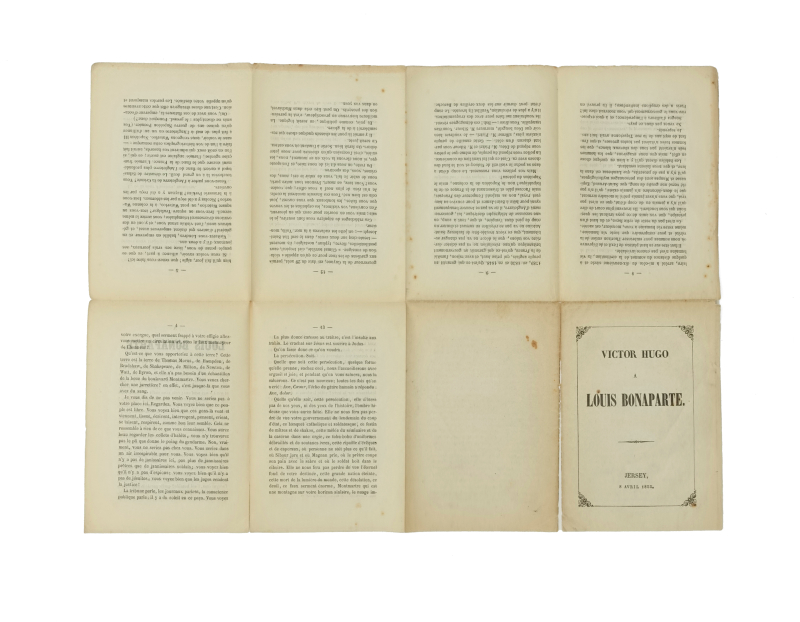
An uncut copy of this text, as it appeared, representing the culmination of Victor Hugo’s fury against the man he had believed to be the man of order, but whom he now considered a traitor and a usurper.