Brunet, III, 350 ; Cohen-De Ricci, 500 ; Blackmer, 834 : “The plates were both designed and engraved by Houel himself, and illustrate scenes from daily life, and views, plans and antiquities. A very beautifully produced book” ; Mira, I, 480 ; Moncada Lo Giudice, 1106 : “Una delle più sontuose opere grafiche del ‘700 sull’Italia meridionale”; Millard, French, n° 80; Les Stroganoff. Une dynastie de mécènes. Paris, Musée Carnavalet, 2002; Larisa Walsh, “The Stroganov Book Collection in the Context of Stalin’s Campaign to Sell Russian Cultural Treasures Abroad”, in Slavik & East European Information Resources, 2016, vol. 17. Not in Abbey nor Atabey.
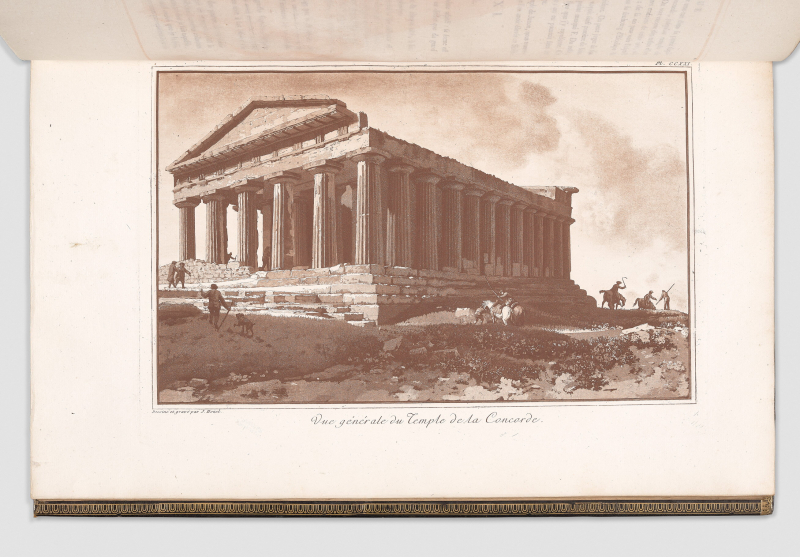
First edition of one of the most beautifully illustrated works on Sicily and the Aeolian Islands, decorated with 264 plates pulled in sepia. Count Grigori Alexandrovitch Stroganoff’s copy.
The painter and engraver Jean-Pierre Houel (1735-1813) first studied with Le Bas and Casanovo, before receiving a grant from the King allowing him to travel to Rome. His first visit to Italy was between 1769 and 1772; his second visit in 1776 brought him to Naples and Malta.
“The plates were both designed and engraved by Houel himself, and illustrate scenes from daily life, and views, plans and antiquities. A very beautifully produced book” (Blackmer).
It was during this second travel that Houel produced all the drawings and, upon his return, engraved all of the plates himself and wrote the accompanying text.
The Empress of Russia, Catherine II, helped financing the printing of the book by purchasing some five hundred original drawings. The 264 aquatint plates (printed on 263 sheets) are all printed in sepia (“tirées en bistre de manière à imiter le dessins”, Cohen-De Ricci), and depict landscapes, popular scenes, costumes, monuments, and ruins from the classical period: the beautiful plates are of historical value as some of the monuments or buildings have since been destroyed during war or through earth-quakes.
Provenance
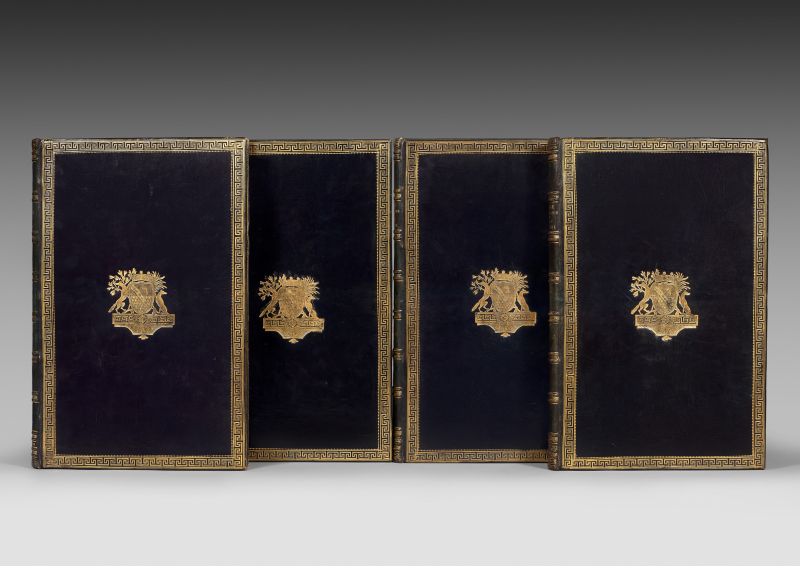
This copy belonged to Count Grigori Alexandrovitch Stroganoff (1770-1857), Russian statesman, art historian, archaeologist, collector, philanthropist and Governor-General of Moscow. It also bears the Imperial stamp of the Russian Tsar on each title page. it was subsequently offered at auction in the 1930’s by the Bolsheviks and documented by the stamp of French customs on the first fly-leaf.
Plante VI with paper-flaw in the image, plates CVIII, CLXXVI, CCXIX slightly stained.
A superb copy, exquisitely bound and of imperial provenance.