DSB VI, 178 ; Gartrell, 242 ; Wheatland, 111 ; Neville, I, 603, Sotheran I, 1818 ; Blay, Blondel, Hulin, & Bernard Maitte. « Introduction », L’École normale de l’an III. Vol. 3, Leçons de physique, de chimie, d’histoire naturelle,Paris, 2006.
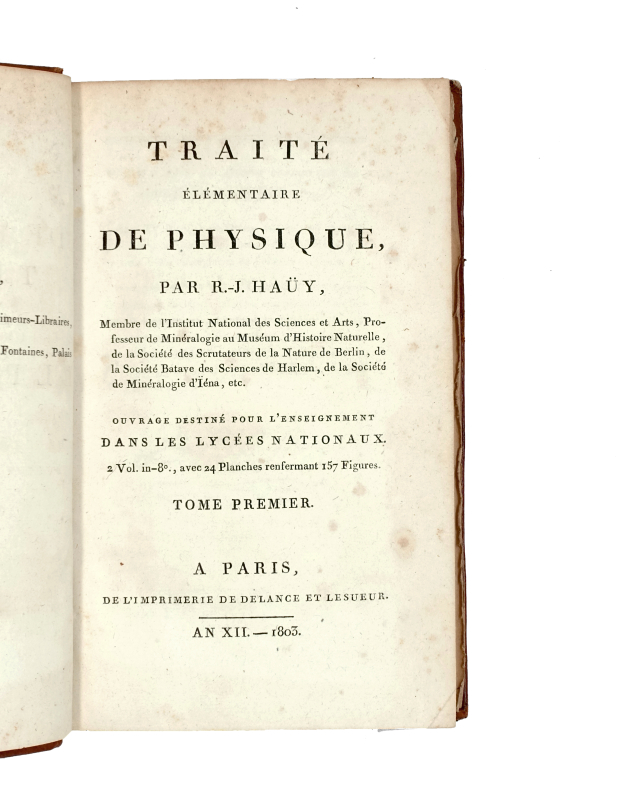
First edition.
Commissioned by Napoleon I, this work, which took just six months to complete, was of paramount importance for the teaching of physics in the 19th century.
Haüy was already a distinguished professor of physics, delivering numerous lectures at the École Normale, when the establishment of the lycées was announced in 1802. A committee of scientists was then tasked with selecting textbooks for this new system of education. It was concluded that no existing physics textbook was suitable for the new system. Haüy was therefore chosen to write one.
He did not merely rewrite the lessons previously given at the École Normale; he added numerous elements and adapted his programs for the fifth-year mathematics class and for the class in transcendental mathematics.
This achievement earned him the Legion of Honour, awarded by Napoleon Ier himself.
“This book was outstanding for its clear, methodical exposition of physics, although mathematical treatment of problems was again lacking. […] His own contribution to physics consisted in his researches on double refraction on crystals, on pyrolectricity in crystals (especially tourmaline and boracite), and on piezoelectricity.” (DSB).
“There are large sections on electricity and magnetism, and this work is also of some chemical interest. The book is divided into 905 paragraphs, each covering a specific topic” (Neville).
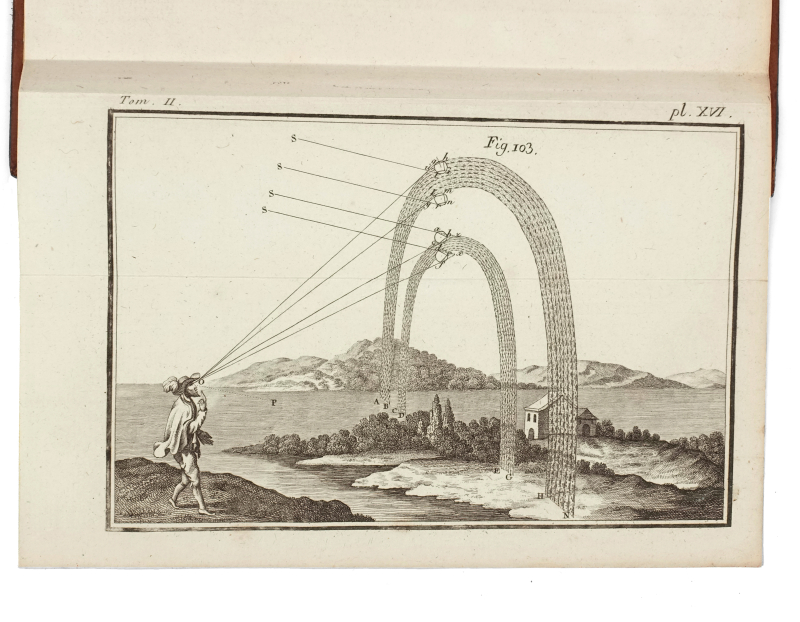
The 24 copperplate engravings, bound out of order in our copy, depict experiments.
The covers are rubbed.
Provenance: Paul Gavelle (bookplate) – François Chrétien (bookplate)