
VENDU
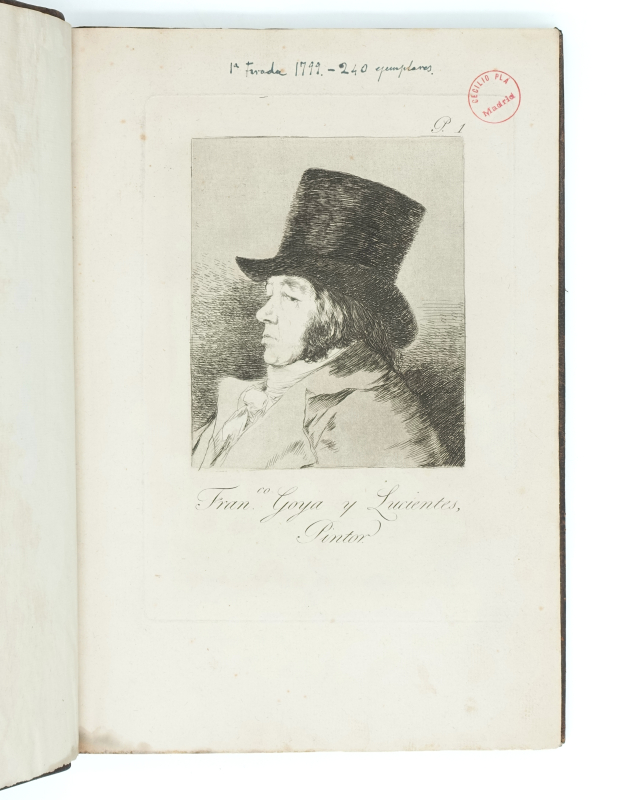
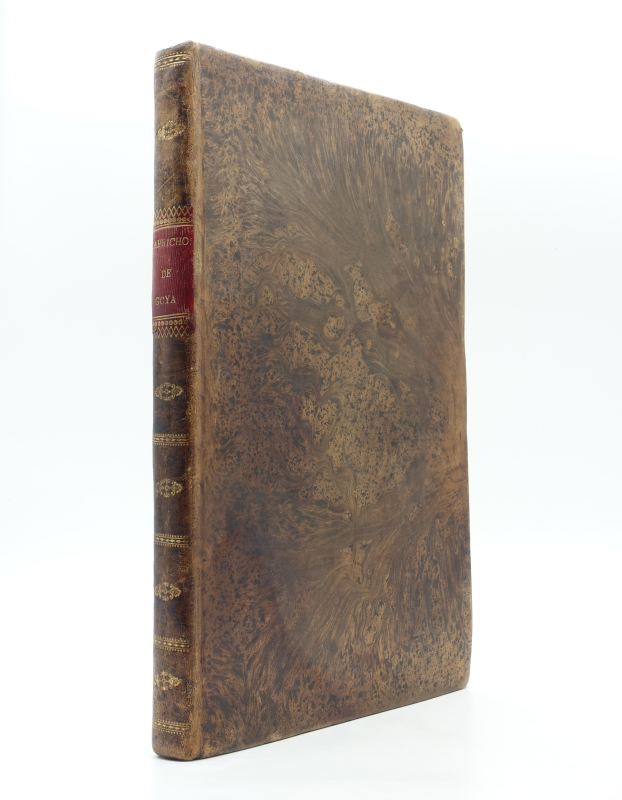
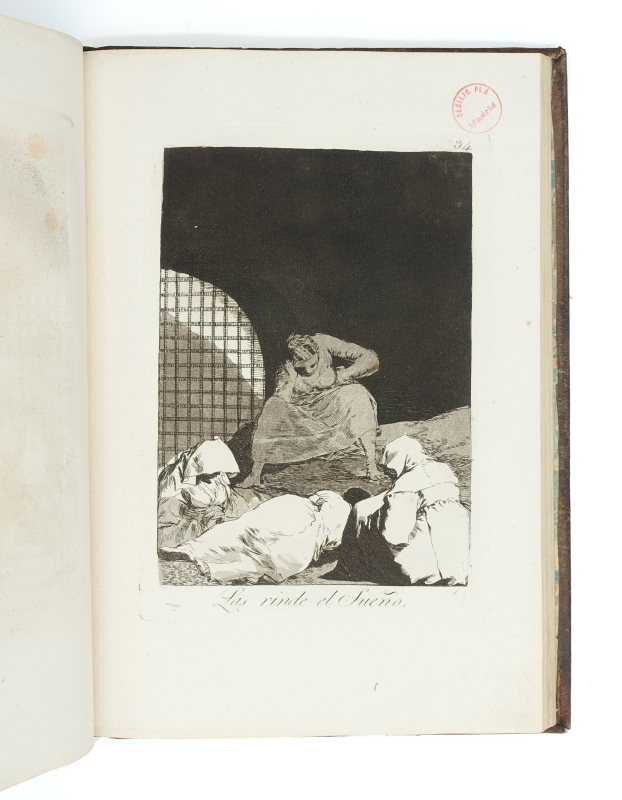
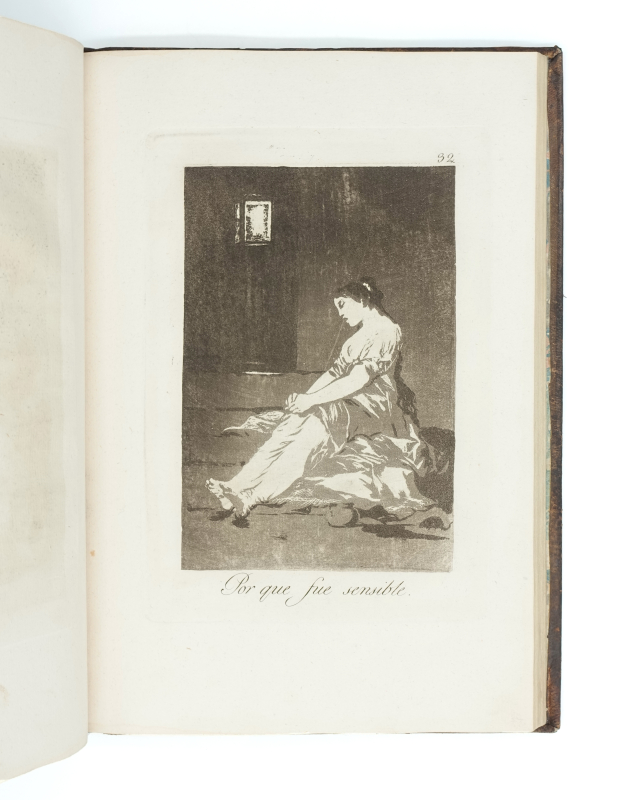
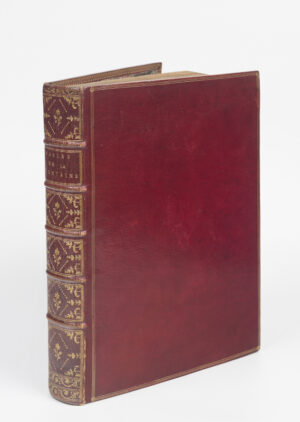
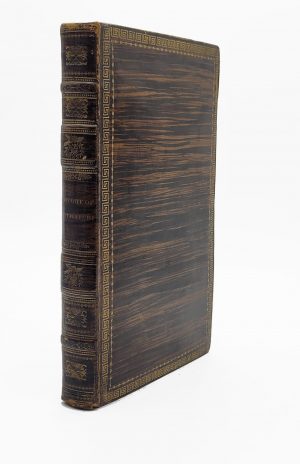
Small folio (300 x 203 mm) set of 80 engravings (etching, dry-point, and aquatinta). Contemporary Spanish tree sheep, flat spine gilt, spine label in red morocco.
1 in stock
Harris, 36-115; Delteil, 38-117.
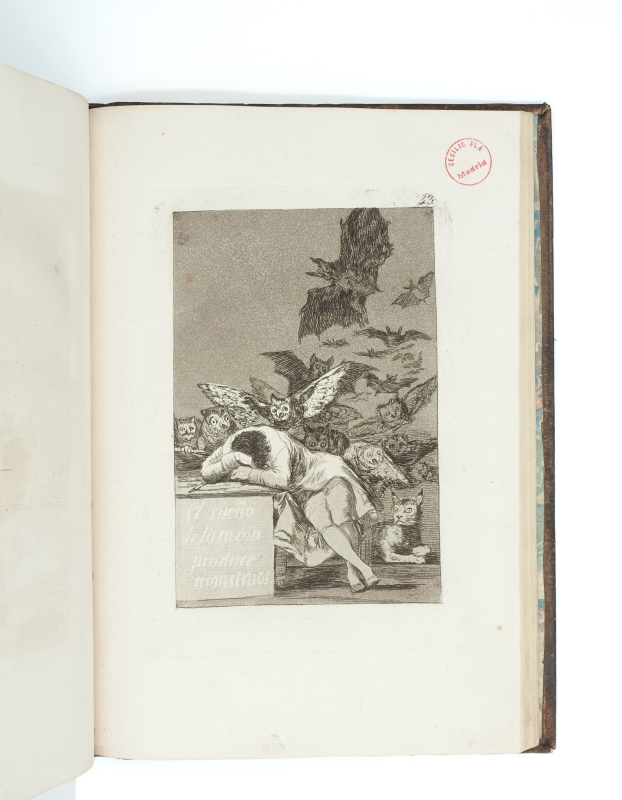
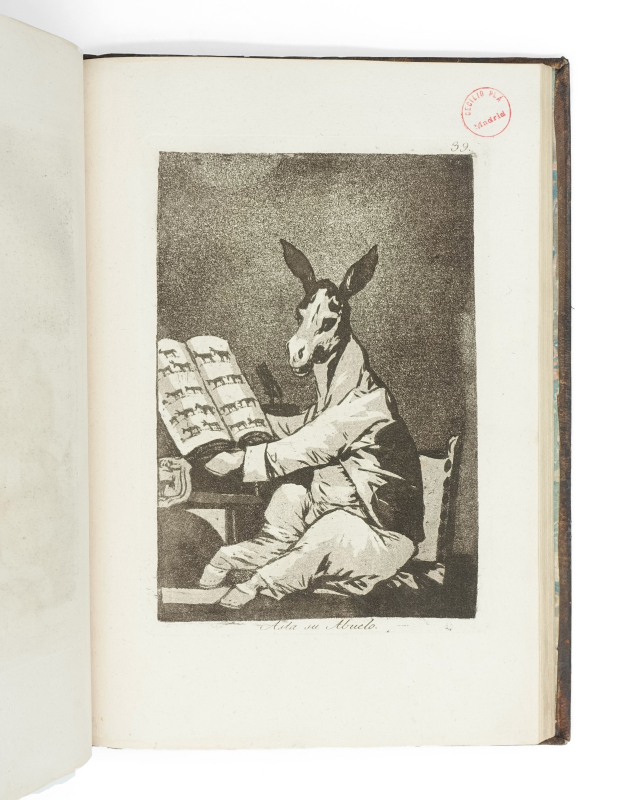
First edition of the complete set of eighty etchings with burnished aquatint, drypoint and engraving printed in sepia with rich contrasts.
Los Caprichos was first published in 1799, and not again until nearly 30 years after Goya’s death. The first edition is thought to have sold less than 30 copies, and it is only through the second edition that a larger audience discovered Goya’s engravings. Goya’s work then quickly went through a further ten editions before the 20th century.
Los Caprichos is central to our conception of Goya. The series exposes the vice and corruption that earned Goya’s homeland the appellation ‘Black Spain’; here Goya mocks the peasantry’s superstitious beliefs, the arrogance of the nobility, and the widespread corruption of the Catholic Church. To avoid alienating powerful individuals at Court and to protect himself from the wrath of the Inquisition, the artist masked his satire by means of images that could inspire multiple interpretations. This subtle layering of meanings is one of the hallmarks of Goya’s artistry. Los Caprichos ultimately became Goya’s most popular and influential series; Domenico Tiepolo owned a set, as did Eugène Delacroix, who borrowed freely from Goya’s images.
“The year 1799 was a turning point in Francisco de Goya’s life and work. Besides being appointed first chamber painter, he enjoyed growing prestige as a portraitist and inaugurated the hermitage of San Antonio de la Florida, which he had decorated; on February 6, the Diario de Madrid announced the sale of the eighty prints that make up his Caprichos series. [The volume was on offer ‘in the store of liquors and perfumes in the calle de Desengaño’ for the sum of 320 reales, roughly equivalent to one ounce of gold. The advertisement was withdrawn after only two days, the result, perhaps, of Goya’s concern that it might attract the attention of the Inquisition.] The publication marked the culmination of an intense period in the painter’s life, which had begun in 1792 when illness led to convalescence at Sebastián Martínez’s home in Cadiz. There, he was able to see English satirical prints that would later influence his work. After returning to Madrid, he cultivated the friendship of Leandro Fernández de Moratín, with whom he exchanged ideas that later emerged in his Caprichos.
The first drawing from the series now known as Los Sueños dates from 1797. These works constitute the visual and conceptual basis for his Caprichos, including its forms, ideas and principle subject matter. During those years, Goya began drawing in albums, where he captured image from everyday life and worked out invented compositions in which he satirically addressed aspects of his time. This activity led to the Álbum de Sanlúcar and the Álbum de Madrid, both of which contain images that are the origin of some of the prints in the later Caprichos.
As the advertisement in the Diario de Madrid mentions, the Caprichos are primarily a satire designed to combat human vice and the absurdities of human behavior. They were the artist’s personal declaration that the chains of social backwardness had to be broken if humanity was to advance, attesting to his political liberalism and his contempt for ignorance and intellectual oppression.
Simplifying, we can group the prints from this series around four major subjects, all unquestionably critical in tone. The first addresses deception in relations between men and women: courtship as a customary practice in which modern men busy with their various occupations allowed their wives to go about their lives in company of handsome young men; the prostitution that denigrated and exploited the condition of both sexes; and unequal marriages or marriages of convenience that were a customary practice in Goya’s time and were criticized by the Enlightenment.
The second satirizes poor education and ignorance, reflecting the Enlightenment’s concern about those matters. In the Caprichos, Goya depicts the consequences of improperly educating children, false beliefs and superstitions resulting from ignorance, and witchcraft as the supreme manifestation of superstition or insufficient education.
The third subject consists of a condemnation of vices rooted in society, and especially among the clergy: vanity, gluttony, sloth, lechery, and avarice are caustically portrayed.
Finally, a fourth group of prints contains the artist’s protest against the abuse of power: the Inquisition, the arrogance of the ruling class, the exploitation of the people and the injustice of the legal system.
From the very start, the Caprichos were often interpreted as biting criticism of that period’s society, sometimes in general, but others, directed at specific institutions or figures, including Godoy and the monarchs. Period interpretations appear in handwritten commentaries on the prints, including those on the series at the Museo del Prado. This series was closest to Goya’s own opinions, as it had belonged to his friend, Agustín Ceán Bermúdez. From then until now, the Caprichos have been subject to the most varied interpretations, which proves the ongoing interest of this series whose reflection of humanity’s extravagances and errors retains all its relevance two-hundred years after its creation.” (Matilla, J. M.: Caprichos; Goya en tiempos de guerra, Madrid, Museo del Prado, 2008, pp. 170-171, n. 21).
Magnificent copy, of great rarity in a Spanish contemporary binding.
Provenance : Cecilio Pla y Gallardo (1860-1934) with his rubber stamp on all plates (except for plate 32 & 51). Cecilio Pla was a Spanish impressionist painter whose work is well represented at the Prado Museum in Madrid – Hans Hartung – Purchased directly from the Hans Hartung Foundation, Switzerland – Private collection, Paris.

Monday to Saturday
10am – 1pm and 2:30pm – 7pm
(6pm Monday and Saturday)
© 2023 All rights reserved.