
VENDU
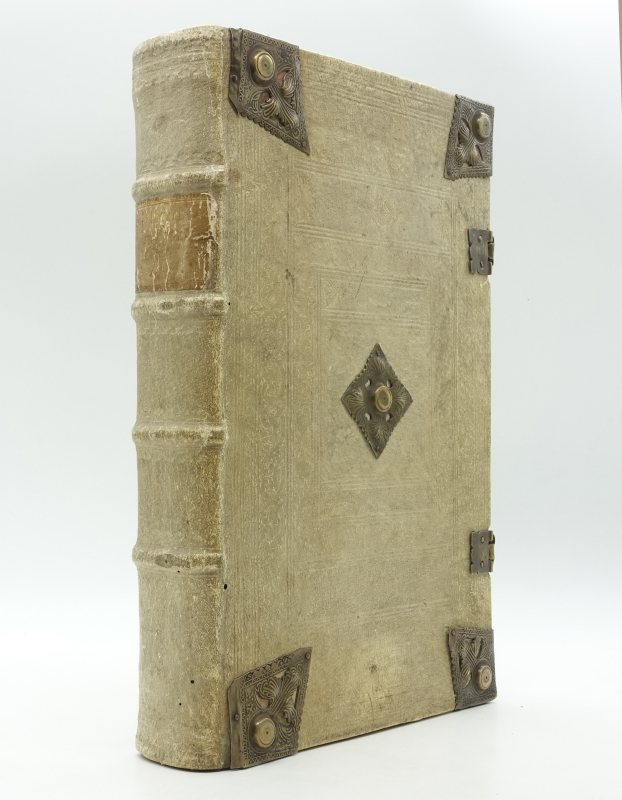
Small folio (298 x 195 mm) Blind-embossed pigskin on wooden boards, 4 metal corner pieces and 1 central metal knob on each cover, 2 intact clasps, spine with raised bands, blue edges (late 17th-century German binding).
1 in stock
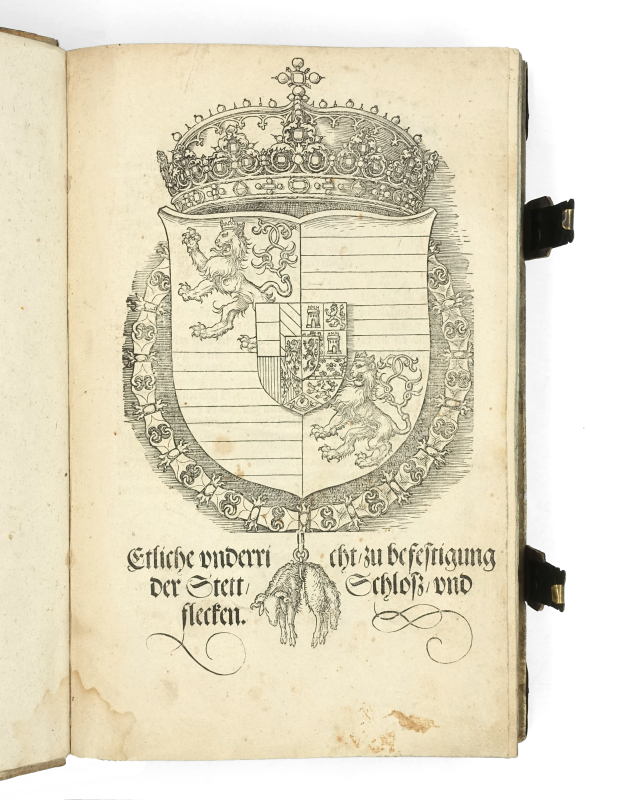
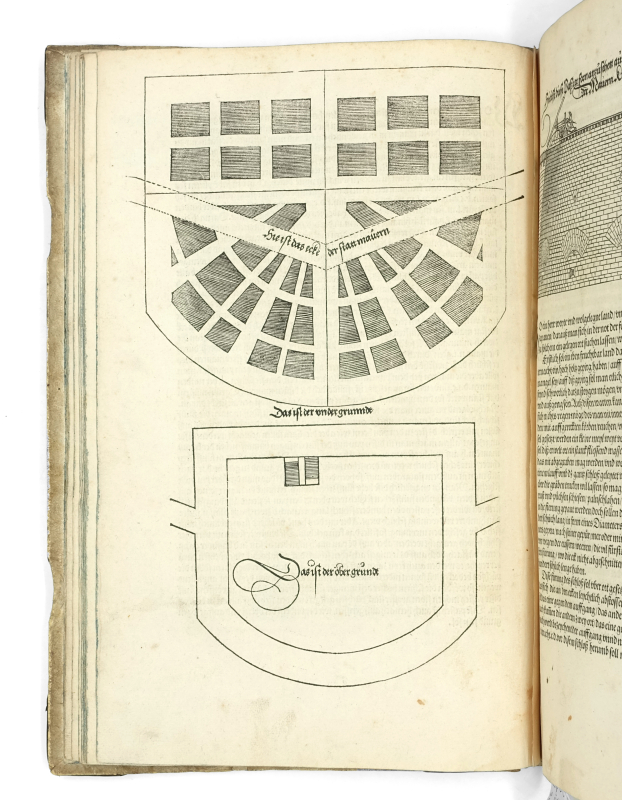
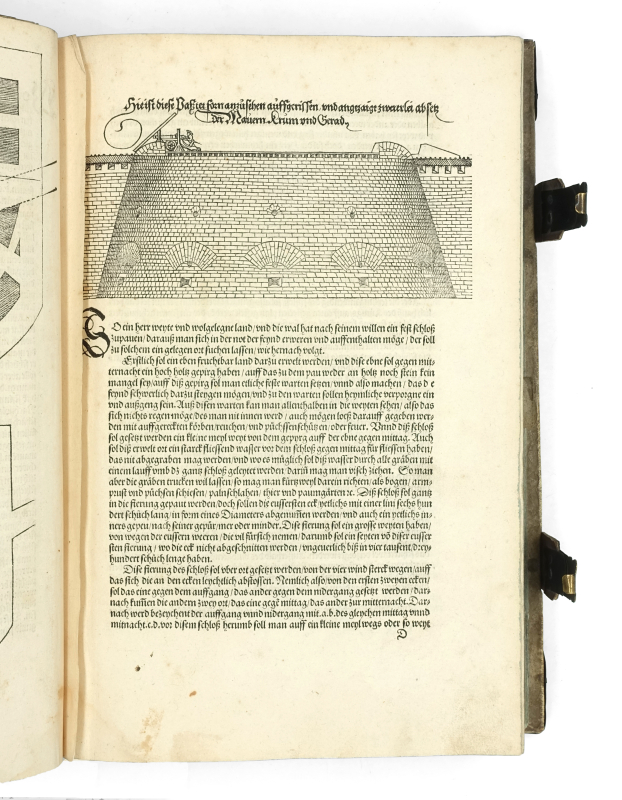
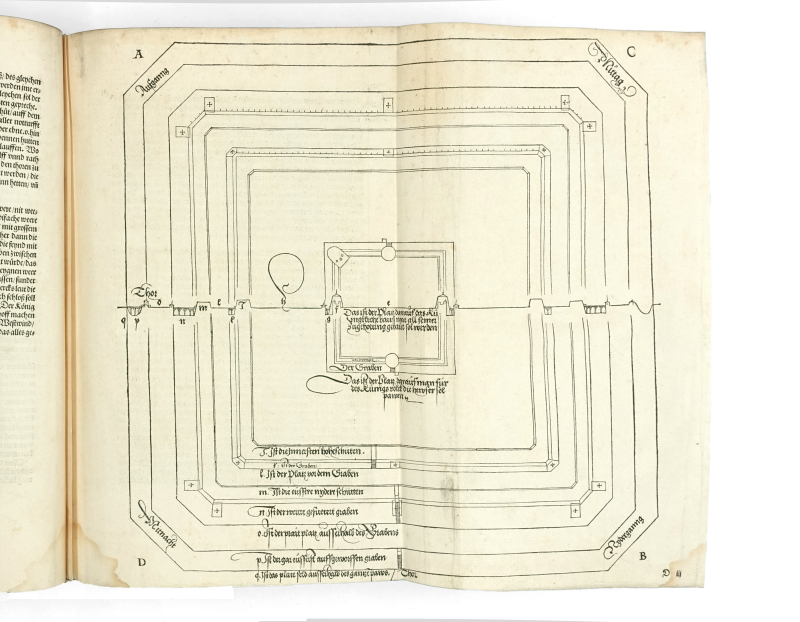
1. Etliche underricht zur Befestigung der Stett, Schlosz, und Flecken. Nuremberg, [Hieronymus Andreä ?] october 1527. Folio, 36 unn.l. Collation : A-B6 C8 D-E6 F4 including fold-out leaves for: A4 (folding leaf added), B1 (folding leaf), B3 (folding leaf), C1 (folding leaf), C3 (folding leaf), C 5-6 (2 full-page woodcuts) D3 (folding leaf) E1 (folding leaf) E3 (folding leaf) F1 (folding leaf) F 2 (folding leaf).
VD-16, D-2853 (Copy corresponding to the digitised copies of the Austrian National Library ÖNB 72.D.-6 and the Bayerische Staatsbibliothek Rar.2156 ; Fairfax-Murray, German, 151. Not in Adams which does not list any editions of this title.
Second edition, published shortly after the extremely rare first edition on the same date.
« Second edition, according to Dodgson, I p. 265 : « there is a very rare first edition [of the same date], briefly mentioned by Brunet, with numerous differences in the text, which contains the signed woodcut Bartsch 137 (the siege of a Fortress), see also Dodgson, who states that he had seen but one copy of the first edition that contained the woodcut, and had never heard of another.
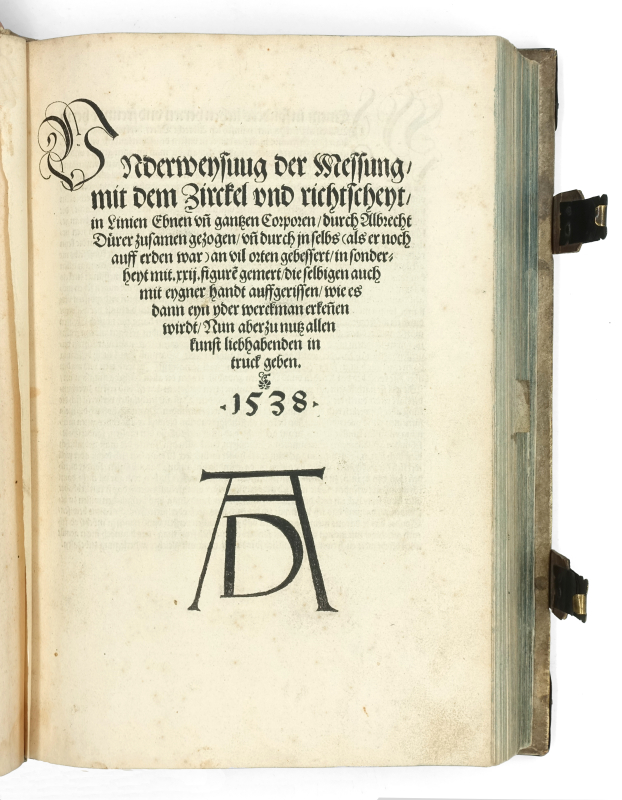
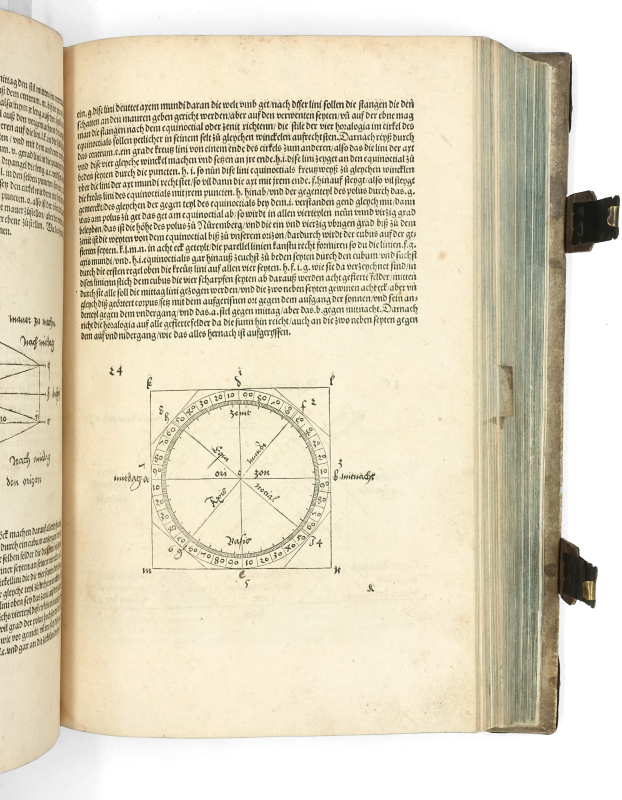
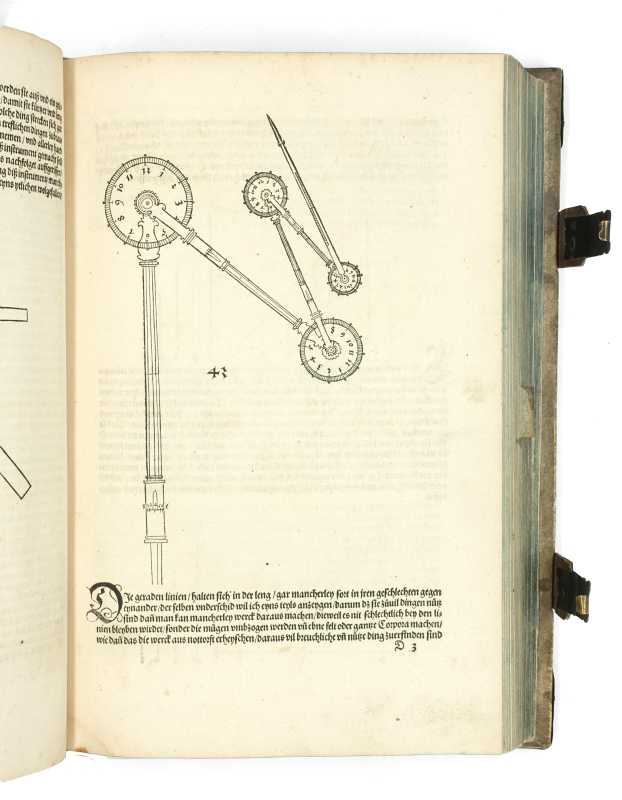
2. Underweysung der Messung mit dem Zirckel und Richtscheyt, in Linien undEbnen und gantzen Corpore. Nuremberg, Hieronymus Formschneyder, 1538. Small Folio of 94 unn.l. Collation : A-P6Q4. P3 (folding leaf) P4 (paste-on) P5 (paste-on) Q3 (folding leaf). 2 folding plates and 2 paste-on.
VD16, D-2858 ; Fairfax-Murray, German, 150. For the first edition of 1525 see Adams, D-1057- PMM, 54 – Carter-Muir 153 – Vagnetti, EIIb7 ; Vitry, 240.
One of the most beautiful printed books of the German Renaissance. Second edition (first edition 1525) of Albrecht Dürer’s famous treatise on perspective, dedicated by its author to his patron Pirckheimer on the verso of the title page.
Dürer not only composed the entire text, but also produced all the illustrations and supervised the layout of this important work.
This edition has been revised from the first. It includes most of the illustrations but contains, for the first time, an illustration of the perspective instrument invented by Jacob de Keyser and used by Dürer to draw with the help of another tool, this time invented by himself: the perspectograph. Both tools are illustrated in this edition (respectively on leaves Q3r/v).
“Le perspectographe fut inventé à la Renaissance par Dürer (1471-1528), on l’appelle aussi la «fenêtre de Dürer». En effet, cet instrument, composé d’un cadre en bois et d’une vitre quadrillée, est semblable à une fenêtre. Le peintre place ce cadre devant la scène qu’ il veut représenter. Le peintre regarde la scène à travers un «oeilleton», bâton se finissant par un cercle de bois à travers lequel le peintre regarde en clignant d’un oeil. La vision du peintre est donc monoculaire (le peintre ne voit la scène que d’un oeil), ainsi, la perspective qu’ il dessine n’est pas tout à fait exacte… Deux siècles plus tard, Christopher Wren, Architecte anglais, reprendra le perspectographe de Dürer et lui apportera de notables perfectionnements. Cette machine est plus simple car elle ne demande ni de calque ni de transfert” («Le perspectographe: machine de précision» en ligne,2009, sur laperspective.canalblog.com).
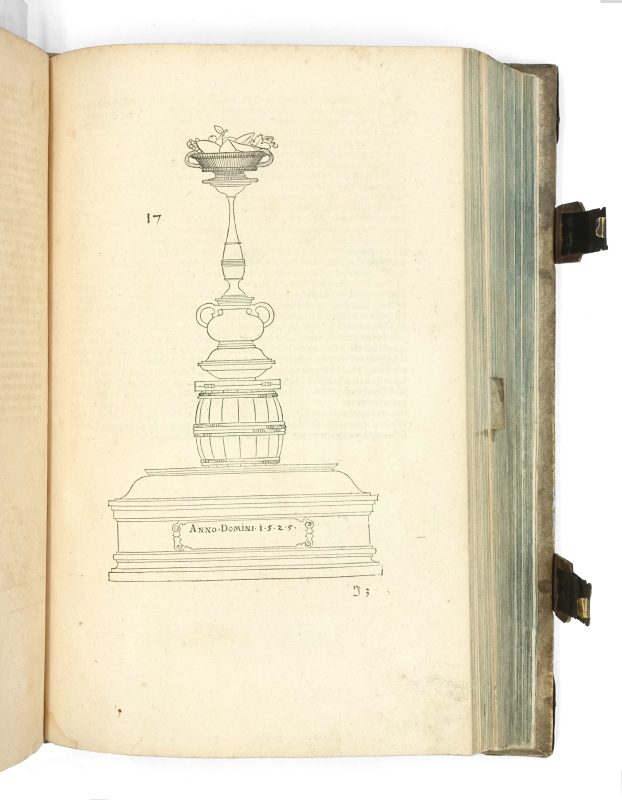
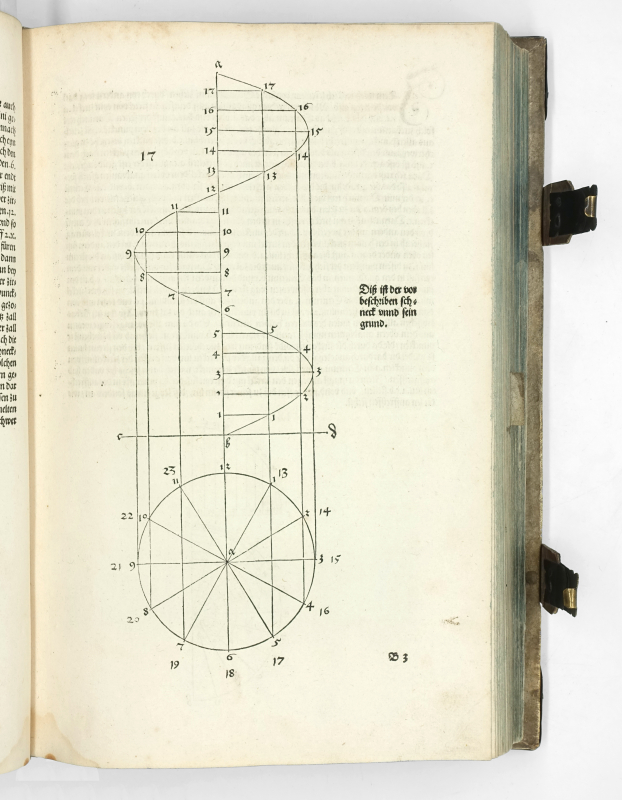
« There are numerous woodcuts throughout, including geometrical diagrams, architectural figures, designs for roman and gothic alphabets, triumphal columns (dated 1525), &c., as well as four half-page cuts of draughtsmen using apparatus for drawing in perspective, the 2nd of these with monogram and date 1525; the two latter appear in this edition for the first time. They are on Q3vo., and, with that on recto, are considerably wider (215 mm.) than the others in the book, and are in consequence folded on the fore-edge” (Fairfax-Murray).
The volume is divided into four books: the first, devoted to lines, deals with the genesis of curves; the second, devoted to surfaces, examines the construction of polygons and tackles the great mathematical problems of antiquity, namely the trisection of angles and the quadrature of circles; the third and fourth books are devoted to regular and semi-regular solids and teach the construction of columns and monuments. The work concludes with a brief introduction to perspective, highlighted by the perspectograph to which Dürer gave his name (the famous “Dürer window”), which allows a perspective view to be drawn using a simple eyepiece device.
Erasmus was one of the first, in 1528 in his De recta Latini Graecique sermonis pronuntiatione, to publicly mention the existence of ‘a book by Albert Dürer, written, it is true, in German, but of admirable erudition’. Through this mention and thanks to the Latin translation made by the humanist Joachim Camerarius in 1532, the Underweysung had an impact on scholars from Europe to China ; among others, the young Galileo Galilei, Tycho Brahe, Johannes Kepler, Simon Stevin, Christoph Clavius and Geoffroy Tory, who became familiar with Dürer’s Latin letterforms and began his famous Champfleury, ou l’Art et Science de la proportion des lettres with a tribute to the German painter.
« This book was the first of the theoretical writings on art which Albrecht Dürer composed towards the end of his life. Its immediate object was to explain the application of practical geometry to drawing and painting and to teach the principles of perspective. These methods were to be applied architecture, painting, lettering (Dürer designed both Roman and Gothic letters) and ornamental forms in general, and his book is therefore addressed not only to artists but also to sculptors, architects, goldsmiths, stonemasons and other craftsmen… Dürer’s work first presented to northern Europe the completely new attitude to artistic creation which had crystalized in Italy during the Renaissance » (PMM).
“The Underweysung der Messung was published by Dürer himself in Nuremberg in 1525, and represented the fruits of mathematical endeavors which can be dated back to at least 1508. As a treatise on geometry in the German vernacular – which is in itself remarkable, though not unique – it was aimed at all those professions whose skills are (or should be) underpinned by techniques of precise mensuration… The Underweysung… is divided into four books, following a broadly Euclidian progression” (Kemp).
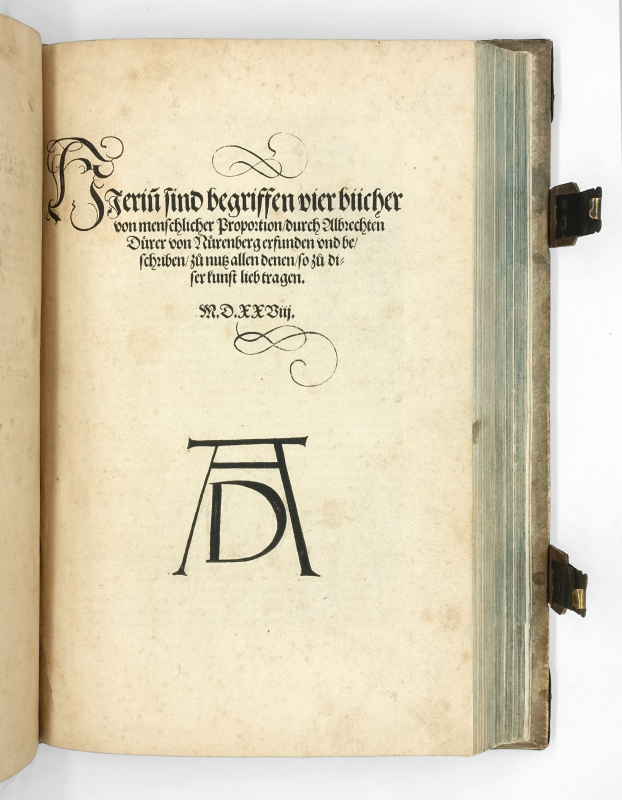
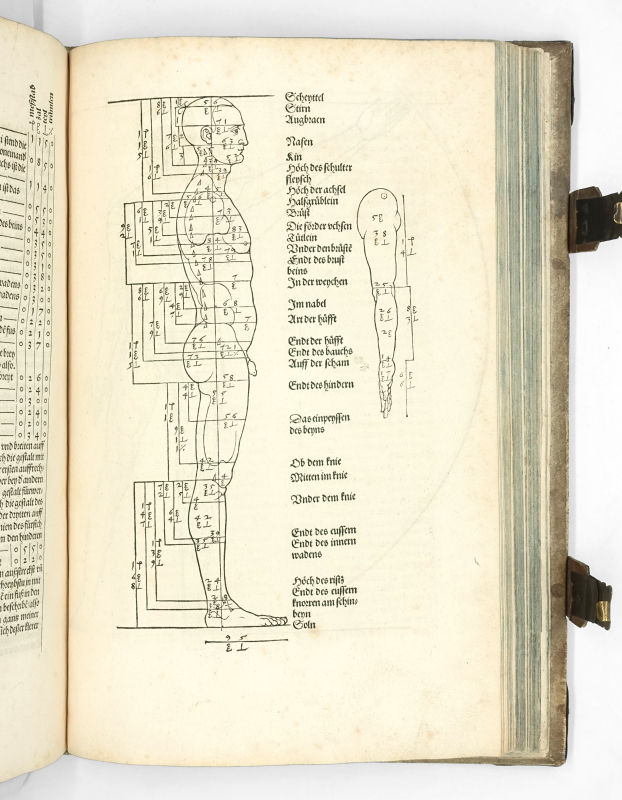
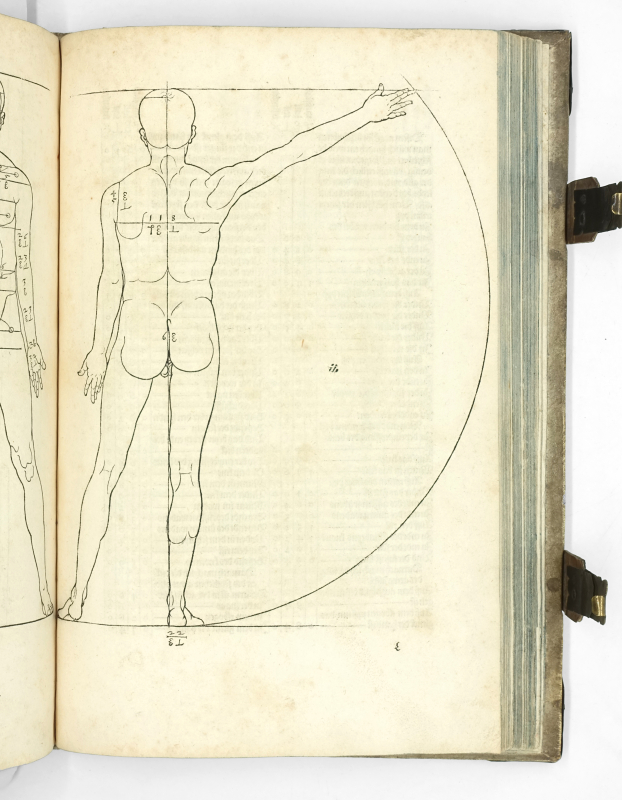
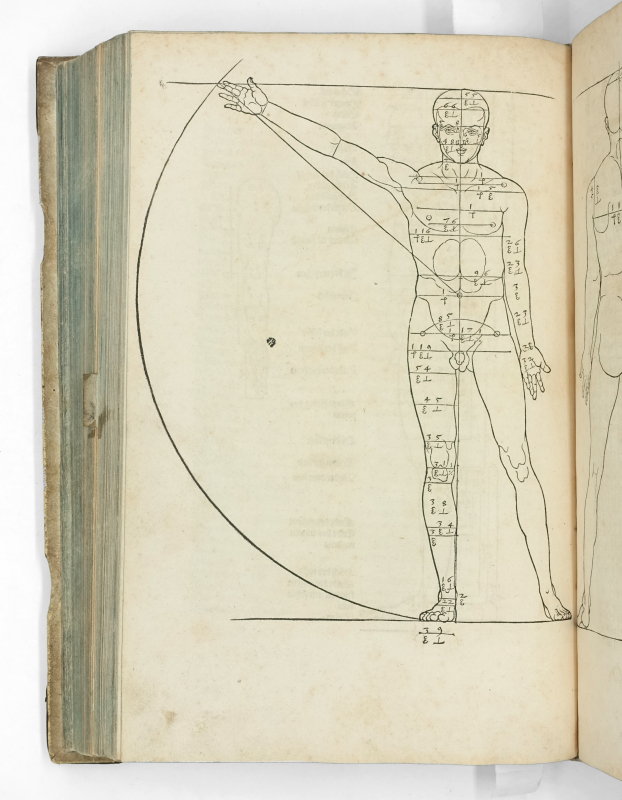
3. Hjerin sind begriffen vier Bücher von menschlicher Proportion. Nuremberg, Hieronymus Formschneider, 31 oct. 1528. Small folio, 130 unn.l. Collation : A-M6 N4 O4 P-R6 S6 T4 V-X6 Y4 Z6. O2 O2 (folding leaf) S1 (folding leaf) S4 (folding leaf) S5 (folding leaf) Y 3 (folding leaf). 5 folding plates (S1 only very slightly).
VD-16, D-2859 ; see Fairfax-Murray, German, 152 (only the latin translation of 1532) ; Choulant-Frank, pp. 141-147 ; Garrison-Morton 149 ; Meder p. 288 ; Norman, 666 (incomplete copy; Albrecht Durer : das druckgraphische Werk, vol III (2001), pp.319-473.
First edition of Dürer’s treatise on the geometry of the human body.
Dürer’s Four Books on Human Proportions codify his approach to figurative representation: using more than 140 full-length studies of men, women and children, as well as some 35 additional vignettes depicting heads, hands, arms and feet, he elucidates the fundamental geometry to which the human form can be reduced. Dürer argued that the essence of true form was the primary mathematical figure (e.g., the straight line, circle, curve, conical section) constructed arithmetically or geometrically and made beautiful by the application of a canon of proportion. However, he was also convinced that the beauty of form was a relative, not an absolute, quality; thus, the purpose of his system of anthropometry was to provide the artist with the means to delineate, on the basis of pure measurements, all possible types of human figures.
The entire work is richly illustrated with figurative diagrams engraved on wood by Dürer. Choulant asserts that these include”the first attempts to represent shades and shadows in wood engraving by means of cross-hatching” (Norman)
“The later sections of his Vier Bücher von menschlicher Proportion (Four Books on Human Proportion), which seems to have been complete by 1523 but was only published posthumously in 1528, are devoted to the stereometry of the body as it moves in space. His starting-point is again similar to that of Piero, or perhaps in this instance even closer to Leonardo. In this relatively early scheme, the basic technique of planar transformation of a human head appears to have suggested its subsequent description in transparent sections as a kind of stereometric cage. This was later developed by Dürer into a technique in which three-dimensional portions of the human body are inscribed within geometrical solids, rather like joints of meat frozen in blocks of ice. These basic blocks can be utilised to describe the jointed motions of the human figure and can be tilted in different planes as required” (Kemp, p. 56).
Magnificent copy. For all the texts, the folding leaves have been folded differently from the structure of the first binding, revealing folds and stitches in the middle with some minor old restorations.
A very beautiful collection bringing together Albrecht Dürer’s three major books.


Monday to Saturday
10am – 1pm and 2:30pm – 7pm
(6pm Monday and Saturday)
© 2023 All rights reserved.