D.S.B., IX, pp. 5-6. ; Poggendorf, II, 10-11 ; Neville, II, p. 125 ; Partington, III, p. 248 ; Manque à la NLM.
First edition.
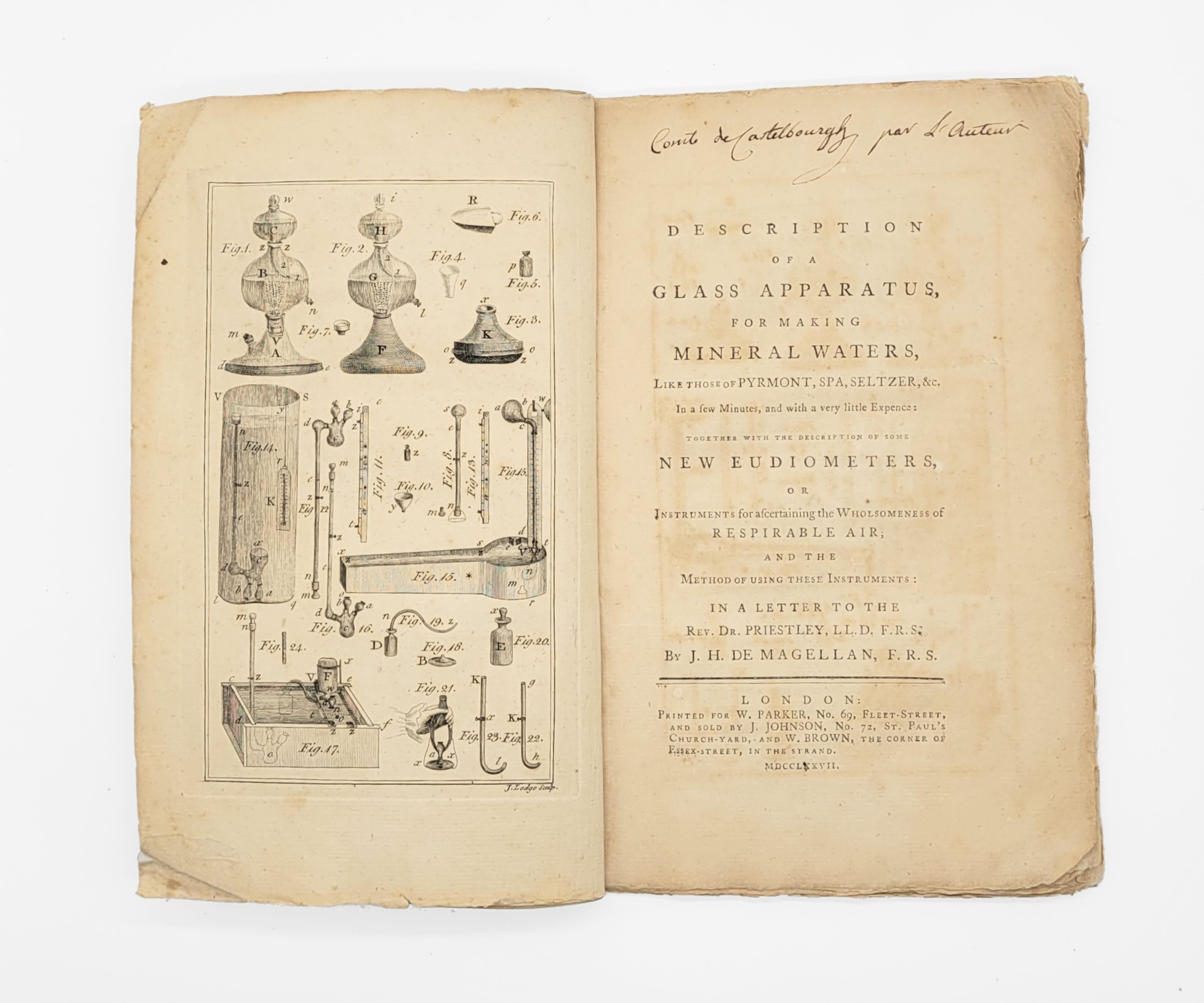
Very good copy, entirely uncut, with an ex-dono at the top of the title page to “Comte de Castelbourgh, par l’auteur”.
This is probably Count Giovanni Antonio Bongiovanni di Castelborgo (1749–1819), a Piedmontese aristocrat and owner of the castle and vineyards at Neive, whose title (like that of his son) is spelled in various ways in several documents (for example, alongside ‘Castelbourgh’ we find ‘Castelbourg’ and ‘Castelborgo’).
Jean-Hyacinthe de Magellan (1722–1790) was a Portuguese scientist who travelled extensively throughout Europe before settling in England around 1764. He maintained a vast European network of correspondents, bringing together scholars, science enthusiasts and members of the enlightened aristocracy (DSB). A member of the Royal Society of London and several other scientific societies, he played an important role in the spread of scientific instruments and discoveries in pneumatic chemistry.
His treatise, which describes a glass apparatus for producing artificial mineral waters, is illustrated with an engraved plate facing the title page, depicting 24 figures.
“an important milestone in the early literature of gas analysis […] he published this account of his researches on gases, addressed to Joseph Priestley. The glass apparatus for impregnating water with fixed air (carbon dioxide) is described in detail. Newly improved by ‘Mr. Parker,’ the apparatus was superior to that used by Priestley and described by him in 1772. Carbon dioxide was prepared by dissolving marble (calcium carbonate) in dilute sulphuric acid. Magellan also describes three new types of eudiometer he had designed; these, and the apparatus for making carbonated waters, are illustrated in the frontispiece.”–Neville, II, p. 125.
A nice copy.