
VENDU
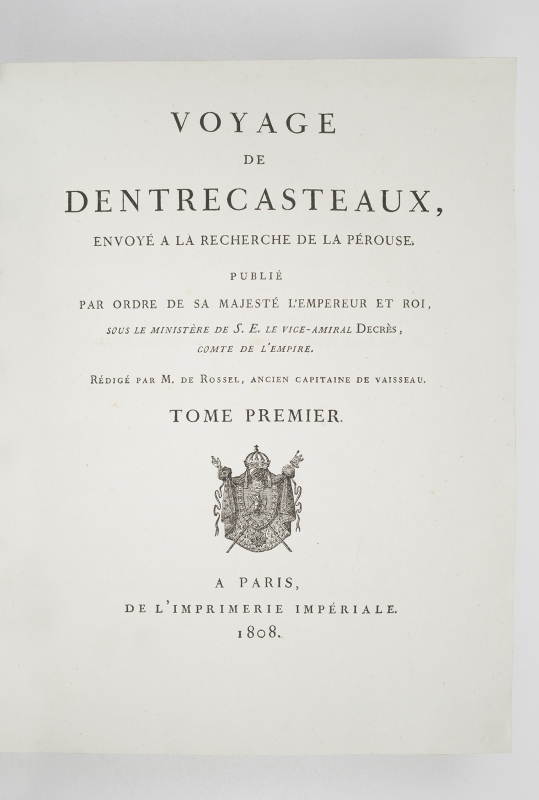
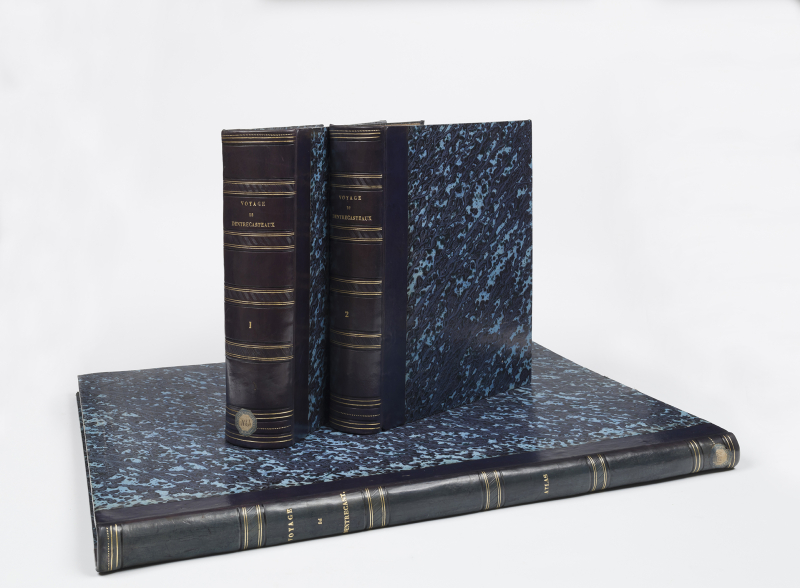
2 text volumes, 4to (287 x 215 mm), and the atlas, large folio (555 x 428 mm). Texte: 2 nn.ll., LVI, 704 pp., 32 engraved folding plates for volume I; 2 nn.ll., VIII, 692 pp., 1 engraved folding plate for volume II. Atlas:2 nn.ll. engraved (title and table of plates), 39 engraved plates (29 double page). Uniformly bound in contemporary half blue calf, flat spine gilt.
1 in stock
Sabin, 22671-72 ; Hill, 467 ; Ferguson, I, 461 ; O’Reilly, Bibl. de la Nouvelle-Calédonie, 82; Taillemite, dictionnaire des marins français, p. 111-112.
First edition.
It contains the account of the rescue expedition of Rear-Admiral d’Entrecasteaux (1737-1793). This expedition, which left between 1791 and 1794, was a relief mission ordered by the Constituent Assembly. Two ships, La Recherche and L’Espérance, were armed as frigates, with the aim of finding traces of La Pérouse’s expedition in the Pacific Ocean.
It was also a voyage of scientific exploration, useful for navigation, geography, commerce, the arts and the sciences, with resources superior to those of La Pérouse. But many of the crew did not survive the voyage. The expedition failed in its primary mission of finding ‘Monsieur de La Pérouse’, but it did provide new topographical knowledge of many of the islands in the Indian Ocean, as well as numerous discoveries, particularly in botany. Thanks to the work of Beautemps-Beaupré, it was a laboratory for modern hydrography.
The expedition’s scientific committee included the following famous researchers: Amboise Pierson (? -1796; astronomer) – Miroir-Jouvency (1754-1798; geographer) – Jacques-Julien Houtou de La Billardière (1755-1834; botanist, naturalist) – Claude Bertrand (1757-1792; geographer, astronomer, encyclopaedist) – Claude Antoine Gaspard Riche (1762-1798; botanist, naturalist) – Jean Blavier (1764-1828; botanist, naturalist, mineralogist) – Louis Ventenat (1765-1794; naturalist and ship’s chaplain) – Louis Auguste Deschamps de Pas (1765-1842; botanist, naturalist) – Charles-François Beautemps-Beaupré (1766-1854; hydrographic engineer, cartographer).
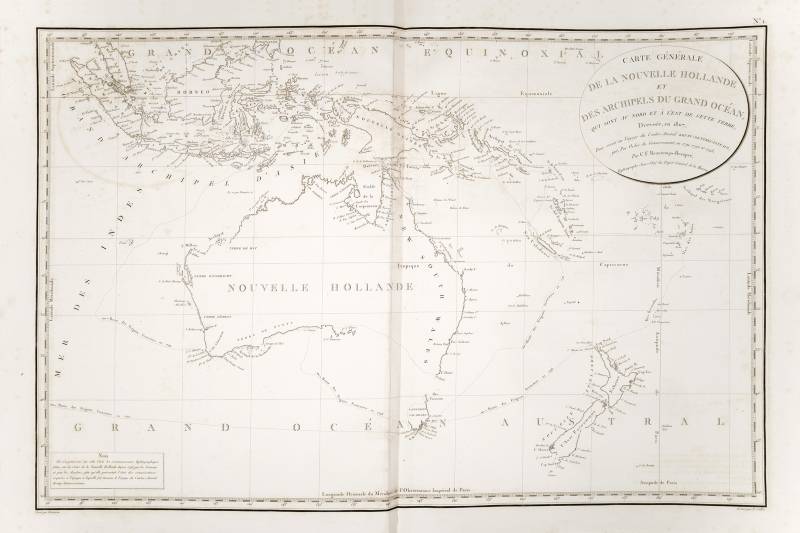
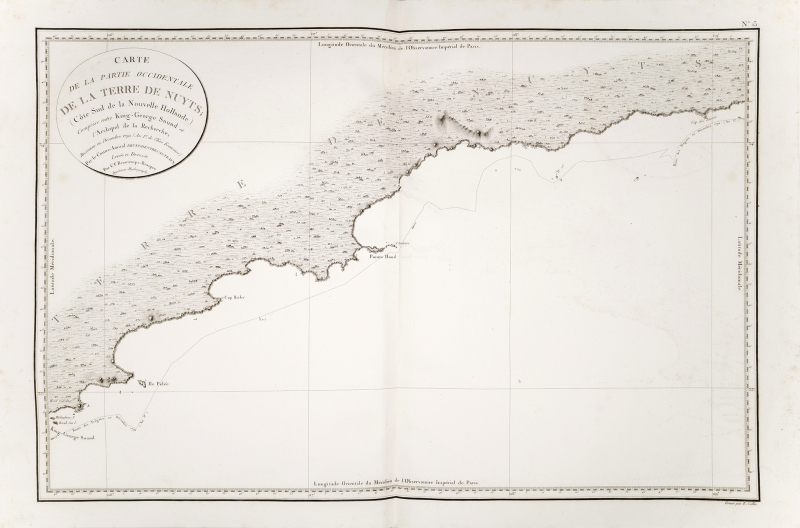
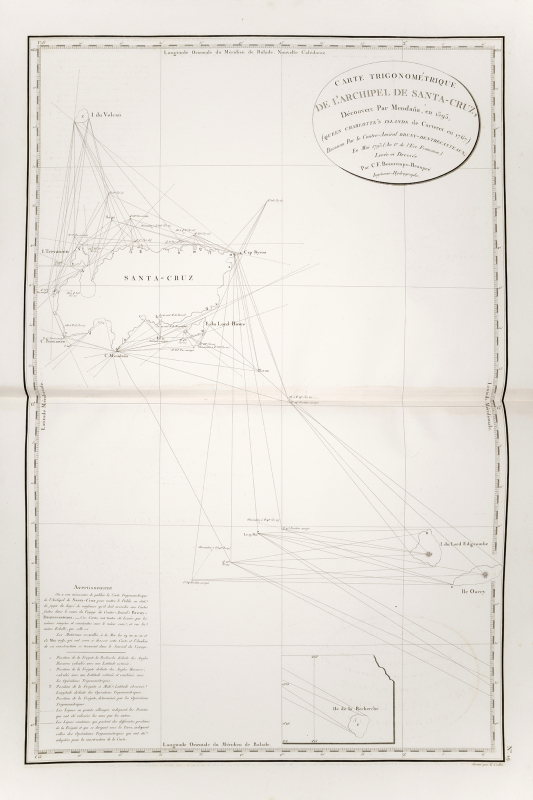
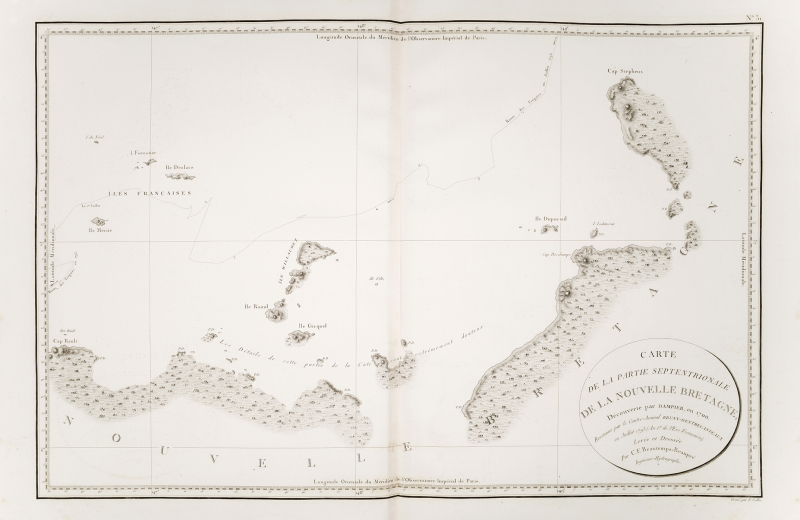
The text is illustrated with 33 folding plates; the atlas, published in 1807, contains 39 maps and plans. A particularly important account of the nautical details of this voyage to the South Seas. The charts that make up the atlas of the voyage were drawn up by the hydrographic engineer Beautemps-Beaupré, and the measurements taken with the aid of the Borda reflection circle helped to clarify the geography of these distant lands. During this voyage, D’Entrecasteaux’s ships were stopped by the Dutch in Java. The logbook and collections seized by the English were not returned to France until 1802.
“[Promoted] to Rear-Admiral in September 1791, he was given command of the Recherche and the Espérance, which were sent in search of the missing Lapérouse. He took with him a scientific team (the botanist La Billardière, the hydrographer Beautemps-Beaupré), which enabled him to make numerous astronomical, nautical, ethnological and other observations. Leaving via the Cape of Good Hope, he reconnoitered Amsterdam Island, reached the southern shores of Australia, reconnoitered Tasmania, the insularity of which he guessed, New Caledonia, the New Hebrides, the Solomon Islands and the Admiralty, then went to rest his crews in Amboine (September 1792). Leaving again five weeks later, she headed for New Holland, stopped off in the Tonga Islands and returned to New Caledonia where Kermadec, commander of the Espérance, died. On 9 May 1793, she set sail for the north, crossed the Santa Cruz Islands and passed unsuspectingly a few miles from Vanikoro, where the Lapérouse disaster had occurred’ (see Taillemite).
“D’Entrecasteaux, French admiral and governor of Mauritius, was sent to the Pacific in 1791 to search for La Pérouse. No traces of the lost expedition were found, but in the course of his search d’Entrecasteaux made important geographical discoveries. He commanded the Recherche and the Espérance. The second captain was Huon Kermadec, after whom the islands north of New Zealand were named. The naturalist for the expedition was Jacques Julien de Labillardière. They explored the west and southwest coasts of Australia, the south coast of Tasmania, the west coast of New Caledonia, and visited Tonga and the Santa Cruz Islands. The D’Entrecasteaux Islands near New Guinea were discovered and named for the admiral, who later died of colic off the north coast of New Guinea. The French Revolution divided the expedition; the royalists joined the Dutch on Java, and the Republicans fell into the hands of the British Royal Navy. Also captured were the expedition’s journal, charts, and natural history specimens. Sir Joseph Banks ordered that they be delivered to the coast of France under a flag of truce” (Hill).
“Du 20 juin au 2 juillet (1792), il longea les récifs qui bordent la côte ouest de la Calédonie sur une longueur de plus de 300 milles, tandis que Beautemps-Baupré dresse sous voile la carte de l’lle. D’Entrecasteaux découvre plusieurs îlots (îlots Huon et Surprise) au nord de la Calédonie et détermine la position du récit qui porte son nom. Il ne pénétra pas dans le récif. Mais reconnait (le 21 juin) Port-Saint- Vincent, qu’il dénomme le Havre trompeur faute d’en avoir su découvrir la passe. Le 23. Ils aperçoivent des indigènes, le 22, dénomment le cap Goulvain du nom du maitre d’équipage de la Recherche et, le 28, le cap Tonnerre – du nom du maitre d’équipage de l’Espérance. Après avoir visité les archipels situés à l’ouest et au nord de la Nouvelle-Guinée et l’archipel des Amis, sans y avoir trouvé des traces de La Pérouse, et après avoir contourné l’Australie, d’Entrecasteaux revient en Calédonie et mouille le 19 avril 1793 à Balade, au lieu même où Cook avait séjourné. L’expédition y restera jusqu’au 1o mai. Pendant que les matelots font de l’eau et du bois, les savants se livrent à leurs occupations : La Billardière et La Haye herborisent et recueillent des spécimens d’oiseaux, Bonvouloir fait des observations astronomiques, Péron dessine. Les relations avec les indigènes ne vont pas sans heurts : la discipline des équipages français est loin d’être aussi stricte que celle de Cook. Il y a des vols, des indigènes tués par des coups de feu, la famine est extrême… On croit bon d’enterrer sur l’ilot, de nuit, secrètement, Huon de Kermadec, le commandant de l’Espérance, mort le 6 mai, par crainte d’une exhumation par les indigènes, cannibales. Le 9 mai l’expédition quitte Balade. Les navires s’en furent reconnaître les récifs que Cook avait découverts au N.-O. de la Nouvelle-Calédonie. D’Entrecasteaux mourut en mer, de dysenterie et de scorbut, en juillet 1793, quelques semaines après son passage en Nouvelle-Calédonie. Le premier récit de son expédition contient des détails sur les indigènes qui complètent ou confirment ceux de Cook” (O’Reilly).
Very nice copy, attractively bound and complete with all plates called for.
Monday to Saturday
10am – 1pm and 2:30pm – 7pm
(6pm Monday and Saturday)
© 2023 All rights reserved.