
VENDU
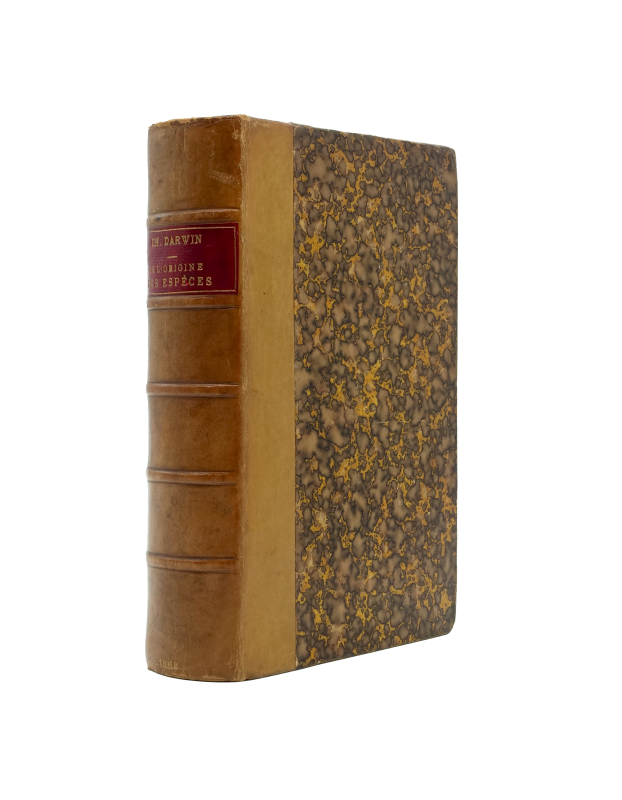
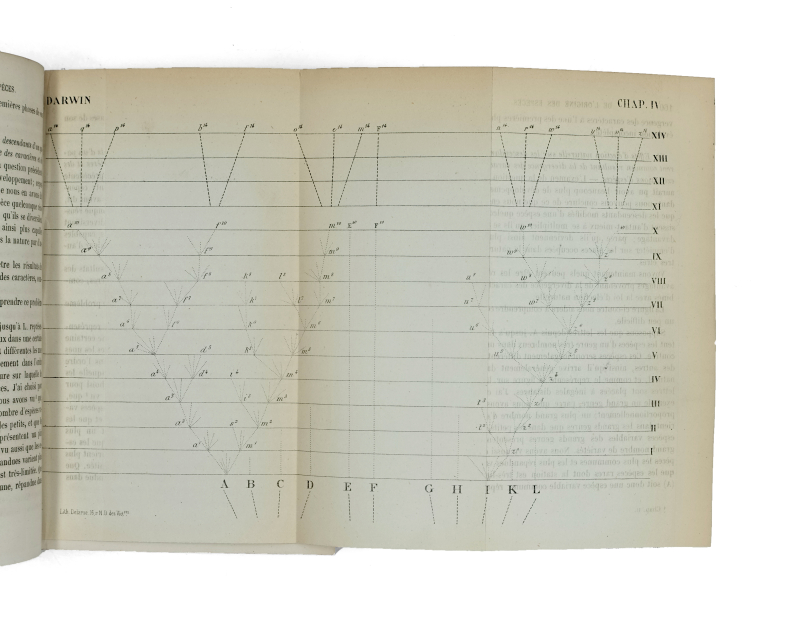
12mo (173 x 108 mm) of LXIV pp., XXIII pp, 1 blank page, then pages 25 to 712 pp, 1 folding plate inserted between the pages160 et 161. Half calf, spine with false bands, title piece in red morroco (contemporary binding).
1 in stock
Brisset “Clément Royer ou Darwin en colère”, in Portraits de traducteurs, pp 173-203 ; Freeman, 655. For the first edition (1859): PMM 344b; Dibner Heralds of Science 199; Horblit 18b; Garrison-Morton 220.
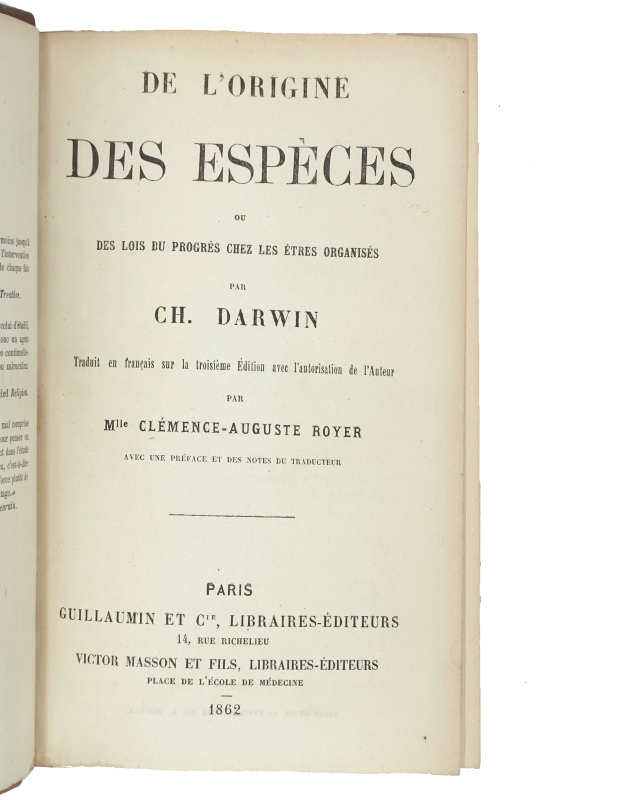
First edition of the first French translation, by Clémence-Auguste Royer, of the most important work on biology ever written.
This edition is the most controversial of the early translations of this text; it was not only translated, prefaced and annotated, but also retitled and placed within a new intellectual framework by Clémence-Auguste Royer, a self-taught philosopher, economist and feminist whom Darwin, after reading the book completed in June 1862, described as ‘one of the cleverest & oddest women in Europe’.
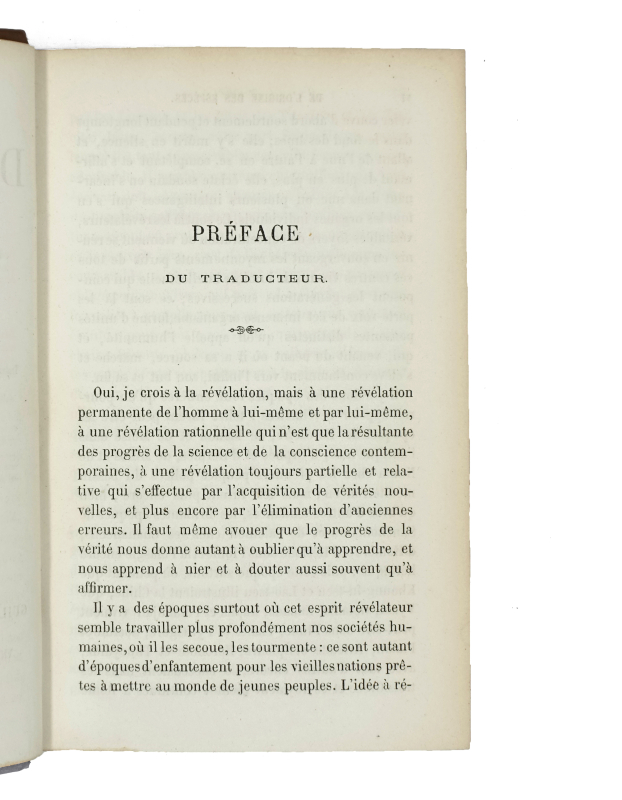
The translator’s sixty-four-page preface is not a preface in the ordinary sense of the term. It is a manifesto: an anticlerical, positivist and proto-eugenicist document that harnesses Darwin’s biology in the service of a social and political programme which he had never approved of and which he would spend the rest of his life partly rejecting. Her footnotes punctuate the main text, sometimes to clarify, often to challenge, and sometimes to correct Darwin from positions he did not share. Her translation of natural selection as natural election, rather than the term natural selection which would later become established, was a lexical choice that Darwin never approved of. The replacement of his sober subtitle — or the Preservation of Favoured Races in the Struggle for Existence — with his own progressive formulation — or the Laws of Progress in Organised Beings — constituted an ideological modification. Darwin had seen none of this before publication. With this translation, French Darwinism in its first decade was shaped as much by Royer’s preface as by Darwin’s text, and this volume is the original repository of that collision.
Darwin had struggled to find a French translator. Louise Belloc, the first person he had contacted, had refused on the grounds that the subject was too scientific. Pierre Talandier, a French political exile who had offered to undertake the work, had withdrawn when no publisher was willing to partner with him. Clémence-Auguste Royer, who was already in the process of having his own two-volume work, Théorie de l’Impôt, published by the Parisian publisher Guillaumin, learnt that the position was vacant and contacted Darwin with a firm publishing contract from Guillaumin et Cie and Victor Masson et Fils already in hand. On 10 September 1861, Darwin wrote to John Murray asking him to send a copy of the third English edition of The Origin to him at 2, Place de la Madeleine, Lausanne. He did not know her well, but at first glance, what he knew of her was reassuring: she had given a series of scientific lectures in Lausanne in 1859; she had taken a keen interest in Lamarck; she had corresponded with radical republicans across Europe; she had written on economics and logic. Permission was granted. The French title page bears the words with the author’s permission in small capitals, as if this phrase endorsed the entire undertaking; in reality, it referred only to the permission granted by Darwin to translate the third English edition of 1861. Royer continued his work without any supervision.
Royer’s personal contributions did not stop at the preface. Footnotes are scattered throughout the main text, sometimes brief and technical, more often at length and argumentative; where Darwin remains evasive, she is firm; where he defer to theological sensibilities, she removes these concessions.
Behind the scenes, attempts were made to supervise the scientist’s work: the Genevan zoologist Édouard Claparède, whom Royer had consulted for biological advice, tried unsuccessfully to temper her commentary and wrote to Darwin with some exasperation, describing the endeavour as impossible.
When his copy arrived at Down House in early June, Darwin read it with unease and dismay. Whilst Darwin recognised Royer’s intelligence, he was far more reserved regarding the translation of his book. In June 1862, he wrote on the subject to his botanist friend Asa Gray:
« I received 2 or 3 days ago a French Translation of the Origin by a Madelle. Royer, who must be one of the cleverest & oddest women in Europe: is ardent Deist & hates Christianity, & declares that natural selection & the struggle for life will explain all morality, nature of man, politicks &c &c!!!. She makes some very curious & good hits, & says she shall publish a book on these subjects, & a strange production it will be.»
A month later, he expressed his regret to Armand de Quatrefages that his translator had not possessed a greater knowledge of natural history; to Hooker, that Royer had sought to allay his own doubts by adding footnotes denying that there was any cause for doubt; and to Claparède, private thanks for an intervention that had clearly failed to have the desired effect.
The impact of this work on French intellectual life was considerable. French naturalists active in the 1860s were slow to embrace Darwin: Quatrefages, Milne-Edwards and Claude Bernard either ignored the book or approached it with scepticism, and the Academy of Sciences refused to elect Darwin as a corresponding member until 1878, and then only in botany. This reluctance was partly due to the French scientific establishment’s natural attachment to Lamarckian transformism, which it preferred to defend rather than replace; it was also partly due to the tendency of French Darwinism, as reflected in Royer’s work, to be dismissed as anti-clerical propaganda disguised as science.
Despite all these controversies, in 1870, Royer became the first woman elected to the Paris Anthropological Society, an organisation founded and directed by Broca; she published her own major work, Origine de l’homme et des sociétés, in the same year; and Ernest Renan, in a phrase that has become famous and which ultimately gave its title to Joy Harvey’s modern biography, described her as almost “a man of genius”. The preface to the first French edition of L’Origine is now reprinted as a standalone text in Geneviève Fraisse’s book, Clémence Royer, philosophe et femme de sciences, published in 1985, and discussed at length in Harvey’s Almost a Man of Genius: Clémence Royer, Feminism, and Nineteenth-Century Science (1997), where its status as a founding document of French social Darwinism — and, more discreetly, of French feminist scientific writing — is now generally recognised.
Nearly 30 years later, she reflected on her work as a translator in an interview for the Bulletin de l’Union universelle des femmes; this was an opportunity for her to highlight the originality of her own thinking and to assert her independence, presenting herself as an accomplished scientist:
« C’est pour répondre aux critiques […] que […] je traduisis L’Origine des espèces […] et que j’écrivis la préface qui a fait tant de bruit, où j’ai tiré de la doctrine de Darwin, les conclusions qu’il avait réservées jusque-là, et auxquelles il n’est arrivé que plus tard, dans son livre Descent of Man, publié un an après mon volume : Origine de l’homme et des sociétés » (janvier 1891)
A complete copy, including the fold-out plate.
Dark spine.
Provenance: Alain Pol, handwritten note in black ink on the page preceding the half-title; this may refer to the filmmaker born in Besançon in 1916 and director of À l’Assaut De La Tour Eiffel.

Monday to Saturday
10am – 1pm and 2:30pm – 7pm
(6pm Monday and Saturday)
© 2023 All rights reserved.