Brunet, Manuel du libraire, I, 1748 ; L. Rius, Bibliografia critica de las obras de Miguel de Cervantes Saavedra, Madrid, 1895, I, 13.
First homogeneous edition of Don Quixote.
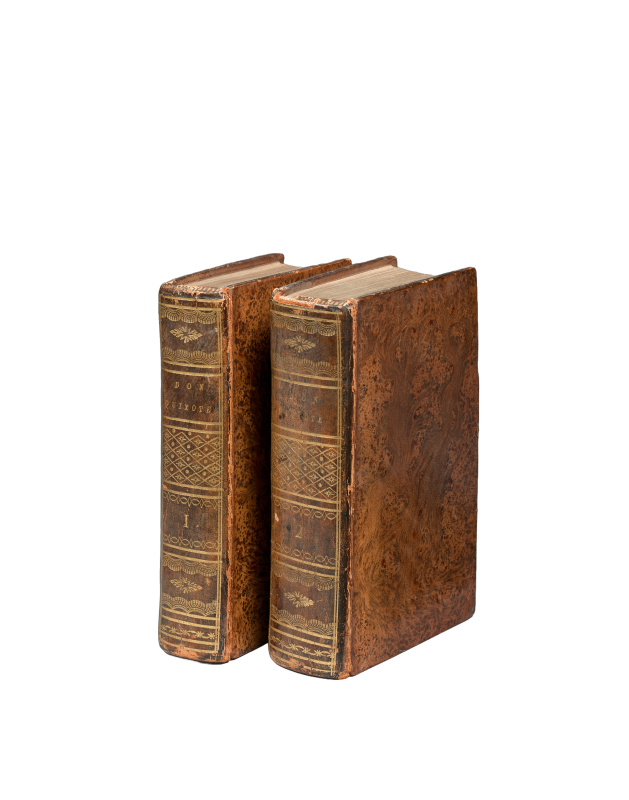
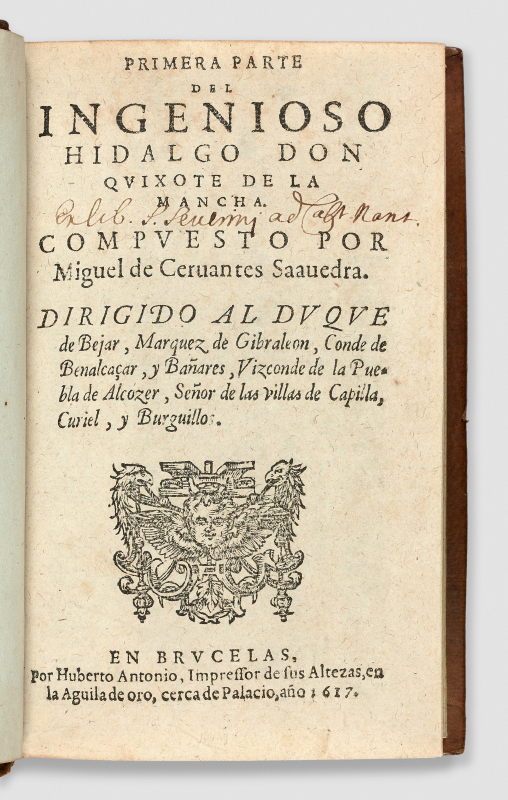
Second edition of the second part, and third Brussels edition of the first part. One year after the publication of the second part by Cuesta in Madrid, a simultaneous edition of the two parts of Don Quixote printed by the same publisher was finally undertaken in Brussels: first the Segunda parte, in 1616 – resuming the just- published edition of 1615 – then the Primera parte, in 1617. This Brussels edition thus constitutes the first homogeneous edition of Don Quixote.
“Only one other edition of the Segunda Parte (after the first of Cuesta) is known to have been published in Cervantes’ lifetime, namely, that of Brussels, in 1616 by Huberto Antonio, in which the approbation of Marquez Torres is omitted… The edition printed in Barcelona in 1617 is, according to Salva, the first complete edition of the two parts of Don Quixote, published the year after the author’s death. The two parts, however, are not printed uniformly, nor by the same printers, and it is doubtful whether they were intended to be issued together.” (Henry Edward Watts, Miguel de Cervantes his life and works. London, Adam and Charles Black 1895, page 263-264)
It should be noted that Brussels appears early in the first editions of Don Quixote, becoming the first non-Iberian city where the Spanish novel was published in 1607.
The publication, ten years apart, of the two parts of the first edition of Don Quixote would have a lasting effect on the constitution of the first copies of the great Spanish novel. The first part had known nine editions since its first edition of 1605 before the second part of Don Quixote appeared for the first time in 1615. An editorial discrepancy made it impossible to acquire a copy of the first edition and the following in older uniform binding.
The copies of the first editions of Don Quixote are either composite – the two parts belonging to different editions – or in modern binding, implying an à posteriori gathering of the two parts of the same edition.
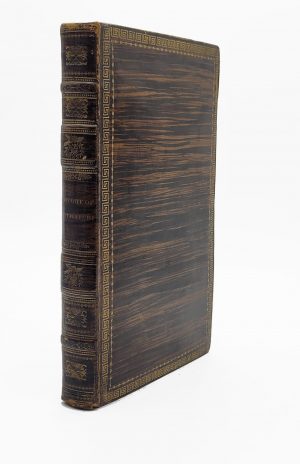
The particularity of this copy of Don Quixote, in addition to its remarkable binding, is the possession of a proven older provenance. We read the inscription by a 17th century hand on the title page of each of the volumes: “Ex lib[reria]. S[antum] Severini ad Cast[rum] Nant[onis)”.
The royal abbey of Saint-Séverin, in Château- Landon, was of Augustinian obedience. The Archbishop of Canterbury, Thomas Beckett made a stop there in 1167 during his travels in France. The abbey and its contents would be sold as national property during the French Revolution.
This copy of Don Quixote would go to the library of Alexandre-Christian Becker, a Danish merchant and Danish consul in Arkhangelsk (Russia) in the first half of the 19th century. Becker had acquired the Château de la Houssaye-en-Brie (Seine- and-Marne region) in 1817, not far from the abbey de Saint-Séverin. The following year, he married Adèle Hottinguer (1799-1847), daughter of Baron Jean-Conrad Hottinguer (1764-1841), founder of the bank of the same name.
Marginal annotations in ink (Spanish) and pencil in (French) by two different hands.
Manuscript ex-libris from the seventeenth century, in brown ink on the headpiece of each volume: “Ex lib[reria]. S[antum] Severini ad Cast[rum] Nant[onis]”, meaning: “of the abbey of Saint- Séverin in Château-Landon” — Alexandre-Christian Becker (ex-libris).
Quires t to z of the first volume slightly burnished, slight tear to leaf u2.