Borba de Moraes, I, 476 ; Rodrigues 1407 ; Sommervogel XII 154 ; Atkinson, 260 ; Leclerc, 122.
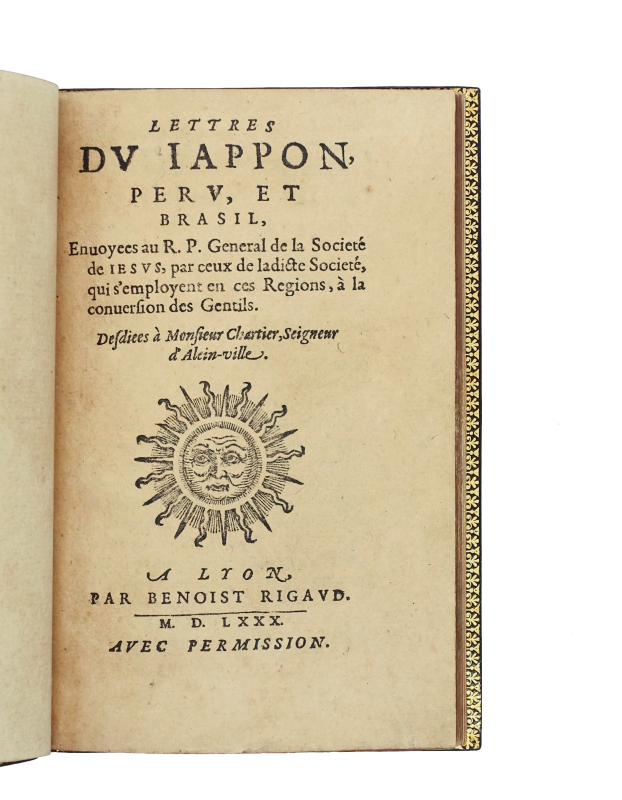
An important collection of letters from Portuguese and Spanish missionaries, containing essential information on the evangelisation of Japan, Peru and Brazil. Second edition, following the first, which was printed in Paris in 1578.
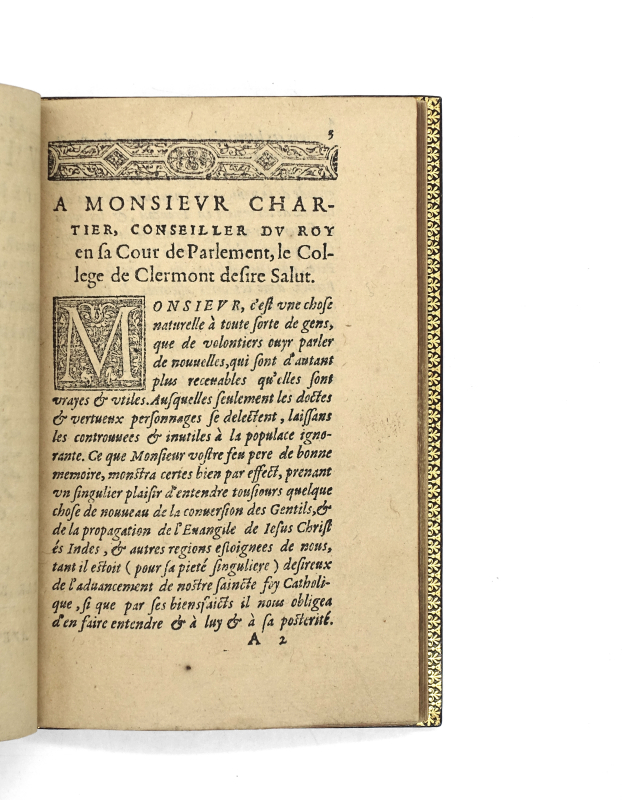
« Ces lettres furent publiées pour la première fois en français, les éditions dans leur langue d’origine parurent ultérieurement. La version française est due à Michel Coyssard, professeur de rhétorique au collège de Clermont qui signa aussi la préface ». Sommervogel
The letter from Father Luiz Fonseca, written in Bahia on 17 December 1577, is of paramount importance to the history of Brazil. This text is one of the oldest, most detailed and longest documents ever published in French on Brazil by an eyewitness present in the country. Although this letter was undoubtedly written in Portuguese or Latin, it was first published in French. The reason for this publication in French almost certainly lies in the Jesuits’ desire to capitalise on what they regarded as the successful colonisation by Portuguese Catholics of a region where the French Huguenots, under the leadership of Villegagnon, had failed so miserably. The only significant precedents for a description of Brazil in such detail in French are the works of Thévet, only part of which concerned Brazil, and much of which was the subject of polemical attacks in the 16th century, as well as Jean de Léry’s major account of Villegagnon’s expedition, the first edition of which appeared in 1578, the same year as the first edition of the present work. In it, Fonseca recounts for the first time Antonio Salema’s conflict at Cabo Frio against the Tamoios Indians. In 1575, the Portuguese governor Antonio Salema launched a military campaign at Cabo Frio to control the south-eastern coast of Brazil, then contested between the Portuguese, the French and the indigenous Tamoios peoples. The Tamoios, allied with the French, threatened Portuguese interests and traded in brazilwood. Salema mobilised around 400 Portuguese soldiers and 700 indigenous allies to attack a strategic fortress. After a siege and fierce fighting, the fortress was taken: around 500 Tamoios were killed or captured, and nearly 1,500 were enslaved. The surrounding villages were destroyed or abandoned, leading to massive depopulation. This victory consolidated the Portuguese presence, eliminated French influence, and marks a brutal episode in Brazil’s colonial wars.
At the beginning of the volume is the letter on Japan by Francisco Cabral (1528 or 1533–1609), a Portuguese Jesuit who arrived in Japan in 1570 with the rank of Second Superior of the Society of Jesus. Upon his arrival, he set about convening an assembly of missionaries at Shiki on the island of Shimo-jima to establish the rules for evangelisation. He was quickly able to convert and baptise great lords and their families. From 1574 onwards, he devoted himself to the evangelisation of the island of Kyushu. In the letter reproduced in our collection, he announces that the Christianisation of Japan is progressing and that he counts 20,000 converts.
Next comes the letter on Peru by Jerónimo Ruiz del Portillo (1532–1590), who led the first Jesuit Mission in Peru. He set out in 1566 accompanied by 23 other Jesuits and founded two colleges, one in Cuzco and the other in Lima. In his report of February 1575, transcribed in our volume, he states that there are now 70 Jesuits and that they are actively pursuing evangelisation. They founded several churches, some of which house treasures; he mentions an altar adorned with a piece of the Holy Cross entrusted to them by Rome. This letter provides him with an opportunity to boast of their achievements, including the founding of a convent for women thanks to the recovery of the inheritance of a man who died without a male heir. Del Portillo succeeded in persuading the widow and her daughter to build a convent, of which they were the first nuns
This second edition is extremely rare; Worldcat lists only one copy at the Newberry Library. Borba de Moraes mentions an edition published by Rigaud in 1578, but we have found no trace of it.
A small lack of paper in the white margin on page 69.
Provenance: Jean Perrette, bookplate engraved on the inside front cover ‘J.R.P.’ (Christie’s sale, 5 April 2016, lot 301).