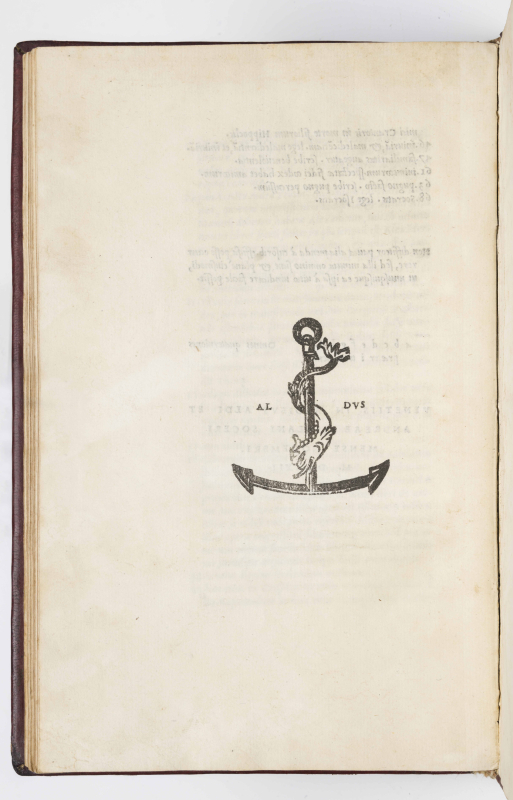
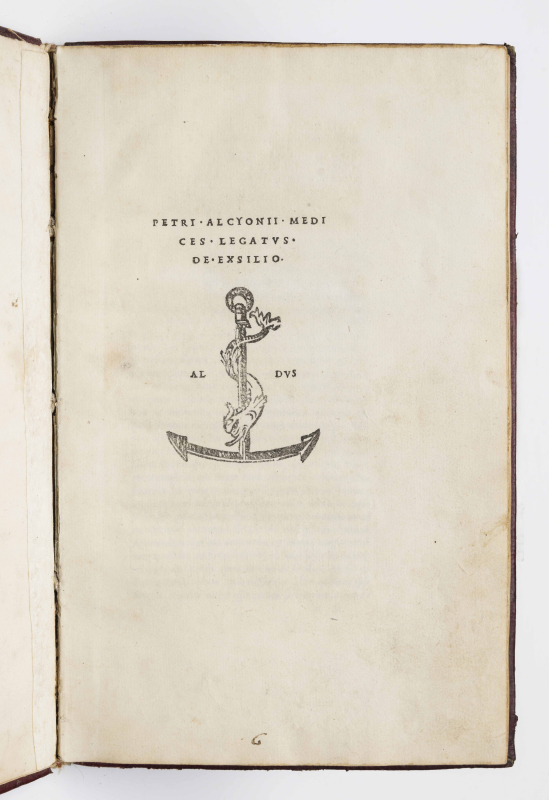
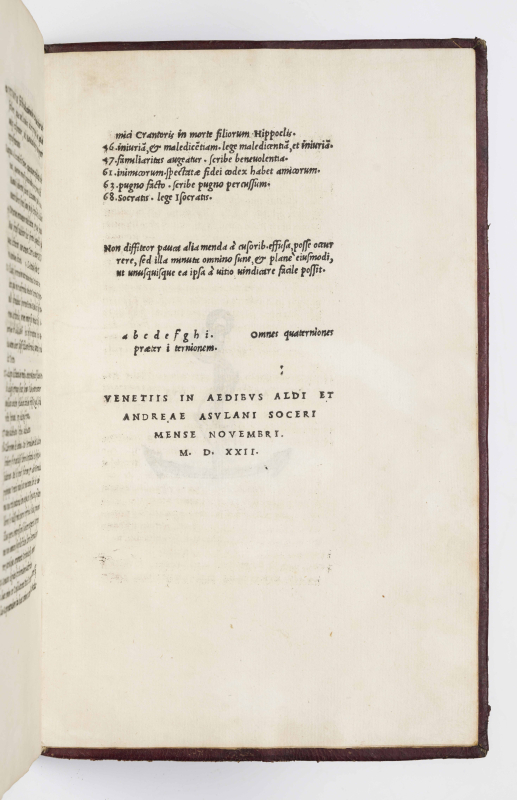
Adams A633 ; Brunet I, 153 ; Renouard, Alde, 1834, p. 95, n° 6.
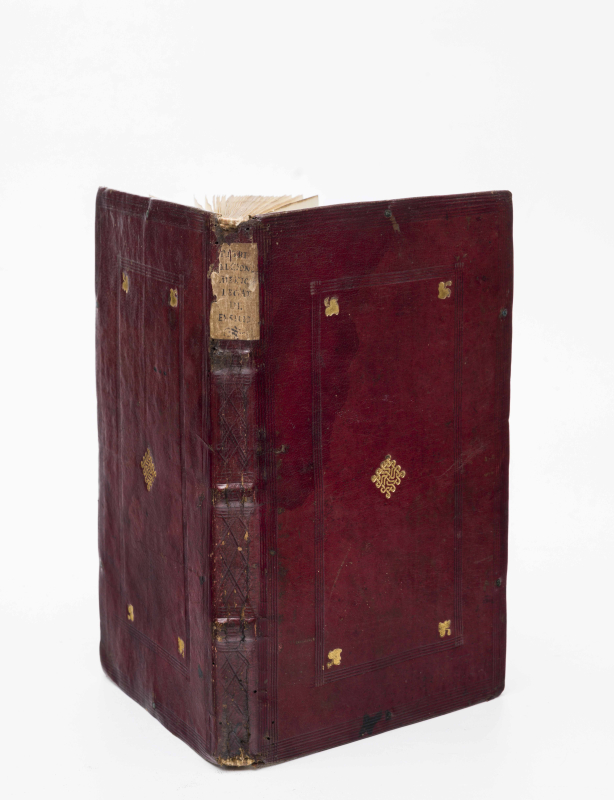
First edition of Alcionio’s famous philosophical dialogue on exile. Elegant Venetian binding attributed to the “Mendoza binder”.
Alcionio (1487–1527), a pupil of Giulio de’ Medici, obtained a chair in Greek at the University of Florence through his patronage, and later followed him to Rome when Giulio became Pope.
De exsilio is a dialogue in two books, set in 1512, featuring Giovanni de Medici (then papal legate, the future Pope Leo X), Giulio de Medici (the future Clement VII) and Lorenzo de Medici, the future Duke of Urbino.
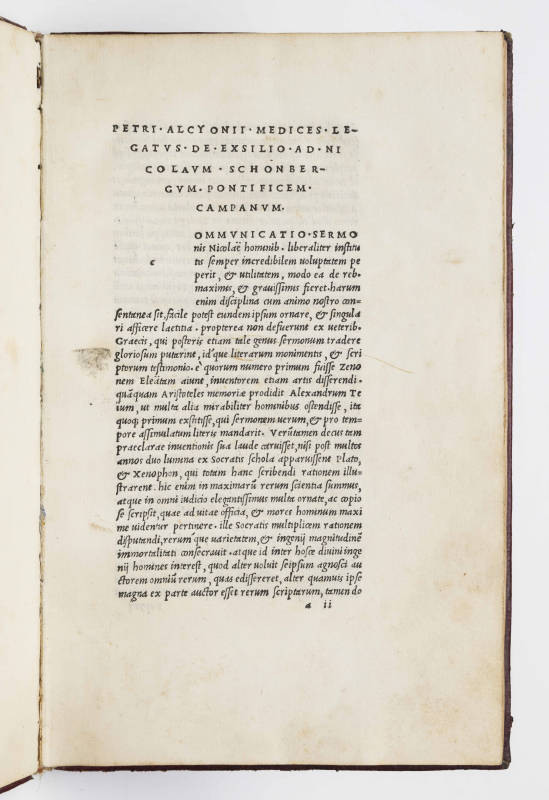
The book is dedicated to Cardinal Nikolaus von Schönberg, Archbishop of Capua and a close associate of Giulio, who was in Florence in 1522, temporarily removed from the Roman Curia.
The fictional dialogue draws on numerous examples from antiquity to show that exile can also have positive and formative aspects.
« On sait que son auteur est accusé d’avoir mis à contribution le traité De Gloria de Cicéron, puis d’en avoir ensuite détruit le manuscrit (…). Au reste, cette accusation est le plus bel éloge que l’on ait pu faire de l’ouvrage d’Alcyonius. » (Renouard, Alde, 1834, p. 95, n° 6).
Through the combined use of blind stamping fillet, small ivy leaves and a gold knot, this binding can be linked to those of the “Mendoza binder”, now recognised as the workshop of Andrea di Lorenzo, who was active in Venice around 1530 for some thirty years. Located in the parish of San Fantin, the “Mendoza binder” worked closely with the Aldine bookshop established in the Merceria, Venice’s central shopping street, and many of its bindings adorn Aldine editions. This name derives from the numerous bindings produced by this workshop for the library of Diego Hurtado de Mendoza (1506–1575), Spanish ambassador to Rome and a great bibliophile.
“Diego Hurtado de Mendoza (1506-75) was a man of many talents, a fluent Latinist, an excellent Greek scholar, a student of Arabic (a language perhaps learned from the Morisco villagers of the family estates south of Granada), a vernacular poet and historian, a soldier, diplomat and statesman. As Spanish ambassador in Venice from 1539 to 1546 he set out to form a Greek collection to rival the library that Francis I’s agents were assembling in the palace of Fontainebleau. The Greek manuscripts, of which there were more than 250, and a selection of the printed books were decorated with plaquettes. Seventy-five such bindings survive of an original total before the Escorial fire of 1671 of probably more than three hundred.” (Hobson, Humanists and bookbinders, p. 120).
This design is similar to what Hobson describes as the “simple style” (Renaissance book collecting, Jean Grolier and Diego Hurtado de Mendoza, their books and bindings, Appendix 5 and fig. 45).
There is also a decoration similar to the bindings of the “Mendoza Binder” described by M. Foot in The Henry Davis Gift, a collection of bookbindings, III (2010): no. 261, Aullius Gelius, 1515; no. 262, Cicero. 1523; see also no. 301 — also in Tammaro De Marinis, La legatura artistica in Italia nei secoli XV & XVI, II, pl. 1623.
Small ink stain on f. Biiii, rust-coloured mark in the lower margin of ff. avi to bi, marginal tear repaired on f. Iiii. Stained binding, missing caps, small tear at the bottom of the spine, wormholes, snag on a raised band.
Provenance: Florentine collection of Tammaro De Marinis (1878–1969), cited under no. 1762 in his reference work La legatura artistica in Italia nei secoli XV & XVI, II, p. 91; Thomas Kimbal Brooker (loose bookplate), lot 108 in the Sotheby’s sale of 12 Oct. 2023 [Bibliotheca Brookeriana: A Renaissance Library. The Aldine Collection A–C]. He had acquired it from Martin Breslauer Inc., New York, 1976