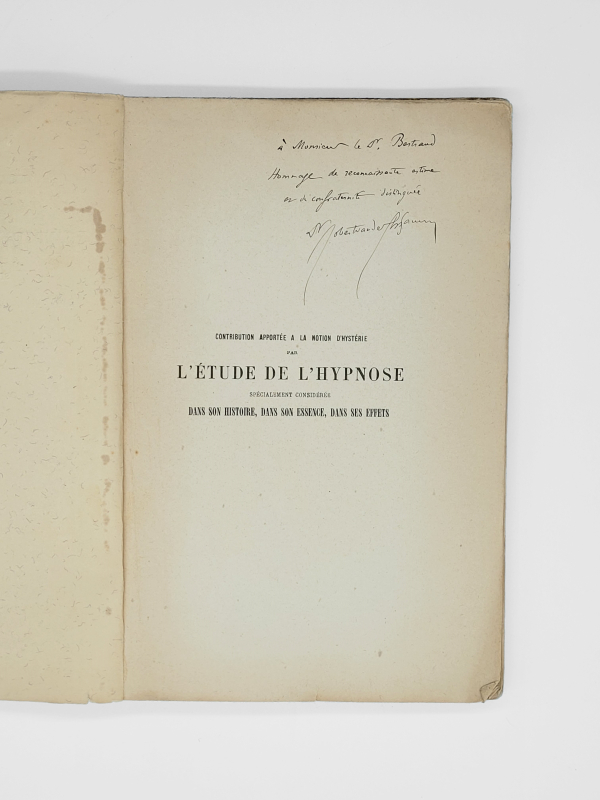
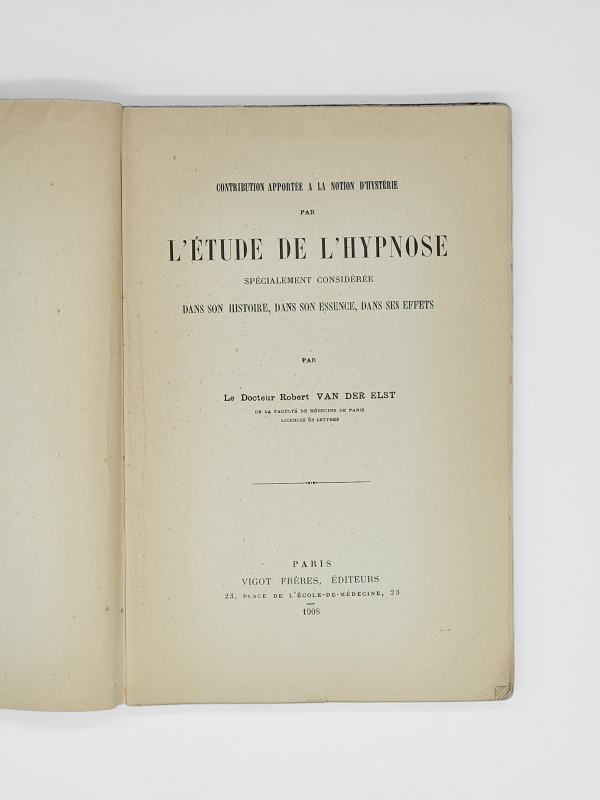
First edition of this highly interesting study on hypnosis, bearing the author’s inscription on the half-title: “à monsieur le Dr Bertrand, hommage de reconnaissante estime et de confraternité distinguée”.
Dr Marcel Bertrand was a Parisian doctor who was among the junior doctors who passed the 1896 competitive examination for the Paris Hospitals, placing him in the same generation of doctors as Van der Elst and within the circle associated with the Salpêtrière. Our copy may have been inscribed to him.
Robert Van der Elst’s research followed a period of intense debate surrounding hypnosis. At the end of the 19th century, interest in this phenomenon was reignited by the clash between two schools of thought: Charcot’s view and that of Bernheim.
For a long time, the concepts of hysteria and hypnosis were closely associated, a link particularly reinforced by the work carried out by Charcot at the Salpêtrière in the late 19th century. He studied hypnosis in female patients suffering from ‘hysteria’ and observed a correlation between certain hypnotic phenomena and the symptoms of this condition, such as paralysis or muscle spasms. He therefore concluded that hypnosis constituted a form of artificial hysteria, and that only those predisposed to hysteria were susceptible to hypnosis.
However, this view was strongly contested by Hyppolite Bernheim, who believed that hypnosis was based primarily on suggestibility and did not constitute a pathological condition. In particular, he was the first to use the term ‘psychotherapy’ in 1891.
Van der Elst’s work focuses in part on these opposing views between the Paris School and the Nancy School, embodied respectively by Charcot and Bernheim. In it, he traces the history of the two concepts, exploring and analysing the mechanisms of suggestion and their therapeutic effects. His argument follows on from Charcot’s conception, as evidenced by the conclusions of his study, which necessarily link hypnosis to hysteria. The thesis concludes with the following words: “l’hystérie seule est justiciable de la suggestion hypnotique“.