Hain, 14345 [sans date] ; Proctor 6224 [1497] ; BM Italian books, p. 615 ; BMC VI 652 [1497 ?] ; Goff, Incunabula in American libraries, S-275 [1497 ?] ; Scapecchi, Gli incunaboli della Biblioteca comunale Rilliana di Poppi, 418 ; Butler, Newberry librayr, Fifteenth century books in Chicago, 1371 [1497] ; ISTC (Incunabula Short-Title Catalogue), is00275000 [after Aug. 1497].
The first edition in the vulgar language of the most important work by the radical Florentine reformer.
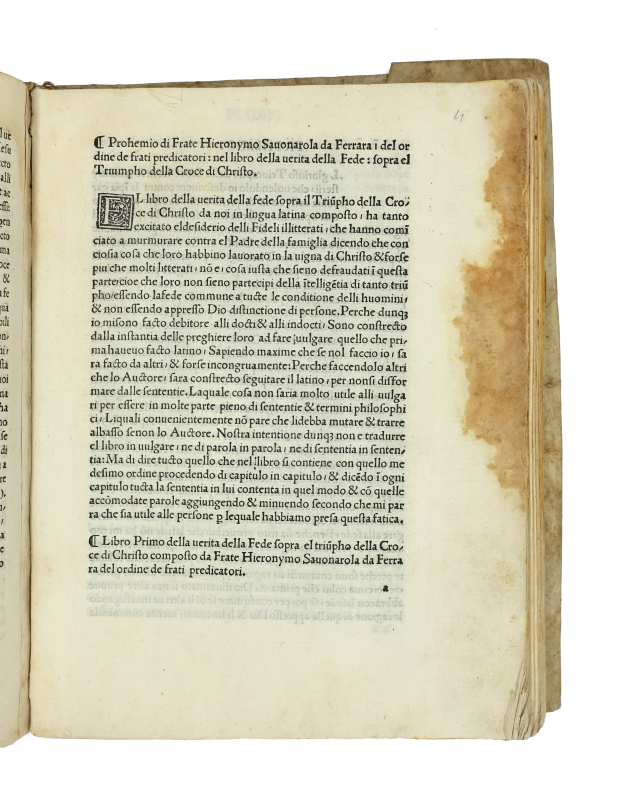
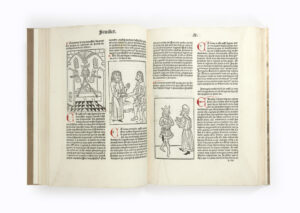
Prepared by the author himself, and published shortly after the original Latin edition of Triumphus crucis seu de veritate fidei (Florence, by Bartolommeo di Libri, 1497), it begins with a table of contents and a preface by Domenico Benivieni, one of Savonarola’s principal defenders.
Opposing moral corruption, luxury, vanity and the decadence of the Church, Savonarola (1452–1498) was excommunicated in June 1497 by Alexander VI. This work, published after the excommunication, aims to demonstrate the malice and falsity of the accusations of heresy. The Triumph of the Cross is regarded as the Dominican friar’s most important work, in which he defends his radical spiritual reform and, across four books, demonstrates the truth of the Christian faith through natural reason rather than authority; he sets out the proofs of God’s existence, fulfilled prophecies and miracles, and the Christian mysteries.
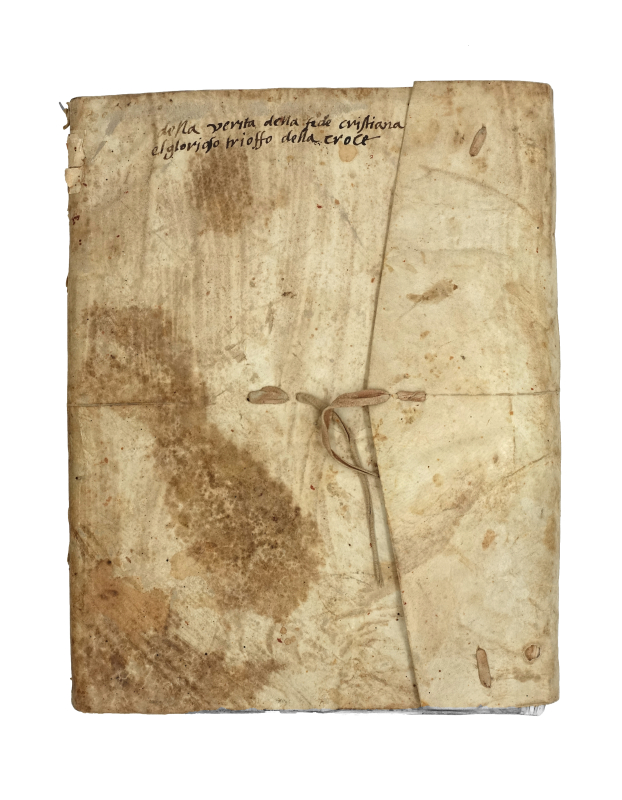
An attractive contemporary binding in supple parchment, typical of the structural, functional humanist bindings designed for practical use.
Provenance: A charming copy from a father who chose to give this polemical work—a symbol of disobedience—to his daughter, a nun: an Italian handwritten annotation on the verso of the last page, which is somewhat illegible : “Questo libro e stato donato (…) a cara figliuola, suor Lorenza monaca (…)”]. / « Ce livre a été donné par Niccholò […] à sa chère fille, sœur Lorenza, religieuse […] » ; Ricasoli Firidolfi (ex-libris armorié début XXe siècle.). Small 19th-century label with a handwritten number on the back cover.
A few foxing spots and faint stains; a marked stain in the margin of the first and last leaves, with small areas of paper missing. Endpapers partially detached.
Stained vellum, small holes, loose stitching in the text block; nevertheless, a highly desirable copy in its contemporary portfolio binding.