Talvart & Place , I, 239.
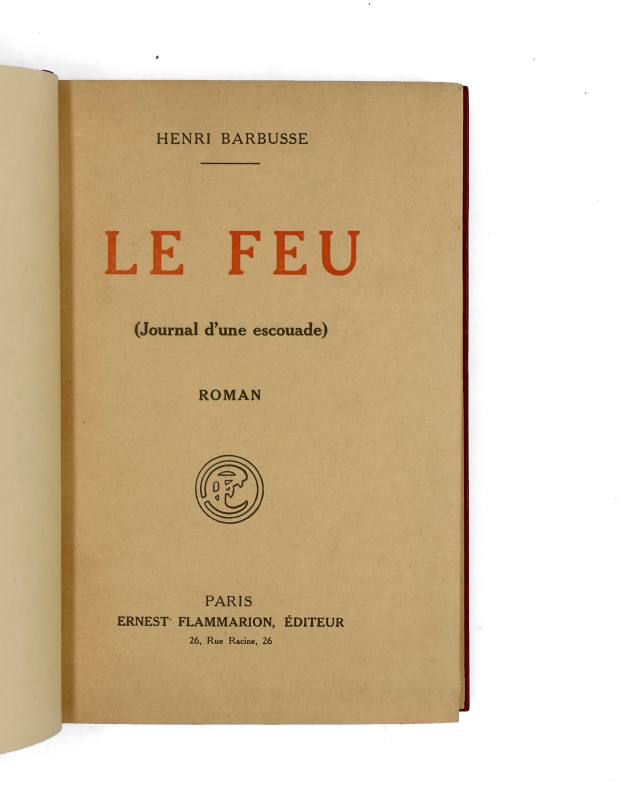
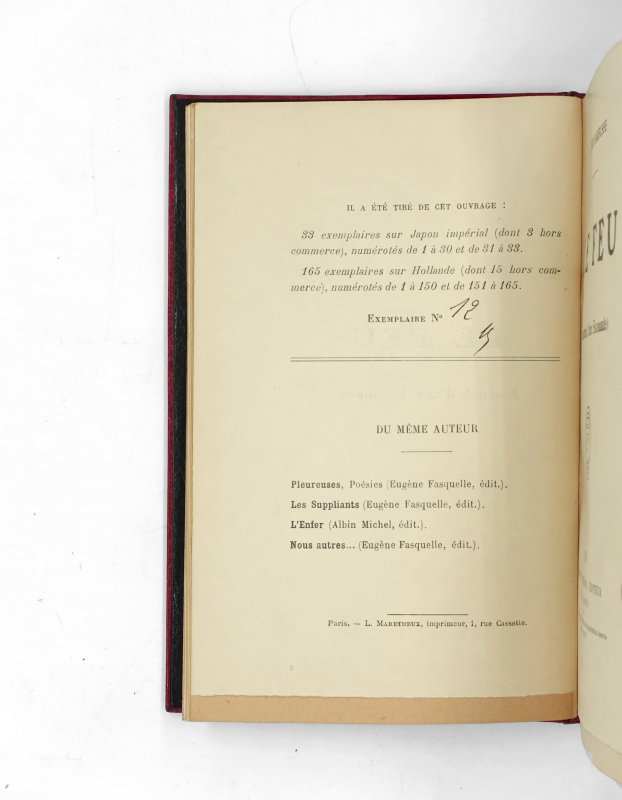
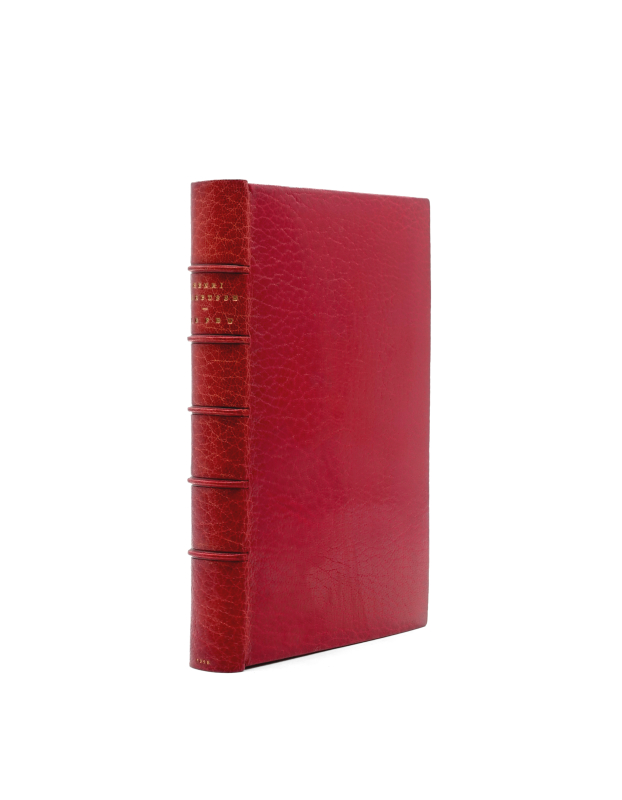
First edition, large paper on Japan (No. 12 of 33), nice copy uncut with full sheets.
A war narrative dedicated to the memory of the author’s comrades who fell alongside him at Crouÿ and on Hill 119.
Having enlisted as a volunteer, Barbusse left for the front in December 1914. Wounded twice and suffering from dysentery, he had to spend several periods in the rear to recover; he was finally discharged in June 1917.
It was during his six-month convalescence in 1916 at the hospital in Chartres and then at the one in Plombières that he wrote his novel. The idea, however, predates this. During 1915, he kept a war diary in which he recorded the violent experience of the trenches. It was this diary that served as the basis for his novel.
It first appeared as a serialized story as he wrote it in L’Œuvre, a dissident newspaper, beginning on August 3, 1916. Despite the journal’s orientation, the text was subject to censorship, likely initiated by the newspaper’s editor, Gustave Téry. Readers therefore had to wait for the publication by Flammarion in November 1916 to fully enjoy the novel in an uncensored version.
A contender for the Goncourt Prize, Barbusse won the prestigious award a few months after publication; he was selected in the first round with 8 votes, with Léon Daudet and Elémir Bourges abstaining.
A very fine copy, spine slightly sun-faded.
Provenance: François Chrétien (bookplate)