
VENDU
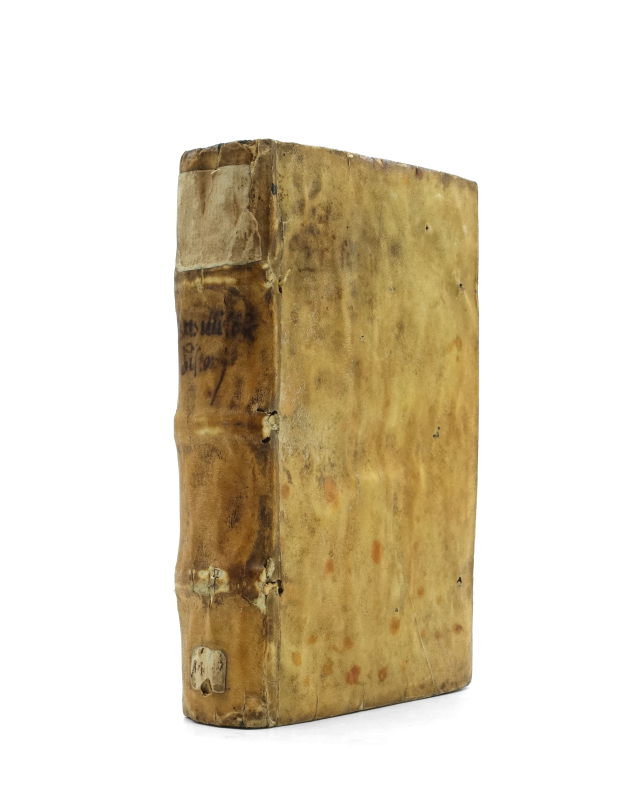
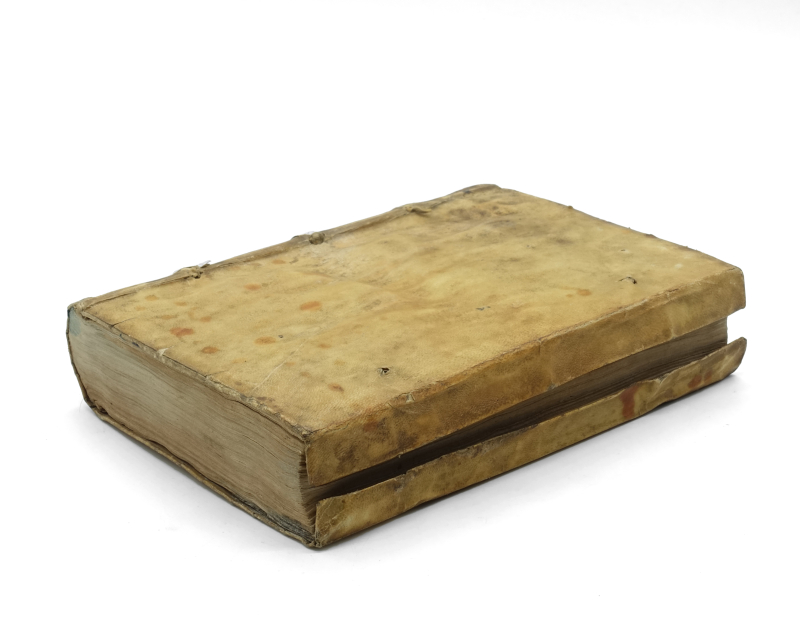
8vo (161 x 106 mm) 24 un.ll., 424 pp., 8 un.ll. Contemporary limp vellum, yapp edges preserved in a 18th century Italian box.
1 in stock
Borba de Moraes, I, 468-469 ; Rodrigues, 1391 ; Sabin, 40148 ; Church, 124; Alden-Landis, 578/47 ; Garraux, 161 ; Maggs, Bibliotheca Brasiliensis, 70 ; Brun, 238.
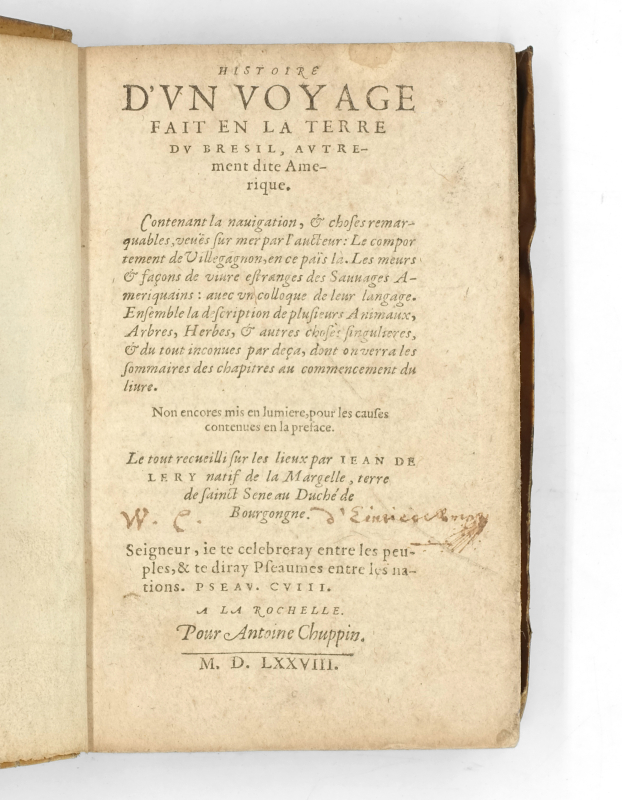
Extremely rare first edition of one of the most important works devoted to Brazil. The great Brazilian bibliographer Borba de Moraes’ copy.
“This book is enchanting. It is literature. Let’s leave ethnology to the ethnologists and let the public read The History of a Voyage to the Land of Brazil as a great work of literature. And also as an extraordinary adventure novel. Take stock of what Léry recounts: for a year and a half, it never stops. During the outward journey, which lasted nearly three months, there were storms, boardings, cannonades and pillaging. The return journey was even more terrible […] As for the stay in Brazil, Léry’s marvelling account is worth the wildest adventures.” Claude Lévi-Strauss.
This very rare first edition begins with a dedicatory epistle to Admiral de Coligny. “Léry, a Protestant minister, had embarked with two other ministers to establish a colony of Reformed Christians in Brazil, under the protection of Admiral de Coligny, who had built a fort there and to whom he dedicated his account. This project having failed, Léry returned to France and published his Voyage, in which he vividly points out all the errors found in Thevet’s France Antarctique. The spirit of intolerance that prevailed at the French court at the time, which regarded all works written by Protestants with suspicion, probably prevented Léry from indicating the city where he had his account printed twice… Léry’s account reveals an observer who was ahead of his time, both in his study of the character and customs of the savages and in his judicious remarks on all matters relating to natural history… Under the title Colloque, his account contains a fairly extensive vocabulary of the Brazilian language. Speaking of Villegagnon’s expedition, which had formed the first settlement of the small colony of Brazil, President de Thou praises Léry’s enlightenment and veracity” (Boucher de la Richardière, VI, 271-272.
A Calvinist militant by vocation and an ethnographer by accident, Jean de Léry (1534-1613) was in his twenties when he arrived in Brazil. A refugee in Geneva, he was sent by Calvin, along with thirteen other Genevans, to join Nicolas de Villegagnon, who had just founded ‘France Antarctique’ innorder to help the Protestant colony established on ‘Villegagnon Island’, a French settlement in the bay of what is now Rio de Janeiro. From the outset, the project to establish this ‘Christian Republic’ in the tropics relied on the combined support of the Cardinal of Lorraine and Admiral de Coligny. It was mainly thanks to the latter that Nicolas de Villegagnon succeeded in organising a large expeditionary force of soldiers and craftsmen who landed in Rio in 1555, entrenching themselves on a small island at the entrance to Guanabara Bay. The French built a fort, which was named Coligny. However, Villegagnon ruled his colony with an iron fist, causing discontent among many of the colonists. conspiracies and rebellions subsequently broke out, leading Villegagnon, in early 1556, to write to Calvin, his fellow student at the Faculty of Law in Orléans, asking him to send a contingent of supporters of the Reformed faith to Rio de Janeiro in order to find a solution to the conflicts that were undermining the colony from within.
Thus, fourteen Huguenots, sent by Calvin, landed in 1557 on the islet in Rio Bay, including Jean de Léry. However, their arrival did not resolve the disputes that were tearing France Antarctique apart and instead led to disintegration and the outbreak of a major religious conflict. The Calvinists eventually left Fort Coligny and sought refuge on the mainland with the Tupinamba. Lery and his companions were then forced to share the life of these cannibalistic Indians before being permanently expelled from Brazil on 4 January 1558. He managed to return to France on 24 May 1558 after a gruelling voyage marked by terrible famine.
The account of his stay, which he did not publish until 1578, 20 years after his return to France, paints a striking picture of primitive humanity. With colourful anecdotes and passionate observations, his description of the life of the Indians he lived among for nine months leaves nothing out: their environment, daily life, family relationships, customs, religious beliefs, culinary habits, scenes of war, cannibalism…
Claude Lévi-Strauss, father of modern ethnology, considers Jean de Léry to be one of his predecessors. ‘I feel a sense of complicity, a parallelism, between Léry’s existence and my own,’ says Lévi-Strauss.
In the chapter ‘Des Cannibales’ (On Cannibals) of the Essays, Montaigne offers a paradoxical praise of the Savage. After a digression on the geographical changes that may have affected the world and explain the presence of an unknown continent, Montaigne proceeds to a sort of summary of Léry, whom he never mentions by name: habitat, diet (where we recognise ‘cahouin’ and manioc), warlike customs… The very name ‘Cannibals’ is absent from the chapter, except in its title. Cannibal is in fact derived from Carib, an ethnic group from the Lesser Antilles. The Cannibals presented to us by Montaigne are in fact the Tupinambás, previously described by Jean de Léry in 1578. The Tupinambas of Brazil were certainly cannibals, but they were the best allies of the French in their fight against the Portuguese during the short-lived France Antarctique, founded in 1555 by Villegagnon in Rio de Janeiro Bay.
Our copy bears the name La Rochelle on the title page. Another copy is known, described by Brunet, without the name of the city. It would appear that the print run with the place of printing mentioned is rarer – the two digitised copies in the Bibliothèque nationale de France are part of the print run without the place of printing indicated.
According to Borba de Moraes, there are two print runs that can be distinguished by a parenthesis at the bottom of folio a3v. Ours belongs to the first one and is, according to Borba, “more difficult to find .” There are also a few pagination errors on pages 126, 239, 270, 286, 311, 314, 319, and 366 (incorrectly numbered 124, 22, 170, 186, 295, 414, 303, 352, respectively) . Contrary to Church’s indications, page 255 is correctly paginated here.
‘In a long preface to his book, Léry refutes all untruths contained in Thevet’s work. He attacks him mercilessly, calling him “a liar and impostor”. The fact remains, however, that Léry made extensive use of Thevet’s book to describe the manners and customs of the Indians, and the flora and fauna of Brazil’ (Borba).
The important vocabulary mentioned by Boucher de la Richardière occupies chapter XX (pp. 341-377). Entitled “colloquium”, it contains details of the words of the “Toupinambaoults & Toupinenquin” and their equivalents in French.
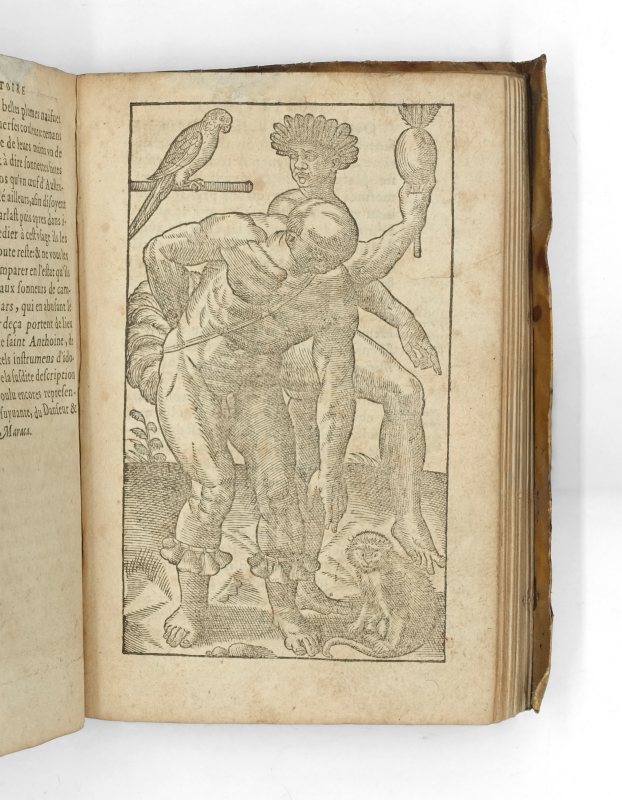
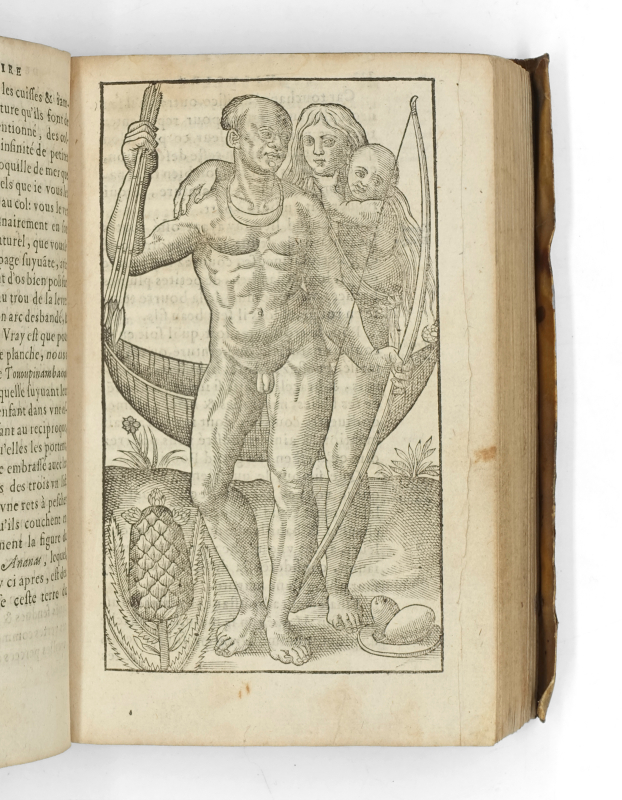
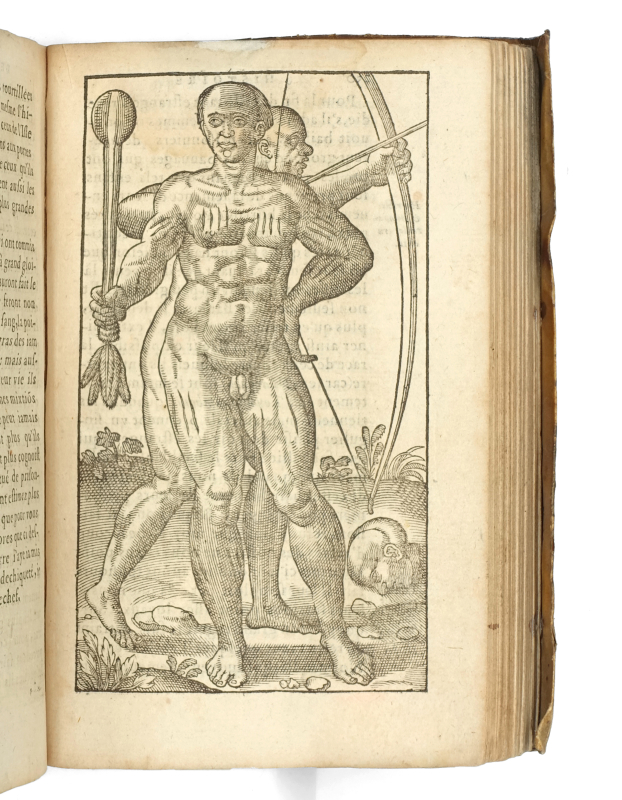
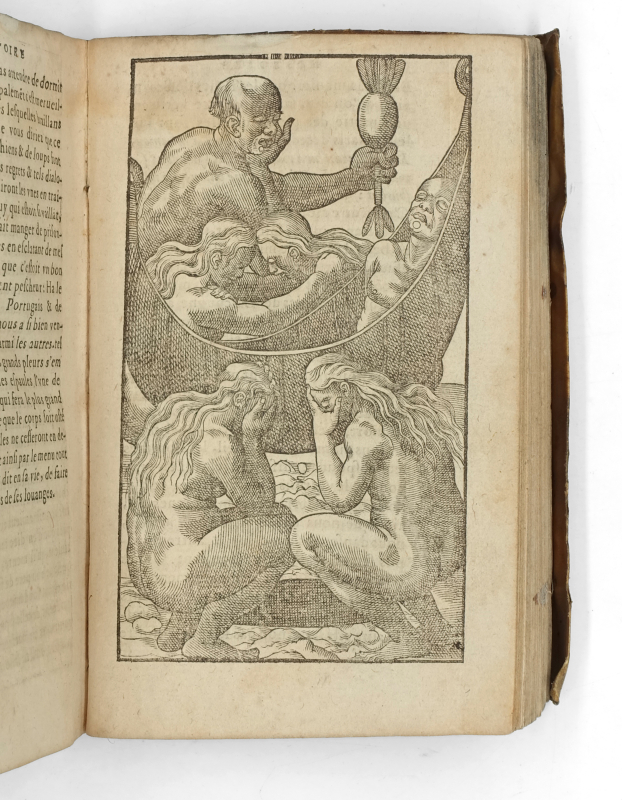
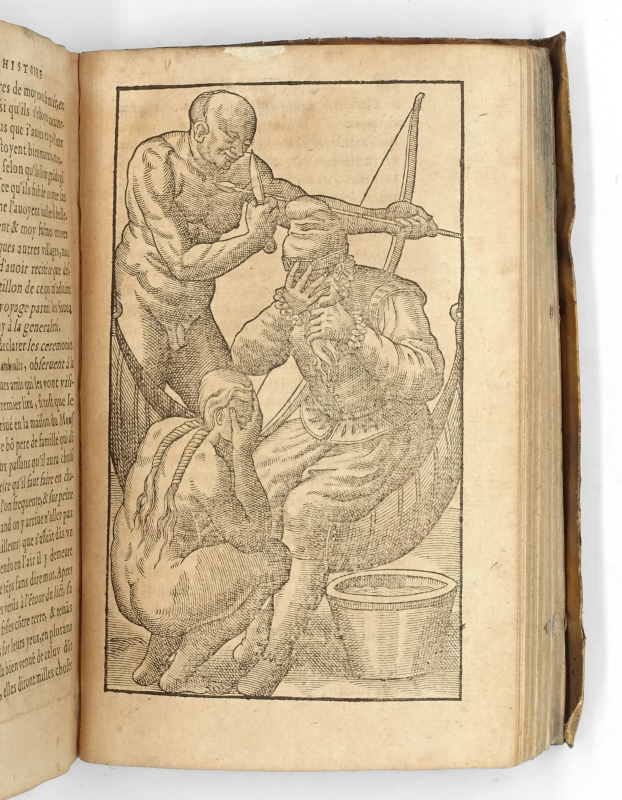
The narrative is illustrated with six full-page woodcuts (one of which is repeated) depicting Brazilians in various activities and attire: with their families, armed (repeated), receiving visitors, in festive dress surrounded by animals and fruit, and in mourning. The body decorations made by scarification on some of the characters are clearly visible.
‘The plates illustrating the book were drawn, if not by Léry himself, under his close scrutiny, and are very faithful ethnographic documents. These plates are not the same in all editions’ (Borba).
Extremely rare on the market, we have only been able to trace three copies of this work: one sold at Sotheby’s (with “La Rochelle” on the title page, but with an undetermined print run, without the last blank page, sold in 1963), another copy at Sotheby’s in 1965 (without the name “La Rochelle”, bound in contemporary calfskin but incomplete with the index and errata), and a final copy at Bloomsbury in 2009 (with the name “La Rochelle”, bound in modern calfskin without the last blank page). The present copy is therefore the only one we have been able to trace in contemporary limp vellum and complete with the index, errata, and last blank leaf.
Small stains and occasional restorations in the margins. Slight water damage on the last sections. Lower margins of the last leaves with a small trace of mould.
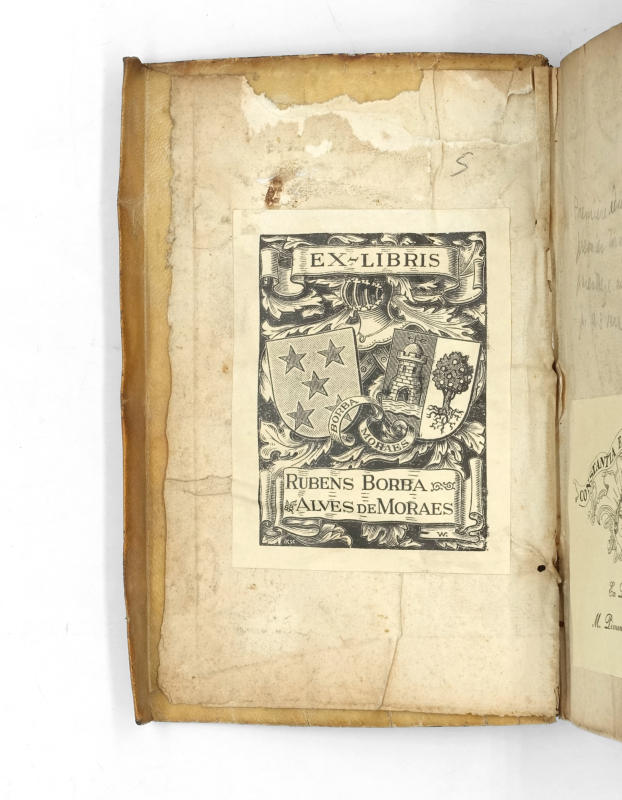
Provenance: Rubens Borba Alvens de Moraes (ex-libris) – Pimenta Camargo (ex-libris, with his motto “Constantia et Fortitudine”).

Monday to Saturday
10am – 1pm and 2:30pm – 7pm
(6pm Monday and Saturday)
© 2023 All rights reserved.